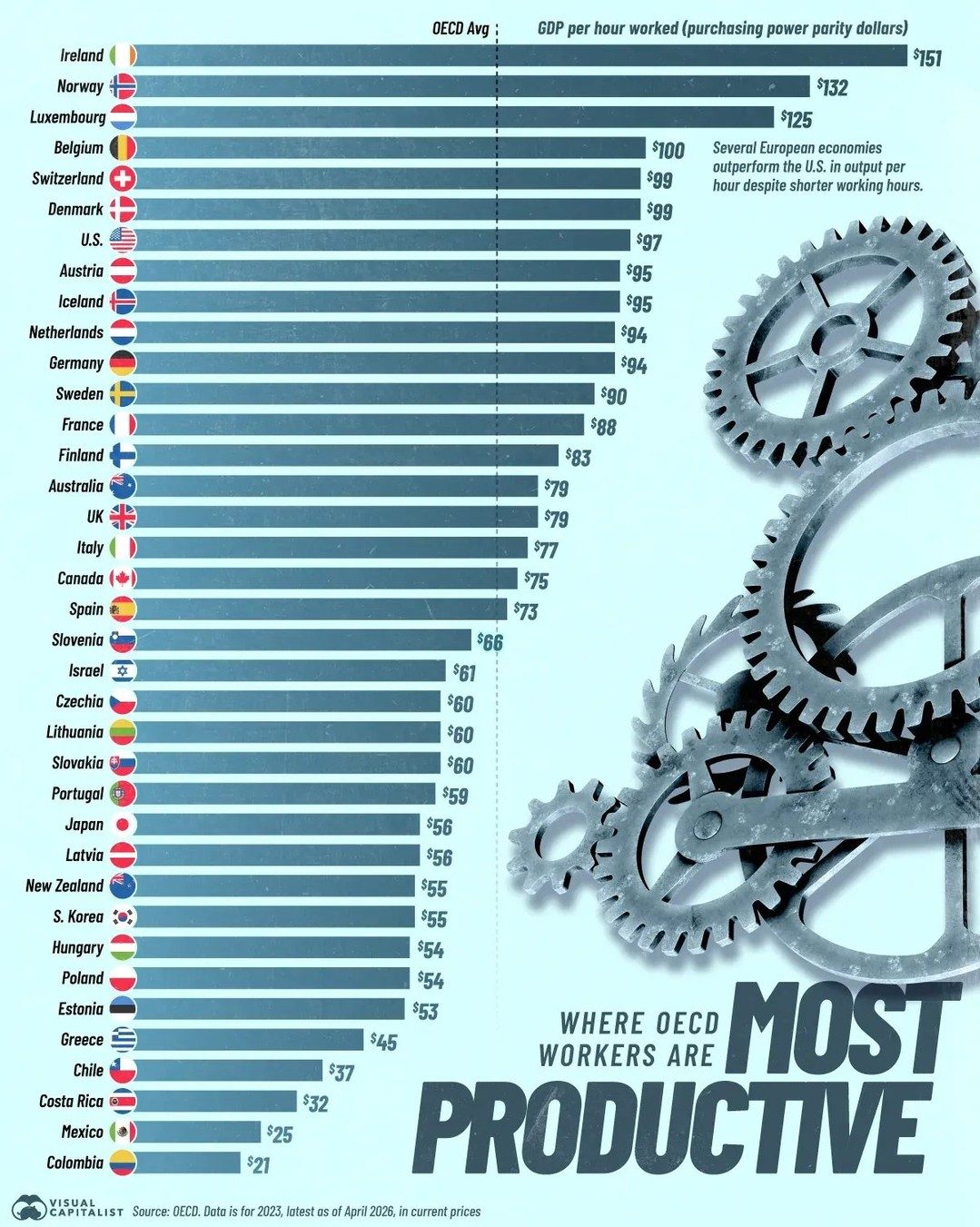
Global Productivity Rankings: GDP per Hour Worked
Ireland leads the world in productivity, generating $151 in GDP per hour worked. This places Ireland at the top of the list for OECD countries. This ranking reveals significant differences in productivity across the globe, with European countries dominating the top ranks.
Why This Matters
Understanding global productivity differences is crucial for businesses, economists, and policymakers. Productivity, measured as GDP per hour worked, indicates how efficiently a country's workforce converts hours into economic output. This metric is vital for assessing a nation's economic health and competitiveness.
Main Discussion
European Dominance
Several European countries rank high in productivity. Norway and Luxembourg both exceed $120 per hour, closely following Ireland. Belgium, Switzerland, and the Netherlands also show strong productivity levels, each generating over $90 per hour. These countries benefit from advanced economies, highly skilled labor forces, and efficient business environments.
High-Performing Economies
Iceland, Austria, the Netherlands, and Germany also perform well, each generating over $90 per hour. These countries demonstrate robust economic structures and efficient labor markets, contributing to their high productivity levels.
Mid-Range Performers
Countries like Sweden, France, and Finland fall into the mid-range, with GDP per hour worked between $80 and $90. While these countries are economically strong, they face challenges in maintaining high productivity levels due to factors like labor regulations and work-life balance policies.
Lower Productivity Nations
At the lower end of the spectrum, countries like Mexico and Colombia generate less than $25 per hour. These nations often struggle with economic challenges such as underdeveloped infrastructure, lower educational attainment, and less efficient use of technology in the workplace.
Global Context
The United States, a major global economy, sits at $97 per hour, below several European countries. This ranking highlights the need for the U.S. to address issues like workforce training, technological adoption, and labor market efficiency to enhance productivity.
Practical Tips
For Businesses
Businesses can learn from high-productivity countries by adopting advanced technologies, investing in workforce training, and fostering a culture of innovation. Efficient management practices and streamlined operations can also boost productivity.
For Policymakers
Policymakers should focus on creating an environment that supports high productivity. This includes investing in education and infrastructure, promoting technological adoption, and implementing policies that encourage innovation and efficiency.
For Workers
Workers can enhance their productivity by developing relevant skills, staying updated with technological advancements, and adopting efficient work practices. Maintaining a healthy work-life balance is also crucial for sustained productivity.
Important Takeaways
- Ireland leads the world in productivity, generating $151 in GDP per hour worked.
- European countries dominate the top ranks, with Norway, Luxembourg, and Belgium performing exceptionally well.
- The United States ranks lower than several European countries, highlighting areas for improvement.
- Productivity varies significantly across countries, influenced by economic structures, labor markets, and technological adoption.
Conclusion
Global productivity rankings provide valuable insights into the economic performance of countries. Ireland's lead, along with the strong performance of other European nations, underscores the importance of efficient labor markets, advanced technologies, and supportive policies. For businesses, policymakers, and workers, understanding these rankings can guide strategies to enhance productivity and economic competitiveness.
Watch the Reel
Questions readers ask
Which countries typically rank high in global productivity comparisons?
European countries often rank at the top in global productivity comparisons. Ireland, for instance, leads the world in productivity, with Norway and Luxembourg also performing exceptionally well. Other nations from this region frequently appear in the highest ranks.
What is Ireland's GDP per hour worked?
Ireland generates $151 in GDP per hour worked, which places it at the top of the list for OECD countries. This metric highlights the efficiency of Ireland's workforce in converting hours into economic output, contributing to the country's strong economic performance.
What does GDP per hour worked measure?
GDP per hour worked measures how efficiently a country's workforce converts hours into economic output. This metric is crucial for assessing a nation's economic health and competitiveness. It provides insights into the productivity of a country's workforce and its overall economic efficiency.
Why is understanding global productivity differences important?
Understanding global productivity differences is vital for businesses, economists, and policymakers. It helps in assessing a nation's economic competitiveness and making informed decisions about investments, policies, and labor strategies. This information can guide efforts to improve productivity and economic output.
How do productivity rankings impact a nation's economy?
Productivity rankings significantly impact a nation's economy by reflecting the efficiency of its workforce. Higher productivity rankings indicate that a country can generate more economic output with the same amount of work, which can lead to increased competitiveness, higher wages, and overall economic growth.
How does Ireland's productivity ranking benefit its economy?
Ireland's high productivity ranking benefits its economy by enhancing its global competitiveness. This ranking attracts investments and businesses seeking efficient and productive workforces, contributing to economic growth. Additionally, a more productive workforce can lead to higher wages and improved living standards.
What are OECD productivity rankings?
OECD productivity rankings evaluate the economic output of countries, focusing on GDP per hour worked. These rankings provide a comparative analysis of how efficiently different nations convert labor hours into economic output, highlighting the productivity levels of their workforces. They are derived from data collected by the Organisation for Economic Co-operation and Development.
Recent articles
Fresh deep dives from the latest Reels we unpacked.




Comments
Be the first to comment.