Investor Sentiment: A 30-Year Perspective
Investor sentiment has long been a critical factor in the world of finance, offering clues about how investors might behave and, subsequently, influencing investment decisions and broader market trends. The relationship between sentiment and the stock market is complex and not always straightforward. This is particularly evident when examining the sentiment data from the American Association of Individual Investors (AAII) over the past 30 years.
Context: Why Investor Sentiment Matters
Investor sentiment, or the overall mood of the market, is often used as an indicator of whether investors are bullish (optimistic) or bearish (pessimistic). This sentiment can shift based on various economic factors, including interest rates, inflation, and geopolitical events. Understanding these shifts can provide valuable insights into potential market movements and help investors make more informed decisions.
Extreme sentiment readings can sometimes serve as a contrarian indicator. When sentiment swings sharply in one direction, it may signal to some investors that the market is reaching an extreme, prompting them to take positions in the opposite direction.
Key Events and Trends in Investor Sentiment
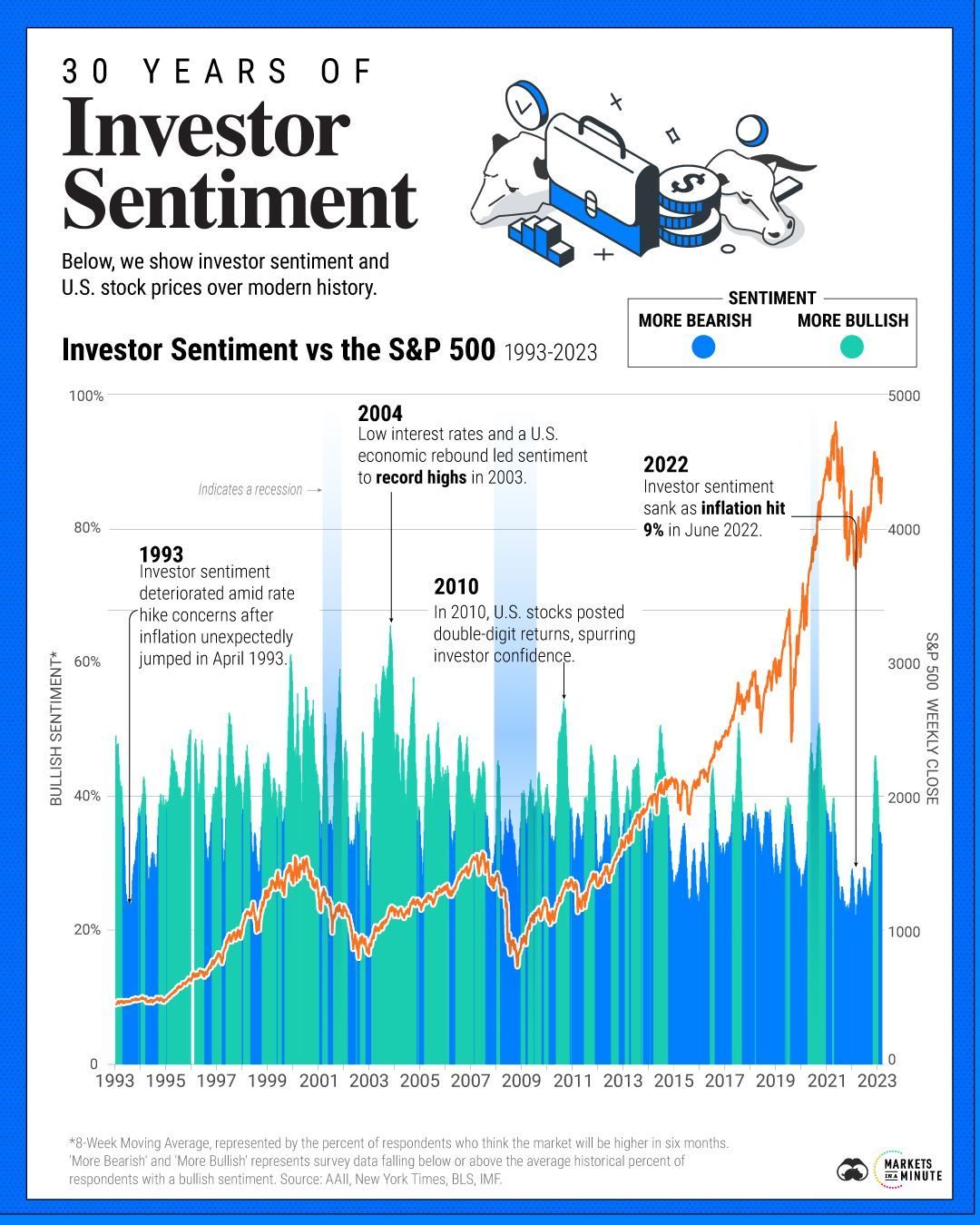
A visual representation of 30 years of investor sentiment, juxtaposed with the S&P 500, can reveal significant trends and turning points. Here, we break down some of the key events and trends highlighted over this period.
The Early 1990s: Navigating a Recession
Investor sentiment in 1993 was particularly influenced by concerns over rate hikes, which deteriorated sentiment amidst an economic downturn. This period was marked by volatility, with investors wary of further economic instability. The graph shows a sharp decline in sentiment during this time, aligning with a tumultuous period in the stock market.
The Mid-2000s: Economic Rebound and Low Interest Rates
By 2004, investor sentiment had rebounded, largely due to low interest rates and an economic recovery. Low interest rates typically incentivize borrowing and spending, which can boost economic growth and, consequently, investor confidence. This period saw record highs in investor sentiment, reflecting the optimism of the time.
The 2010s: Double-Digit Returns and Investor Confidence
The year 2010 was another pivotal year, with U.S. stocks posting double-digit returns and spurring investor confidence. Double-digit returns are a strong indication of a healthy and robust market, and these performance metrics were reflected in investor sentiment. This period showed an alignment between strong stock performance and high investor sentiment.
The 2020s: Inflation Concerns and Market Volatility
Investor sentiment took a significant hit in 2022, particularly in June when inflation rates soared to 9%. High inflation rates can erode purchasing power and diminish the value of investments, leading to a more bearish outlook. The graph highlights the sharp decline in investor sentiment during this period, reflecting these inflationary concerns.
Practical Tips for Navigating Sentiment Shifts
Navigating shifts in investor sentiment requires a nuanced understanding of the market and its underlying factors. Here are some practical tips for investors looking to interpret and respond to changes in sentiment:
Monitor Economic Indicators
Keeping an eye on key economic indicators, such as interest rates and inflation, can provide valuable context for understanding shifts in sentiment. When these indicators suggest a change in economic conditions, investors can anticipate potential shifts in sentiment and adjust their strategies accordingly.
Diversify Your Portfolio
Diversification is a fundamental strategy for mitigating risk. By spreading investments across different asset classes and sectors, investors can reduce the impact of market sentiment on their overall portfolio. This approach helps smooth out the volatility associated with shifts in sentiment and provides a more balanced investment strategy.
Consider Contrarian Signals
As mentioned earlier, extreme sentiment readings can sometimes serve as contrarian indicators. When sentiment shifts sharply in one direction, it may be a signal to take a position in the opposite direction. Investors should be cautious and consider this approach in the context of broader economic trends and market fundamentals.
Important Takeaways
- Economic Factors Influence Sentiment: Economic factors such as interest rates, inflation, and economic conditions significantly impact investor sentiment.
- Historical Trends Provide Context: Historical data on investor sentiment and stock market performance can provide valuable context for understanding current and future market trends.
- Extreme Sentiment Can Be a Contrarian Signal: When sentiment shifts sharply, it may be a signal to take a positioning in the opposite direction.
- Diversification and Monitoring Economic Indicators are Key: Diversifying your portfolio and monitoring economic indicators can help navigate shifts in sentiment.
Conclusion
Investor sentiment plays a crucial role in shaping market behavior and influencing investment decisions. By examining the history of investor sentiment over the past 30 years, we gain valuable insights into how economic factors and market performance have influenced sentiment. This understanding can help investors make more informed decisions and navigate the complexities of the stock market.
Watch the Reel
Questions readers ask
What is the American Association of Individual Investors (AAII) sentiment survey?
The AAII sentiment survey is a weekly poll that gauges the mood of individual investors, classifying their outlook as either bullish, bearish, or neutral. This data provides a snapshot of investor sentiment, helping to inform broader market trends and investor behavior.
How has investor sentiment influenced the S&P 500 over the past 30 years?
Over the past 30 years, extreme investor sentiment readings—both very bullish and very bearish—have often coincided with significant turning points in the S&P 500. These sentiments can act as contrarian indicators, where extreme optimism may signal a market peak, and extreme pessimism may signal a market bottom.
What are some key economic factors that influence investor sentiment?
Several economic factors can impact investor sentiment, including interest rates, inflation, unemployment rates, and geopolitical events. For instance, rising interest rates can dampen sentiment due to increased borrowing costs, whereas low inflation might boost investor confidence.
How can investors use historical sentiment data to inform their decisions?
By analyzing historical sentiment data, investors can identify patterns and trends that may repeat over time. This analysis can help investors make more informed decisions, such as when to enter or exit the market, by understanding how sentiment has influenced past market movements and investor behavior.
What are some common pitfalls to avoid when interpreting investor sentiment?
One common pitfall is relying solely on sentiment data without considering other market indicators. Sentiment should be used as one of many tools in an investor's arsenal. Additionally, investors should be wary of overreacting to short-term sentiment shifts, as these can often be noise rather than a signal.
Recent articles
Fresh deep dives from the latest Reels we unpacked.




Comments
Be the first to comment.