Interest Rates by Country
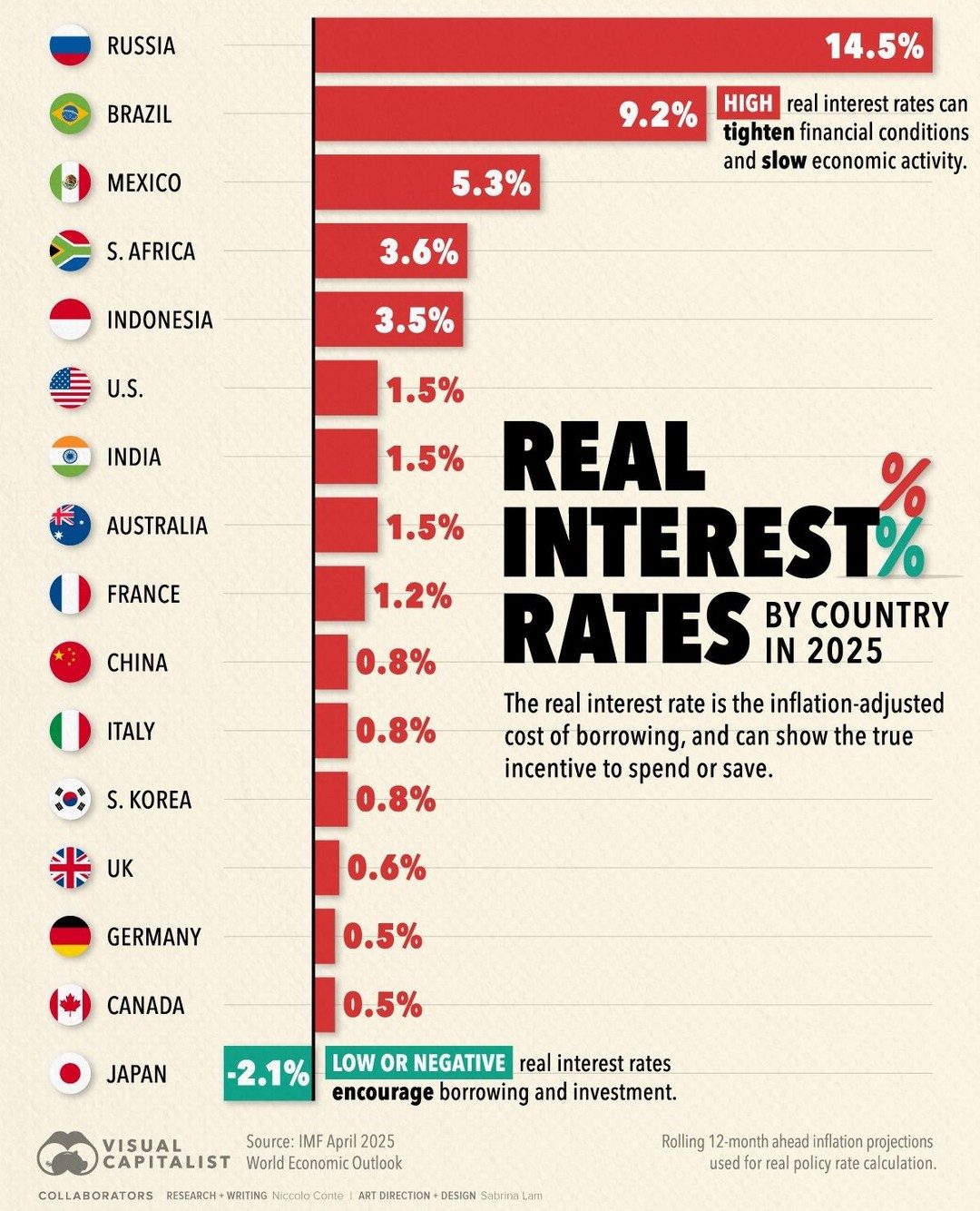
Interest rates play a pivotal role in shaping the economic landscape of any country. They influence borrowing costs, investment decisions, and overall economic activity. In 2025, the disparity in real interest rates across major economies is stark, with some countries maintaining extremely low or even negative rates, while others have high rates to combat inflation.
Context / Why This Matters
Understanding the current state of interest rates is crucial for investors, businesses, and policymakers. Real interest rates, which are adjusted for inflation, provide a clearer picture of the true cost of borrowing and the incentive to save or invest. High real interest rates can tighten financial conditions, slowing economic activity, while low or negative rates encourage borrowing and investment.
Main Discussion
Global Trends in Real Interest Rates
Japan: The Outlier with Negative Rates
Japan stands out as an outlier with a real interest rate of -2.1%. This ultra-loose monetary stance is part of a broader strategy to stimulate economic growth and encourage investment. By keeping interest rates low, the Bank of Japan aims to make borrowing cheaper, thereby boosting spending and investment.
Russia: Leading with High Rates
On the other end of the spectrum, Russia leads with a real interest rate of 14.5%. This high rate is a response to persistent inflation, as the central bank aims to curb rising prices by making borrowing more expensive. This approach can slow economic activity but is often necessary to control inflation.
Regional Insights
Latin America: Mixed Approaches
In Latin America, Brazil has a real interest rate of 9.2%, while Mexico's rate is 5.3%. These rates reflect differing economic conditions and strategies. Brazil's higher rate suggests a more aggressive approach to controlling inflation, while Mexico's lower rate indicates a more balanced approach, aiming to stimulate growth without ignoring inflation risks.
Asia: Varied Economic Strategies
Asian countries show a range of real interest rates. South Africa has a rate of 3.6%, Indonesia 3.5%, and both India and Australia sit at 1.5%. These rates reflect various economic conditions and policies. China, Italy, South Korea, and the UK all have real interest rates of 0.8%, 0.6%, and 0.5% respectively, indicating a more cautious approach to monetary policy.
Europe: Stability and Growth
In Europe, France has a real interest rate of 1.2%, while Germany and Canada both have rates of 0.5%. These countries often prioritize stability and controlled growth, using interest rates to manage inflation and support economic activity.
Practical Tips
For Investors
Understanding real interest rates can help investors make informed decisions. Countries with low or negative real interest rates may offer better opportunities for borrowing and investing, while those with high rates may provide more stability but less growth potential.
For Businesses
Businesses should consider the real interest rates of the countries they operate in or plan to expand to. Lower rates can make borrowing cheaper, facilitating expansion and investment, while higher rates may incentivize saving but make borrowing more costly.
For Policymakers
Policymakers need to strike a balance between controlling inflation and stimulating economic growth. Real interest rates are a key tool in this balance, and understanding their implications can help in designing effective monetary policies.
Important Takeaways
- Real interest rates are crucial for understanding the true cost of borrowing and the incentive to save or invest.
- Japan's ultra-loose monetary policy aims to boost growth and investment.
- Russia's high rates are a response to persistent inflation.
- Countries like Brazil and Mexico have varying approaches to balancing growth and inflation control.
- Asia and Europe show a range of economic strategies reflected in their interest rates.
- Investors, businesses, and policymakers should consider real interest rates in their decision-making processes.
Conclusion
Real interest rates are a critical component of economic policy, affecting borrowing costs, investment decisions, and overall economic activity. Japan's negative rates and Russia's high rates exemplify the extremes of monetary policy strategies. Understanding these rates and their implications can provide valuable insights for investors, businesses, and policymakers alike. By staying informed about the current state of real interest rates, stakeholders can make more strategic decisions and navigate the complex economic landscape more effectively.
Watch the Reel
Questions readers ask
Why does Japan have a negative interest rate of -2.1%?
Japan's negative interest rate is designed to stimulate economic growth by encouraging borrowing and investment. This policy can also weaken the currency, making exports more competitive and helping to combat deflationary pressures.
What is the purpose of Russia's high 14.5% interest rate?
Russia's high interest rate is primarily aimed at curbing inflation, which has been a significant economic challenge. By raising the cost of borrowing, the central bank can reduce consumer spending and investment, thereby controlling inflationary pressures.
How do these interest rate policies impact the economies of Japan and Russia?
In Japan, the low interest rate encourages businesses to invest and consumers to spend, potentially boosting economic activity. In contrast, Russia's high interest rate can slow economic growth but helps maintain price stability.
What are the potential risks associated with Japan's negative interest rate policy?
Japan's negative interest rate can lead to difficulties for financial institutions, as they earn less on loans and may face challenges in maintaining profitability. Additionally, it can discourage saving, as savers see their deposits lose value over time.
How might Russia's high interest rate affect its inflation rate in the future?
By keeping the interest rate high, Russia can slow down consumer spending and investment, which in turn helps control inflation. However, if the rate remains high for an extended period, it could also slow economic growth and potentially lead to a recession.
What factors should investors consider when evaluating these interest rate disparities?
Investors should consider the impact on currency values, as lower interest rates can weaken a currency, making exports more competitive. Additionally, they should evaluate the potential returns on investments and the stability of the financial markets in each country.
How do Japan and Russia's interest rate policies compare to global trends in 2025?
In 2025, Japan's negative interest rate and Russia's high interest rate are at the extremes of global trends. Many countries are likely to have rates somewhere in between, reflecting a balance between stimulating economic growth and controlling inflation.
What are the implications for international trade from such contrasting interest rate policies?
Contrasting interest rate policies can lead to currency fluctuations, affecting international trade. For instance, a weaker Japanese yen due to low interest rates could boost exports, while a stronger Russian ruble could make imports cheaper, impacting trade balances and economic interdependence.
Recent articles
Fresh deep dives from the latest Reels we unpacked.




Comments
Be the first to comment.