Inflation's Impact on Investments
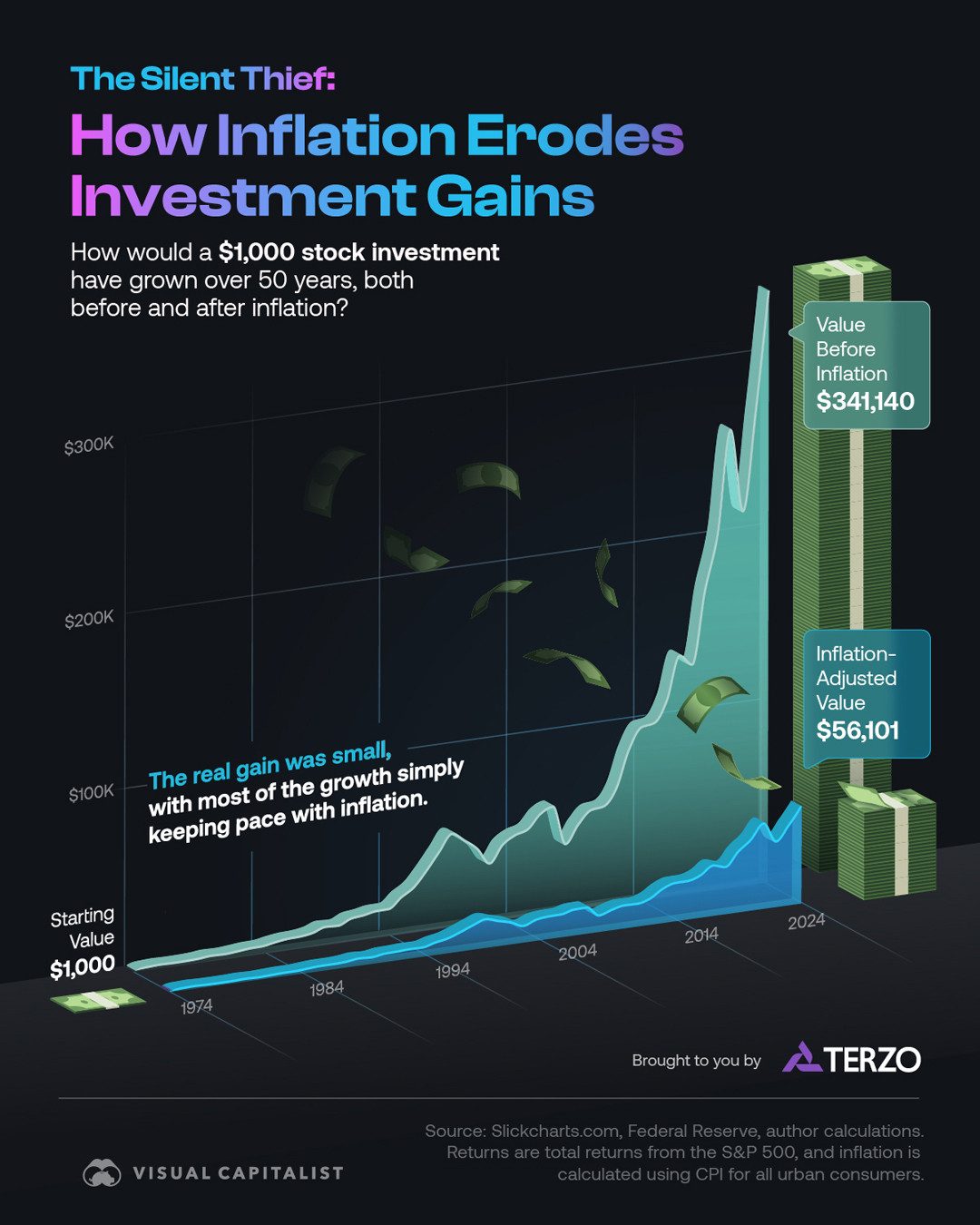
Inflation is a critical factor that can significantly impact the value of stock investments over time. Understanding its effects is essential for investors looking to make informed decisions. The visualization from TERZO shows a stark contrast between the nominal and real values of a $1,000 stock investment made in 1975 and held until 2024.
Context / Why this matters
Inflation erodes the purchasing power of money, meaning that over time, the same amount of money can buy fewer goods and services. For investors, this means that the nominal gains on their investments may not translate into real gains. This is particularly important for long-term investors who need to account for inflation to understand the true value of their returns.
Main discussion
The Silent Thief: How Inflation Erodes Investment Gains
Inflation is often referred to as the "silent thief" because it gradually diminishes the value of investments without being immediately noticeable. A $1,000 stock investment in 1975, if adjusted for inflation, would have a significantly different value today compared to its nominal value.
Nominal vs. Real Returns
When evaluating the performance of a stock investment, it's crucial to distinguish between nominal and real returns. Nominal returns are the gains calculated without adjusting for inflation, while real returns account for the effects of inflation.
For example, a $1,000 investment in the S&P 500 in 1975 grew to approximately $341,140 by 2024 in nominal terms. However, when adjusted for inflation, the real value of this investment is around $56,101. This discrepancy highlights how inflation can significantly reduce the real gains on an investment.
The Importance of Inflation-Adjusted Returns
Investors often focus on nominal returns, which can be misleading. Over long periods, the effects of inflation can substantially reduce the real value of an investment. For instance, the real gain of a $1,000 investment over 50 years was small, simply keeping pace with inflation. This means that the investment's real value did not increase significantly after accounting for inflation.
To make informed investment decisions, it's essential to consider inflation-adjusted returns. This provides a more accurate picture of how an investment has performed and helps investors understand the true value of their gains. By focusing on real returns, investors can better assess the impact of inflation on their investments and make more informed decisions.
Historical Data and Calculations
The visualization from TERZO uses data from Slickcharts.com and the Federal Reserve to illustrate the impact of inflation on investment returns. The returns are based on total returns from the S&P 500, which is a widely used benchmark for the overall U.S. stock market. The data includes both capital appreciation and dividends, providing a comprehensive view of investment performance.
The calculations also take into account the historical inflation rates, which have varied over the years. By incorporating these factors, the visualization provides a clear and accurate representation of how inflation has affected investment returns over the past 50 years.
Practical tips
Adjusting for Inflation
When evaluating the performance of an investment, always adjust for inflation to get a more accurate picture of its real value. This can be done by using historical inflation rates and applying them to the nominal returns of the investment. This will provide a better understanding of the investment's true performance and help investors make more informed decisions.
Diversifying Investments
Diversifying investments across different asset classes can help mitigate the impact of inflation. For example, investing in stocks, bonds, and real estate can provide a mix of income and capital appreciation, helping to offset the effects of inflation. This strategy can also enhance overall portfolio performance and reduce risk.
Regularly Reviewing Investment Performance
Regularly reviewing investment performance against inflation-adjusted benchmarks can help investors stay on track with their financial goals. By periodically assessing the real value of their investments, investors can make necessary adjustments to their portfolios and ensure they are achieving their desired returns.
Important takeaways
- Inflation can significantly reduce the real value of investment gains over time.
- It's essential to consider both nominal and real returns when evaluating investment performance.
- Adjusting for inflation provides a more accurate picture of an investment's true value.
- Diversifying investments and regularly reviewing performance can help mitigate the impact of inflation.
- Historical data and calculations from reliable sources can provide valuable insights into the effects of inflation on investments.
Conclusion
Understanding the impact of inflation on investments is crucial for making informed decisions. By considering both nominal and real returns, investors can gain a clearer picture of their investments' performance and adjust their strategies accordingly. Regularly reviewing investment performance and diversifying investments can help mitigate the effects of inflation and enhance overall portfolio returns. The visualization from TERZO provides a clear illustration of how inflation can erode investment gains, highlighting the importance of considering this factor in investment decisions.
Watch the Reel
Questions readers ask
What is the real value of a $1,000 stock investment made in 1975 and held until 2024?
A $1,000 stock investment made in 1975 and held until 2024 would yield approximately $56,000 less in real value than the nominal gains due to inflation. This means the actual purchasing power of the investment has significantly decreased over time.
How does inflation affect the value of stock investments?
Inflation erodes the purchasing power of money, making the nominal gains on stock investments appear more valuable than they actually are. This is crucial for investors to understand, as it impacts the real returns on their investments, especially over long periods.
What is the difference between nominal and real stock returns?
Nominal stock returns represent the absolute gains on an investment, while real returns account for inflation. For example, a $1,000 stock investment in 1975 might show high nominal returns by 2024, but the real returns would be much lower due to the erosion of purchasing power caused by inflation.
Why is it important to consider inflation when evaluating stock investments?
Considering inflation is vital for understanding the true value of stock investments. Ignoring inflation can lead to an overestimation of investment gains, making it difficult for investors to plan for future expenses and financial goals.
Is it possible to visualize the impact of inflation on stock investments?
Yes, using tools like the visualization from TERZO, you can compare the nominal and real values of a $1,000 stock investment made in 1975 and held until 2024. This visual representation helps investors understand how inflation has eroded the value of their investments over time.
How can I adjust my stock investment returns for inflation?
To adjust your stock investment returns for inflation, you can use a stock investment inflation calculator. This tool will help you determine the real value of your investments by accounting for the effects of inflation, giving you a more accurate picture of your returns.
Why is the 1975 to 2024 period significant for understanding inflation's impact on stocks?
The 1975 to 2024 period is significant because it covers a five-decade span where inflation has had a substantial impact on the purchasing power of money. This period allows investors to see the long-term effects of inflation on stock investments, highlighting the importance of considering real returns.
Recent articles
Fresh deep dives from the latest Reels we unpacked.




Comments
Be the first to comment.