Inflation Rates by Country
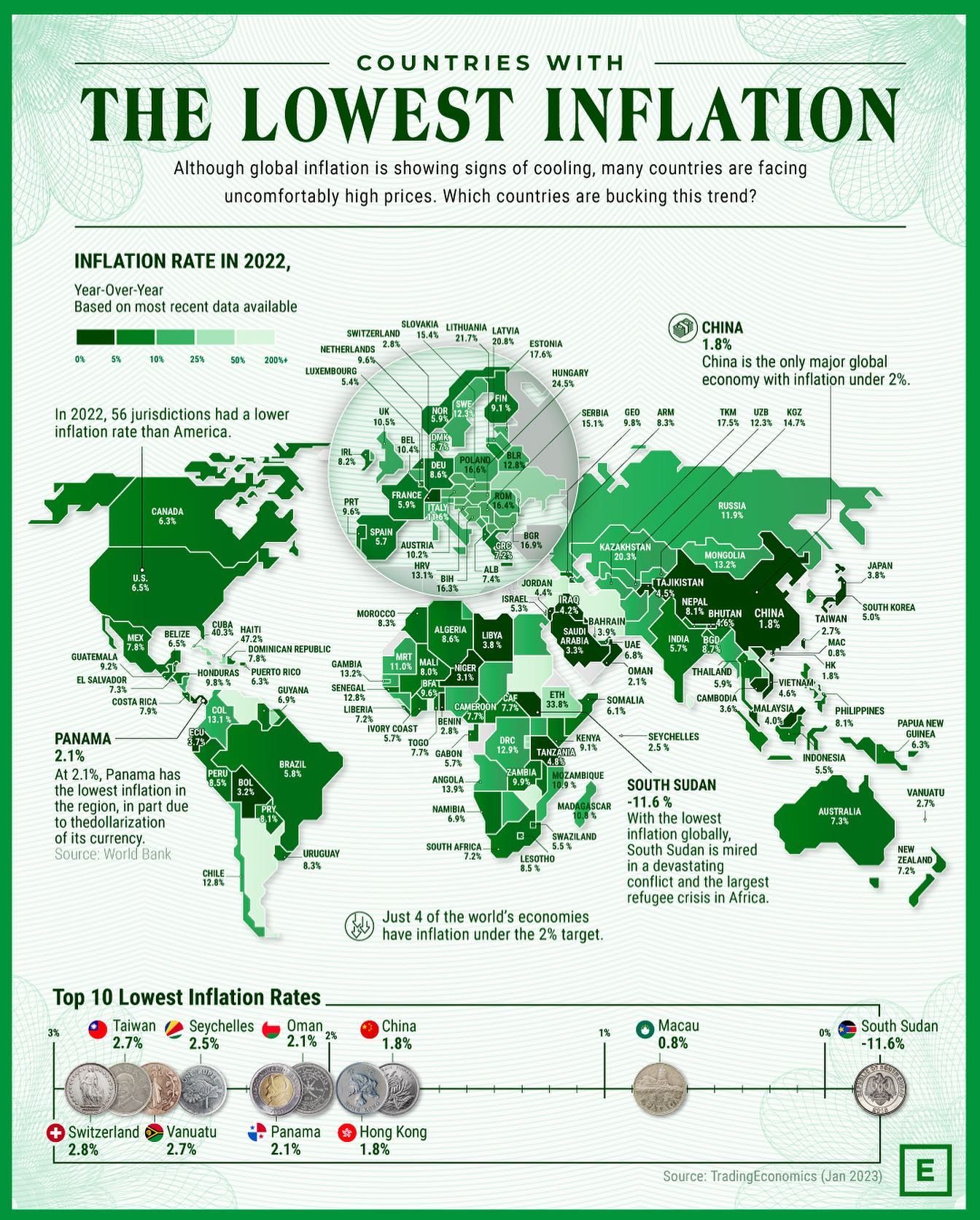
Global price pressures may be easing, but inflation remains a significant concern for many nations. The year-over-year inflation rates of 130 countries in 2022 reveal a wide range of experiences, with some countries managing to keep inflation relatively low. This data offers a snapshot of how different economies are faring amidst global economic challenges.
Context / Why this matters
Understanding inflation rates is crucial for both policymakers and individuals. High inflation erodes purchasing power, while low inflation can indicate economic stability and effective monetary policy. By examining which countries have the lowest and highest inflation rates, we can gain insights into the factors driving price changes and the effectiveness of different economic strategies.
Main discussion
Countries with the lowest inflation rates
China stands out as the only major economy with an inflation rate under 2%, at 1.8%. This is a significant achievement, especially when compared to other major economies like the United States (8.3%) and the Eurozone countries (ranging from 5.7% in Spain to 10.2% in Belgium). Several other countries also managed to keep inflation relatively low:
- Taiwan: 2.7%
- Vietnam: 3.1%
- Switzerland: 3.2%
- Malaysia: 3.8%
These low inflation rates can be attributed to various factors, including effective monetary policy, stable currency, and controlled spending.
Countries with the highest inflation rates
On the other end of the spectrum, several countries are grappling with extremely high inflation rates:
- Turkey: 58.9%
- Argentina: 16.7%
- Venezuela: 39.9%
- Egypt: 16.4%
- Libya: 16.6%
These high inflation rates can have severe economic consequences, including reduced purchasing power, increased poverty, and social unrest. High inflation is often a result of factors such as political instability, currency depreciation, and economic mismanagement.
Inflation in Europe
Europe presents a mixed picture, with some countries experiencing relatively low inflation while others are grappling with significant price increases. For example, Estonia and Latvia have inflation rates of 17.6% and 15.4%, respectively, while Switzerland and Portugal have rates of 3.2% and 6.7%, respectively.
Inflation in the Middle East and Africa
Several countries in the Middle East and Africa have inflation rates above 10%, with some even exceeding 50%. This high inflation can be attributed to factors such as political instability, currency depreciation, and economic sanctions. For instance, Turkey and Libya have inflation rates of 58.9% and 16.6%, respectively, while Egypt and Morocco have rates of 16.4% and 4.2%, respectively.
Inflation in Asia
Asian countries present a diverse range of inflation experiences. While China and Taiwan have managed to keep inflation relatively low, other countries are facing significant price increases. For example, South Korea and the Philippines have inflation rates of 5.0% and 7.7%, respectively, while Thailand and Malaysia have rates of 5.9% and 3.8%, respectively.
Practical tips
For consumers
High inflation can be a significant challenge for consumers, eroding their purchasing power and making it harder to afford essential goods and services. Here are some practical tips for coping with high inflation:
- Plan your budget: Track your spending and prioritize essential expenses. Look for areas where you can cut back to save money.
- Shop around: Compare prices at different stores and online to find the best deals.
- Consider generic brands: Generic or store-brand products are often cheaper than name-brand products and can offer similar quality.
- Cook at home: Eating out can be expensive, so try to cook at home as much as possible.
- Avoid impulse purchases: Stick to your shopping list and avoid buying items on impulse.
- Use coupons and discounts: Look for coupons, discounts, and promotional offers to save money.
- Shop with a list: Make a list of the items you need before you go shopping and stick to it.
For businesses
Businesses can also be affected by high inflation, as increased costs can eat into profits. Here are some practical tips for coping with high inflation:
- Plan your budget: Track your expenses and prioritize essential costs. Look for areas where you can cut back to save money.
- Negotiate with suppliers: Try to negotiate better prices with your suppliers or look for alternative suppliers who can offer better deals.
- Adjust your prices: If your costs are increasing, you may need to adjust your prices to maintain your profit margins. However, be mindful of how price increases will affect your customers.
- Diversify your product offerings: Consider diversifying your product offerings to appeal to a wider range of customers and reduce your dependence on any one product or market.
- Invest in technology: Investing in technology can help you improve efficiency, reduce costs, and increase productivity.
For governments
Effective monetary policy is crucial for managing inflation. Here are some practical tips for governments:
- Monitor inflation: Keep a close eye on inflation rates and adjust monetary policy as needed to maintain price stability.
- Use interest rates: Adjust interest rates to control inflation. Raising interest rates can make borrowing more expensive, reducing consumer spending and slowing down inflation. Lowering interest rates can increase borrowing and spending, potentially increasing inflation.
- Control government spending: Controlling government spending can help prevent excessive inflation. Widespread deficits can drive inflation by adding to the money supply.
- Promote economic growth: Promoting economic growth can also help manage inflation. Higher economic growth can lead to increased consumer spending, increased productivity, and increased employment. This can help reduce inflation by increasing the supply of goods and services.
- Fiscal policy: Implementing fiscal policies, such as reducing taxes, can also help manage inflation. Reducing taxes can increase consumer spending, leading to increased demand for goods and services. This can help reduce inflation by increasing the supply of goods and services.
Important takeaways
- China: is the only major economy with an inflation rate under 2%, at 1.8%, as of 2022.
- Turkey: has the highest inflation rate, at 58.9%.
- Many countries: have inflation rates above 10%, with some exceeding 50%. This high inflation can have severe economic consequences, including reduced purchasing power, increased poverty, and social unrest.
- Inflation rates vary widely: across different regions and countries, reflecting a range of economic experiences.
- Monitoring and understanding inflation rates: can help policymakers, businesses, and consumers make informed decisions.
Conclusion
Inflation rates around the world in 2022 highlight the diverse economic experiences of different countries. While some countries have managed to keep inflation relatively low, others are grappling with extremely high inflation rates. Understanding the factors driving these inflation rates can provide valuable insights into the effectiveness of different economic strategies and the challenges facing different economies. By tracking inflation rates and implementing appropriate policies, governments, businesses, and consumers can better navigate the economic landscape.
Watch the Reel
Questions readers ask
Which countries had the lowest inflation rates in 2022?
In 2022, countries like China and Taiwan stood out for maintaining inflation rates below 3%. Other countries with low inflation rates include Japan and Switzerland. These nations have implemented effective monetary policies and have robust economic structures.
How did Turkey and Argentina fare in terms of inflation in 2022?
Turkey and Argentina experienced some of the highest inflation rates in 2022, with both countries seeing inflation soar above 16%. Turkey's inflation rate reached approximately 85.51% while Argentina's reached around 94.8%.
What factors contribute to the differences in inflation rates among countries?
Several factors influence a country's inflation rate, including monetary policy, exchange rates, and global economic conditions. For instance, countries with strong currencies and stable economies, such as Switzerland, tend to have lower inflation, while those with volatile currencies and economic instability, like Argentina, often face high inflation.
Why is understanding global inflation rates important for individuals?
Understanding global inflation rates can help individuals make informed decisions about investments, savings, and spending. High inflation can erode purchasing power, making it crucial to track how prices are changing. A country with stable inflation rates may also be a sign of economic stability, which can be comforting for long-term planning.
How did inflation rates in 2022 compare to previous years?
Inflation rates in 2022 varied significantly from previous years. For example, the global average inflation rate in 2022 was higher than in 2021, reflecting the impact of global economic challenges, such as the pandemic and geopolitical tensions. However, some countries, like China and Taiwan, managed to keep inflation low.
What can policymakers learn from countries with low inflation rates?
Policymakers can learn from countries with low inflation rates the importance of effective monetary policies, fiscal discipline, and economic stability. These countries often have strong central banks, controlled public spending, and strategies for managing global price pressures. Policymakers can adapt these strategies to improve economic stability in their own countries.
How does global inflation affect international trade?
Global inflation can significantly impact international trade. Countries with high inflation may see their currencies devalue, making their exports cheaper and imports more expensive. This can lead to trade imbalances and affect global economic stability. Countries with low inflation, on the other hand, may see more stable trade relationships, with a stronger currency to support their economic interests.
Recent articles
Fresh deep dives from the latest Reels we unpacked.




Comments
Be the first to comment.