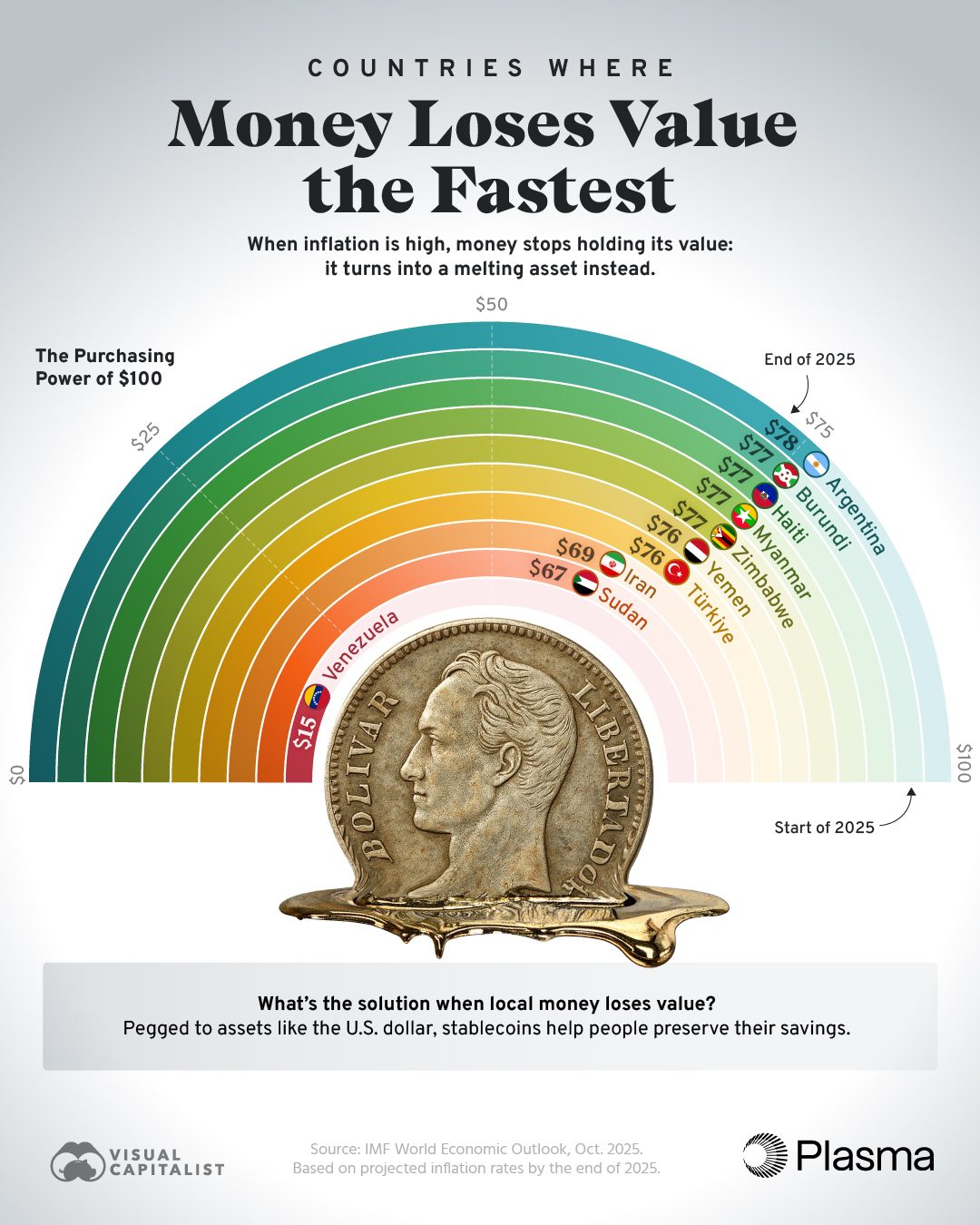
Inflation shrinks the value of $100 in the world's hardest-hit countries. Inflation is a critical topic with far-reaching implications for economic stability and personal financial planning. This article delves into how inflation impacts currency value, focusing on countries with the highest projected inflation rates by the end of 2025. The infographic, created in partnership with PlasmaFdn, provides a stark visual representation of how $100 could diminish in purchasing power across various nations.
Context / Why this matters
Understanding inflation is crucial for navigating economic uncertainties. Inflation erodes the purchasing power of money, making goods and services more expensive over time. For individuals and businesses, this means that the same amount of money buys less than it did previously. This is particularly relevant for countries experiencing rapid inflation, where the value of currency can dwindle significantly in a short period.
Countries with high inflation rates face severe economic challenges, including social unrest, economic instability, and a loss of investor confidence. High inflation can lead to a cycle of devaluation, where the currency's value continues to decline, making it difficult for governments to manage public debt and for citizens to maintain their standard of living.
The IMF World Economic Outlook
The International Monetary Fund (IMF) provides insightful projections on global economic trends, including inflation rates. According to the IMF World Economic Outlook, published in October 2025, several countries are expected to face high inflation. These projections are based on extensive economic data and analysis, offering a glimpse into the potential economic landscape of the future.
The Impact on Everyday Life
Inflation affects everyday life in numerous ways. For consumers, it means higher prices for essential goods and services, reduced savings, and the need to adjust spending habits. For businesses, it can lead to increased operational costs, supply chain disruptions, and challenges in planning and budgeting. Understanding how inflation impacts different countries can help individuals and businesses make more informed financial decisions.
Main Discussion
High-Inflation Countries
The infographic highlights countries where inflation is projected to be particularly severe by the end of 2025. These include nations like Venezuela, Iran, and Argentina, where economic instability and financial mismanagement have led to rapid currency devaluation.
Venezuela
Venezuela has been grappling with hyperinflation for several years, making it one of the most affected countries. The value of the Venezuelan bolivar has declined dramatically, leading to severe economic hardship for its citizens. The country's reliance on oil exports and political instability have exacerbated the inflation problem, making it difficult for the government to implement effective economic policies.
Iran
Iran faces significant economic challenges, including high inflation rates. Economic sanctions imposed by international bodies have further complicated the situation, leading to a decline in the value of the Iranian rial. The country's reliance on oil exports and limited economic diversification have contributed to its economic vulnerabilities.
Argentina
Argentina has a history of high inflation, and the trend is expected to continue. The country's economic instability, political turmoil, and reliance on foreign debt have led to rapid devaluation of the Argentine peso. The government has faced challenges in implementing fiscal reforms and stabilizing the economy, making it difficult for citizens to maintain their standard of living.
Preserving Value in High Inflation Environments
In countries experiencing rapid inflation, preserving the value of savings and assets becomes a critical concern. One recommended strategy is to peg assets to the U.S. dollar, which is considered a stable and reliable currency. This approach can help individuals and businesses protect their financial assets from the devaluation effects of high inflation.
- Dollar-based savings: Holding savings in U.S. dollars can help preserve purchasing power. This is particularly relevant for individuals in countries with volatile currencies.
- Investing in stable assets: Investing in assets like gold, real estate, or foreign stocks can provide a hedge against inflation. These assets tend to retain value even during economic turbulence.
- Diversifying investments: Spreading investments across various asset classes and geographies can help mitigate the risks associated with high inflation. This strategy can provide a safety net and ensure financial stability.
The Role of Central Banks
Central banks play a crucial role in managing inflation. They use monetary policy tools, including interest rates and money supply management, to control inflation. In countries with high inflation, central banks often face significant challenges in implementing effective monetary policies. Central banks must balance the need to control inflation with the goal of fostering economic growth and stability.
However, central banks in high-inflation countries often face political and economic pressures that can limit their effectiveness. For instance, governments may push for lower interest rates to stimulate economic growth, even if it leads to higher inflation. This can create a vicious cycle where the central bank's efforts to control inflation are undermined by conflicting political and economic pressures.
Practical Tips
Monitoring Inflation Rates
Staying informed about inflation rates is essential for making sound financial decisions. Individuals and businesses should regularly monitor inflation trends in their countries and globally. This can help in anticipating changes in the economic landscape and adjusting financial strategies accordingly.
Adjusting Financial Plans
In high-inflation environments, it is crucial to adjust financial plans to account for the reduced purchasing power of money. This may involve revising budgets, reallocating investments, and seeking alternative financial strategies to preserve savings and assets. Consulting with financial advisors can provide valuable insights and guidance in navigating economic uncertainties.
Diversifying Income Streams
Diversifying income streams can provide a buffer against the effects of inflation. This may involve exploring multiple revenue sources, investing in stable assets, or seeking employment opportunities that offer inflation-adjusted compensation. Diversifying income streams can help individuals and businesses maintain financial stability during economic turbulence.
Important Takeaways
Understanding the Impact
Inflation affects every aspect of the economy, from individual spending to government policies. Understanding its impact is crucial for making informed financial decisions and navigating economic challenges. By staying informed about inflation trends and adjusting financial strategies, individuals and businesses can better protect their assets and maintain financial stability.
Global Economic Trends
The economic landscape is highly interconnected, and inflation in one country can have ripple effects globally. Keeping an eye on global economic trends and inflation rates in different countries can provide valuable insights into potential economic risks and opportunities. This knowledge can help in making strategic financial decisions and preparing for future economic challenges.
Financial Strategies
In high-inflation environments, preserving the value of savings and assets is a top priority. Strategies such as pegging assets to the U.S. dollar, investing in stable assets, and diversifying income streams can help mitigate the effects of inflation. Financial planning should be flexible and adaptable, allowing for adjustments based on changing economic conditions and inflation trends.
Conclusion
Inflation is a powerful economic force that shapes the value of money and the overall economic landscape. By understanding the impact of inflation and staying informed about global economic trends, individuals and businesses can make more informed financial decisions and better navigate economic challenges. In countries with high inflation, preserving the value of savings and assets is crucial for maintaining financial stability. Strategies such as pegging assets to the U.S. dollar, investing in stable assets, and diversifying income streams can help mitigate the effects of inflation and provide a safety net during economic turbulence.
Watch the Reel
Questions readers ask
Which countries are expected to experience the highest inflation rates by 2025?
Countries with the highest projected inflation rates by 2025 include those with economic instability, high government debt, or reliance on volatile commodities. Some of the hardest-hit countries may experience inflation rates exceeding 100%, significantly diminishing the purchasing power of $100.
How does inflation affect the value of $100 over time?
Inflation reduces the purchasing power of $100, making goods and services more expensive. For instance, if the inflation rate is 10% annually, $100 today will only buy about $82 worth of goods and services in a single year. Over multiple years, this effect compounds, leading to a substantial loss in value.
What is the projected value of $100 in countries with high inflation by 2025?
In countries with high inflation, the value of $100 could diminish significantly by 2025. For example, in a country with an inflation rate of 50% annually, $100 could lose approximately 82% of its value, equating to around $18 in purchasing power by 2025.
How can individuals mitigate the impact of inflation on their finances?
Individuals can mitigate the impact of inflation by investing in assets that historically outpace inflation, such as stocks, real estate, or inflation-protected bonds. Diversifying investments and maintaining an emergency fund can also help safeguard against economic uncertainties.
What are the economic implications of high inflation rates?
High inflation rates can lead to economic instability, reduced consumer spending, and business uncertainty. It can also result in social unrest and political instability, as the cost of living increases and citizens struggle to afford basic goods and services.
What are some of the best visualizations to understand inflation impact?
Infographics, such as those created in partnership with organizations like PlasmaFdn, provide a clear and concise way to visualize how inflation impacts the value of money over time. These tools can help individuals and businesses understand the future value of $100 in various countries and plan accordingly.
What is the best way to monitor inflation rates and stay informed about future trends?
Staying informed about inflation rates and future trends involves regularly checking reliable sources such as the World Bank, International Monetary Fund (IMF), and national statistical bureaus. Following economic news and consulting with financial advisors can also provide valuable insights into how inflation might impact your finances.
Recent articles
Fresh deep dives from the latest Reels we unpacked.




Comments
Be the first to comment.