India’s Geoeconomic Balancing Act
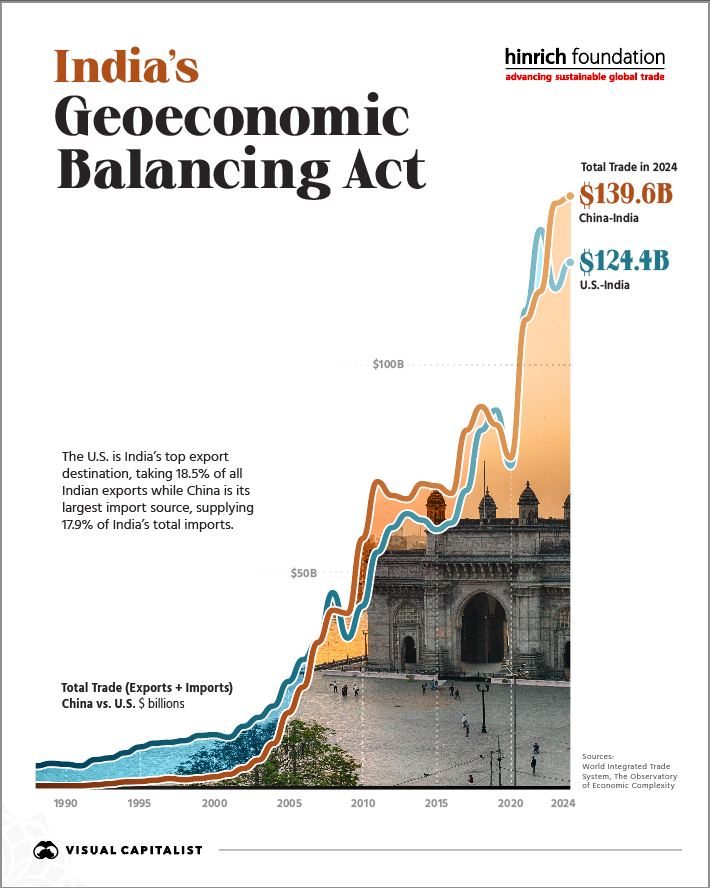
India’s trade relationships with the U.S. and China reflect a dynamic balancing act, with each country playing a crucial role in India’s global trade strategy. This intricate dance is evident in the trade data, which shows a significant split between exports to the U.S. and imports from China.
Context / Why this Matters
Understanding India’s trade dynamics with the U.S. and China is essential for comprehending its broader geoeconomic strategy. As India continues to develop, its trade policies and relationships will significantly impact global markets. The U.S. and China are pivotal players in this narrative, each contributing uniquely to India’s economic landscape.
India’s trade with the U.S. and China highlights several key points. In 2024, the total trade between India and these two countries reached $139.6 billion. Of this, China-India trade amounted to $124.4 billion, while the U.S.-India trade, though smaller in volume, accounts for 18.5% of all Indian exports. Conversely, China supplies 17.9% of India’s total imports. These figures underscore the interconnectedness of global trade and the strategic importance of both countries for India.
Main Discussion
Trade Dynamics with the U.S.
The U.S. is India’s top export destination, absorbing a significant portion of India’s exports. This relationship is crucial for India’s economic growth, as the U.S. market provides a stable and high-demand outlet for Indian goods. Key sectors contributing to this trade include pharmaceuticals, IT services, and engineering goods. The U.S. market not only offers revenue but also serves as a testing ground for Indian products, enhancing their global competitiveness.
Trade Dynamics with China
China, on the other hand, is India’s largest import source. The sheer volume of trade between the two countries underscores China’s role as a critical supplier for India. China exports a wide range of goods to India, including machinery, electronics, and chemical products. This trade dynamic is essential for sustaining India’s manufacturing and production sectors, which rely heavily on Chinese inputs.
China-India trade dynamics are not without challenges. Political tensions and border disputes have periodically strained relations, leading to trade disruptions and policy shifts. These tensions underscore the need for a balanced trade strategy that minimizes dependency on any single country.
Strategic Trade Policy
India’s trade policy aims to balance these relationships to ensure economic stability and growth. This involves diversifying trade partners, enhancing domestic production capabilities, and fostering regional trade agreements. The government’s initiatives, such as "Make in India" and "Aatmanirbhar Bharat" (Self-Reliant India), aim to reduce dependency on imports and boost domestic manufacturing.
Practical Tips
For businesses and investors looking to navigate India’s trade landscape, several practical tips can be useful:
- Diversify Supply Chains: Reducing dependence on a single supplier or market can mitigate risks associated with geopolitical tensions.
- Leverage Trade Agreements: Utilize existing and upcoming trade agreements to access new markets and reduce tariffs.
- Monitor Policy Changes: Stay updated on policy shifts and regulatory changes that may impact trade dynamics.
- Invest in Technology and Innovation: Enhance competitiveness by investing in advanced technologies and innovation, making Indian products more attractive globally.
Important Takeaways
- Balanced Trade Relationships: India’s trade strategy involves balancing its relationships with both the U.S. and China, leveraging their strengths while mitigating risks.
- U.S. as Export Destination: The U.S. is a crucial export destination for India, providing a stable market for Indian goods.
- China as Import Source: China is a critical supplier for India, providing essential inputs for its manufacturing sectors.
- Need for Diversification: Diversifying trade partners and reducing dependency on any single country is essential for economic stability.
- Policy and Innovation: Continued investment in technology and policy initiatives can enhance India’s global competitiveness and reduce dependency on imports.
Conclusion
India’s geoeconomic balancing act between the U.S. and China is a testament to its strategic approach to global trade. By understanding and leveraging the strengths of both relationships, India can continue to grow and diversify its trade portfolio. This delicate balance will be critical for India’s future economic development and its role in the global economy.
Watch the Reel
Questions readers ask
What are the primary goals of India's trade strategy with the U.S. and China?
India's trade strategy aims to leverage the strengths of both the U.S. and China to foster economic growth. The U.S. is a key export destination, while China is the largest import source. By maintaining strong relationships with both countries, India aims to diversify its trade partnerships and reduce dependency on any single market.
How do India's export destinations and import sources reflect its geoeconomic strategy?
India's export destinations and import sources illustrate its geoeconomic strategy, which involves balancing trade with the U.S. and China. The U.S. is a top export destination, indicating a strong demand for Indian goods. Meanwhile, China is the largest import source, highlighting India's reliance on Chinese goods for its domestic market. This balance is crucial for India's economic stability and growth.
What role do trade data and infographics play in understanding India's trade relationships?
Trade data and infographics provide visual and quantitative insights into India's trade relationships. They help track changes over time, identify key trading partners, and understand the balance between imports and exports. For instance, an infographic may show that India's imports from China have steadily increased, while exports to the U.S. have also grown, reflecting the dynamic nature of India's trade strategy.
Why is it important to analyze India's changing trade patterns?
Analyzing India's changing trade patterns offers insights into its evolving economic policies and global market strategies. For example, shifts in trade data can indicate changes in demand for Indian goods or shifts in supply chains. This information is valuable for businesses and policymakers looking to capitalize on opportunities or navigate potential challenges in India's trade landscape.
How might India's trade policies impact global markets?
India's trade policies can significantly impact global markets due to its role as a major player in international trade. For instance, changes in trade agreements with the U.S. or China can alter global supply chains, affect commodity prices, and influence trade flows. Additionally, India's domestic policies can impact the global market for goods and services, making it crucial for other countries to monitor and engage with India's trade strategies.
What are some key considerations for India in balancing trade with the U.S. and China?
India must navigate geopolitical tensions, economic dependencies, and strategic interests when balancing trade with the U.S. and China. For example, it must ensure that its reliance on Chinese imports does not compromise its economic sovereignty, while also fostering strong export relationships with the U.S. to drive growth and innovation. This balancing act requires careful policy-making and strategic foresight.
Recent articles
Fresh deep dives from the latest Reels we unpacked.




Comments
Be the first to comment.