Income Needed to Be Upper-Middle Class in the U.S.
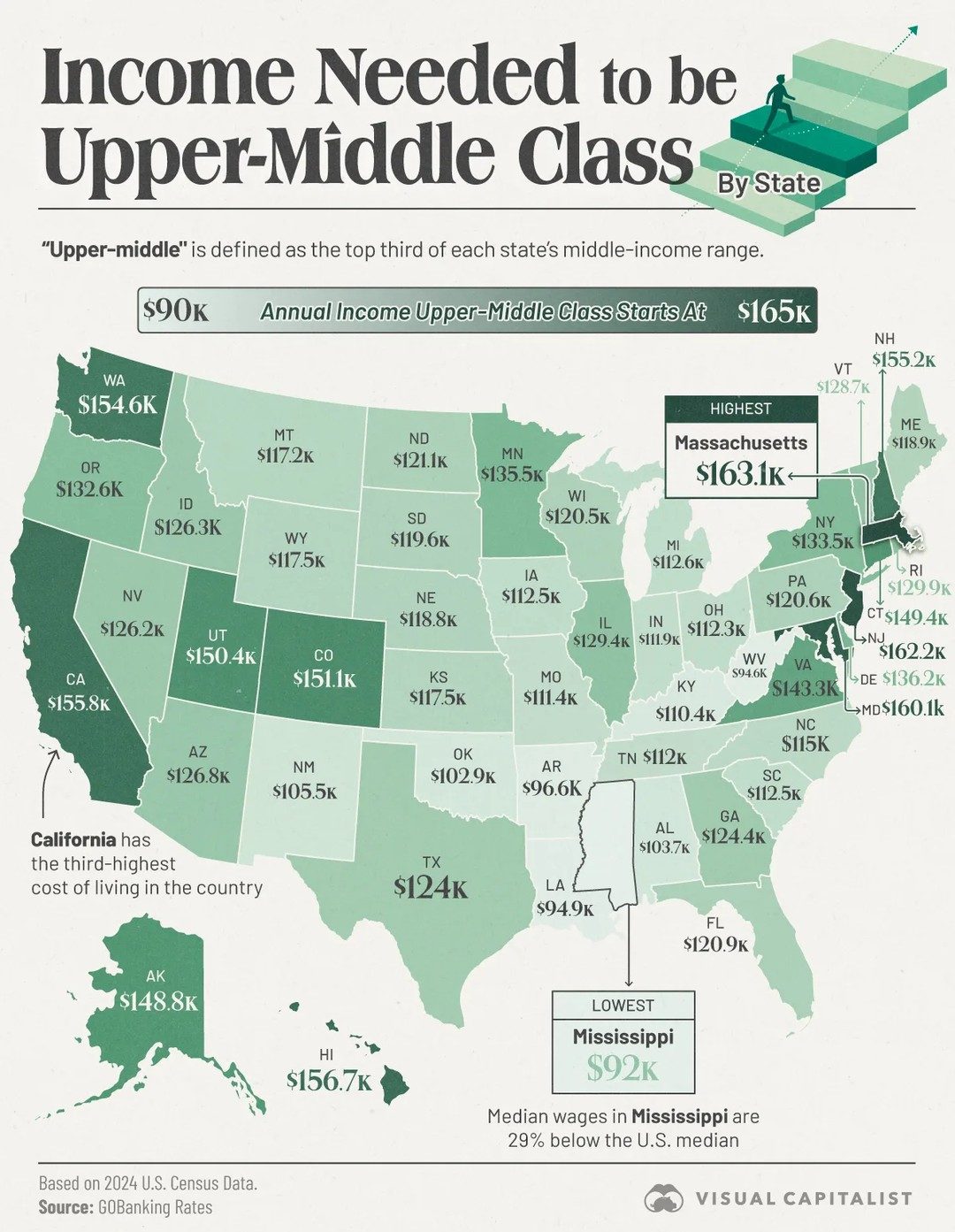
Income is a crucial factor in determining one's socioeconomic status, and the definition of "upper-middle class" varies significantly across different states in the U.S. Recently, an analysis of 2024 U.S. Census data has revealed that in nine states, an annual income exceeding $150,000 is required to be considered upper-middle class. This threshold can be even higher in high-cost states like Massachusetts and New Jersey, where it exceeds $160,000, while in parts of the South, it falls below $100,000.
Why This Matters
Understanding the income thresholds for different socioeconomic classes is essential for several reasons. It helps individuals assess their financial standing, plan for the future, and make informed decisions about their careers and lifestyles. Additionally, policymakers use this information to create programs and policies that support different income groups. The variation in income thresholds across states highlights the diverse economic landscapes and cost of living differences within the U.S. This disparity is influenced by factors such as housing costs, taxes, and the availability of services.
Income Thresholds Across the U.S.
The analysis uses a straightforward definition: the upper-middle class represents the top third of each state's middle-income range. Here are some key findings:
Highest Income Thresholds
Massachusetts tops the list with the highest income threshold for the upper-middle class, requiring an annual income of $163,100. This is followed closely by New Jersey at $162,200 and New York at $156,700. Other states with high thresholds include Connecticut at $149,400, Rhode Island at $150,400, and California at $155,800.
Lowest Income Thresholds
On the other end of the spectrum, Mississippi has the lowest income threshold at $105,500. This is significantly lower than the national average and reflects the state's lower cost of living. Other states with relatively low thresholds include New Mexico at $105,500, Ohio at $112,500, and Oregon at $126,300.
Regional Trends
The data shows clear regional trends:
- Northeast: States like Massachusetts, New Jersey, and New York have the highest thresholds, reflecting their high cost of living, especially in terms of housing and taxes.
- South: States in the South, such as Mississippi, Alabama, and New Mexico, have the lowest thresholds, indicating a lower cost of living.
- Midwest and West: States in these regions fall somewhere in between, with thresholds ranging from $112,500 to $150,400.
What Defines the Upper-Middle Class?
The definition of the upper-middle class can vary, but it generally represents individuals with incomes that place them in the top third of their state's middle-income range. This group typically enjoys a comfortable lifestyle, with access to amenities and services that may not be available to those in lower income brackets. However, the specific income threshold can vary widely based on the cost of living in different regions.
Practical Tips for Managing Income in High-Cost Areas
Living in high-cost areas can be challenging, but there are strategies to manage expenses and maintain a comfortable lifestyle:
Budgeting and Saving
Creating a detailed budget can help track expenses and identify areas where savings can be made. Automating savings can ensure that a portion of income is set aside regularly. High-cost areas often require more substantial savings for emergencies and long-term goals.
Smart Investing
Investing in diverse assets such as stocks, bonds, and real estate can help grow wealth. Real estate, in particular, can be a good investment in high-cost areas, as property values often appreciate over time.
Career Advancement
Pursuing higher education or advanced certifications can lead to better job opportunities and higher salaries. Networking and staying updated with industry trends can also open doors to new career prospects.
Important Takeaways
The income needed to be considered upper-middle class varies significantly across the U.S. High-cost states like Massachusetts and New Jersey require much higher incomes compared to states in the South. Understanding these thresholds can help individuals plan their finances and make informed decisions about their careers and lifestyles. For those living in high-cost areas, budgeting, saving, investing, and career advancement are crucial strategies for managing expenses and maintaining a comfortable lifestyle.
Conclusion
Navigating the economic landscape of the U.S. requires a clear understanding of income thresholds and the cost of living in different regions. With the information provided, individuals can better assess their financial standing, plan for the future, and make informed decisions. Whether you're living in a high-cost state or a more affordable region, knowing these details can help guide your financial journey.
Watch the Reel
Questions readers ask
What are the highest threshold states for upper-middle class income in 2024?
The states with the highest income thresholds for the upper-middle class in 2024 are Massachusetts and New Jersey. In these states, an annual income exceeding $160,000 is needed to be considered upper-middle class. Other states where the threshold exceeds $150,000 include California, Washington, and New York.
How does the upper-middle class income threshold vary by state?
The upper-middle class income threshold varies significantly by state. For instance, in high-cost states like Massachusetts, an annual income exceeding $160,000 is needed, while in states like Mississippi and Alabama, that threshold can be more than $50,000 less, falling below $100,000.
Which states have the lowest threshold for upper-middle class income in 2024?
According to the 2024 U.S. Census data, the lowest thresholds for upper-middle class income are found in the South. States like Mississippi, Alabama, and Arkansas have thresholds below $100,000. This regional difference is largely due to the lower cost of living in these areas.
Why is it important to know the state-by-state income thresholds for the upper-middle class?
Knowing the state-by-state income thresholds for the upper-middle class is important for several reasons. It helps individuals understand their financial standing relative to others in their state. It also aids in future financial planning, such as saving for retirement or planning major purchases, and it informs decisions about living costs and lifestyle choices.
What does the 2024 U.S. Census data tell us about upper-middle class income thresholds?
The 2024 U.S. Census data reveals that in nine states, an annual income exceeding $150,000 is required to be considered upper-middle class. This data highlights the significant geographical disparities in income thresholds, with high-cost states like Massachusetts and New Jersey setting the bar much higher than states in the South.
How can I use the income threshold map for 2024 to my advantage?
The income threshold map for 2024 can be a valuable tool for assessing your financial status and making informed decisions. By comparing your income to the upper-middle class threshold in your state, you can gain insights into your economic standing and plan your financial goals accordingly. This map can also help you understand the cost of living differences across the country.
What are some factors that contribute to the variation in upper-middle class income thresholds by state?
Several factors contribute to the variation in upper-middle class income thresholds by state, including cost of living, housing prices, and regional economic conditions. For example, states with higher housing costs and overall living expenses, such as Massachusetts and New Jersey, have higher income thresholds, while states with lower living costs, like those in the South, have lower thresholds.
Recent articles
Fresh deep dives from the latest Reels we unpacked.




Comments
Be the first to comment.