Improving Website Visibility When Google Refuses to Index Your Pages
When Google refuses to index your website, it can feel like you've hit a brick wall. However, there are still ways to maintain and even improve your online visibility. Let's explore a effective strategy to stay visible, grounded in a recent checklist from Miriam Ellis, who shares her own struggles and solutions.
Why This Matters
Google's indexing issues can significantly impact your website's traffic and visibility. However, with the rise of AI tools in search, there are alternative pathways to ensure your content is seen. Understanding how to leverage these tools can help you stay visible and reach your target audience, even when traditional indexing fails.
Main Discussion
Defining Priority Topics
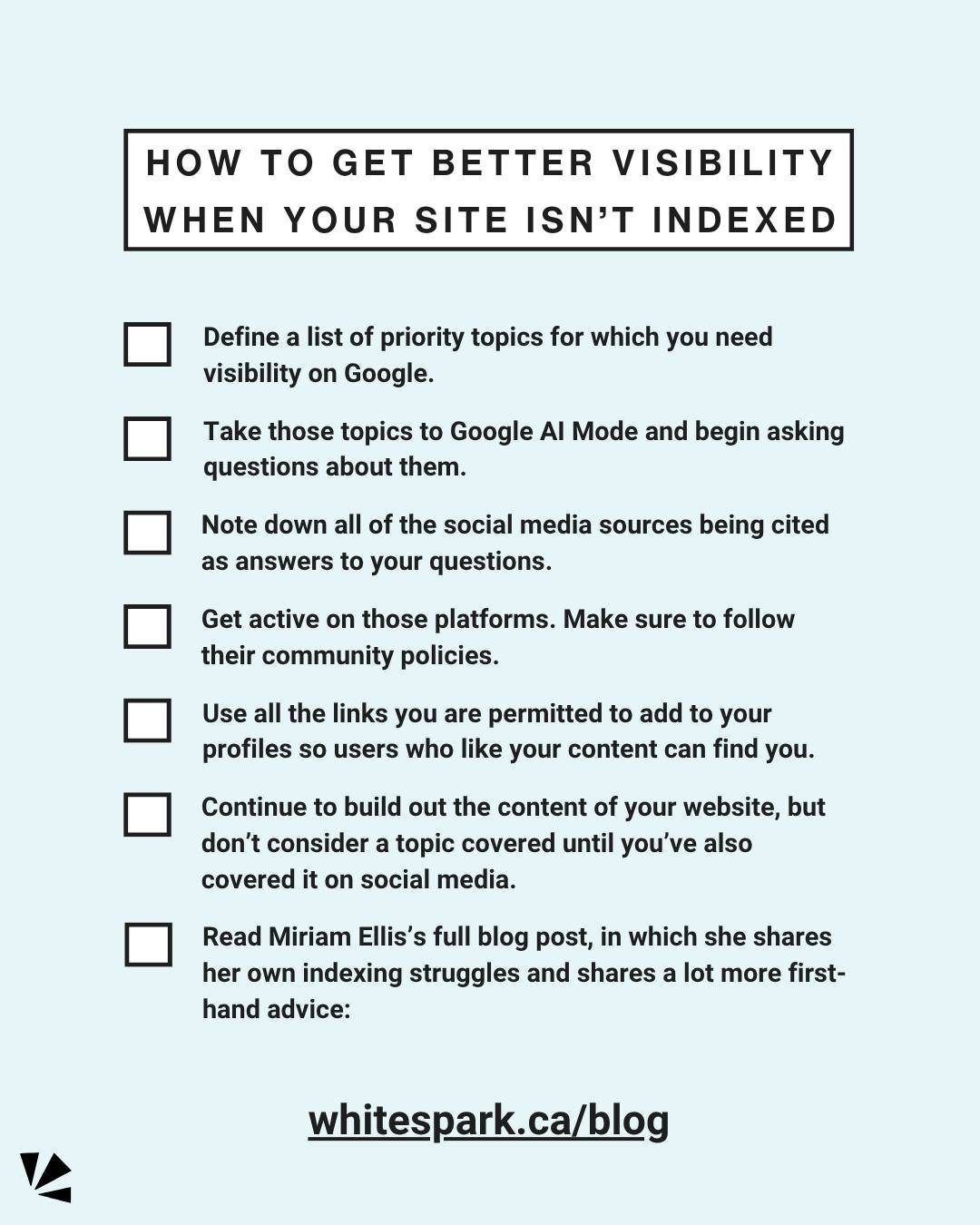
The first step in improving your website's visibility when it's not indexed is to define a list of priority topics. These are the subjects for which you need to gain visibility on Google. By clearly identifying these topics, you can focus your efforts and create targeted content that resonates with your audience. These topics should align with your business goals, your niche, and the information your target audience is seeking.
Using Google AI to Your Advantage
Once you have your list of priority topics, take them to Google AI and start asking questions. Google AI can provide valuable insights and answers that can be cited in your content. For example, if you run a plumbing business, you might ask, “Where can I get help when my wedding ring falls down the sink drain in Denver?” Google AI’s responses can guide your content strategy, helping you address common queries and concerns effectively.
Leveraging Social Media
Social media platforms are increasingly cited as sources of information in AI responses. Note down all the social media sources mentioned in your AI queries and get active on those platforms. It’s crucial to follow their community policies to avoid penalties and ensure your content is well-received. For instance, platforms like Reddit have strict rules about self-promotion, so consider hosting an “Ask Me Anything” (AMA) session instead of posting blatant ads.
Building a Strong Social Media Presence
Make the most of the links you are allowed to include in your social media profiles. These links can direct users who appreciate your content back to your website. Ensure your profiles are optimized with relevant keywords and a clear call-to-action. Engaging with your audience on social media can also build trust and loyalty, making it more likely that users will visit your website and engage with your content.
Content Strategy Across Platforms
Continuously build out the content on your website, but don’t stop there. Ensure that every topic you cover on your website is also addressed on your social media platforms. This cross-platform approach helps reinforce your message and increases your chances of being cited as a reliable source. Consistency in your content across platforms can also enhance your brand’s credibility and visibility.
Practical Tips
Engage with Your Audience
Engaging with your audience on social media is not just about posting content; it’s about building a community. Respond to comments, answer questions, and participate in discussions. This level of engagement can significantly boost your visibility and help you understand your audience better. It’s also an excellent way to gather user-generated content and testimonials, which can be repurposed on your website.
Optimize for AI Search
AI tools are increasingly used for search, and optimizing your content for AI can give you an edge. Use natural language and answer common questions directly. Structured data and schema markup can also help AI tools understand your content better, making it more likely to be cited in search results.
Stay Informed
Stay up-to-date with the latest trends and algorithms in search and social media. Google and other search engines frequently update their algorithms, and staying informed can help you adapt your strategies accordingly. Follow industry blogs, join online forums, and attend webinars to stay ahead of the curve.
Monitor and Adjust
Regularly monitor your social media and website analytics to see what’s working and what’s not. Adjust your strategies based on these insights. For example, if a particular type of content is performing well on social media, create more of it and ensure it’s also present on your website. Use tools like Google Analytics and social media insights to track your performance and make data-driven decisions.
Build Relationships
Building relationships with other influencers and businesses in your niche can also enhance your visibility. Collaborate on content, cross-promote each other’s posts, and engage with each other’s audiences. These relationships can help you reach a broader audience and build a stronger online presence.
Use Visuals
Visual content is highly engaging and can attract more attention on social media. Use high-quality images, infographics, and videos to make your content more appealing. Visuals can also help break down complex information, making it easier for your audience to understand and remember.
Important Takeaways
Improving your website’s visibility when it’s not indexed by Google requires a strategic approach that leverages AI tools and social media. By defining your priority topics, using Google AI effectively, and building a strong presence on social media, you can stay visible and reach your target audience. Engage with your audience, optimize for AI search, and stay informed about the latest trends to maximize your visibility.
Conclusion
When Google refuses to index your website, it’s essential to adapt and find alternative ways to stay visible. By following the checklist provided and implementing the strategies outlined, you can enhance your online presence and reach your target audience effectively. Stay proactive, engage with your audience, and continuously adapt your strategies to stay ahead in the ever-evolving digital landscape.
Watch the Reel
Questions readers ask
Why might Google refuse to index my website?
Google may refuse to index your website for several reasons, including duplicate content, low-quality content, technical issues like robots.txt misconfigurations, or even manual penalties. It's crucial to identify and fix these issues to improve your chances of getting indexed, but in the meantime you can take other steps to stay visible online.
How can I leverage AI tools to improve my website's visibility?
AI tools can help generate content ideas tailored to your target audience, identify trending topics, and even create content outlines. By leveraging AI, you can enhance your content strategy, making it more engaging and relevant, which can boost your online presence even if your site is not indexed by Google.
What role does social media play in improving website visibility?
Social media platforms can significantly boost your website's visibility. By actively engaging with your audience, sharing your content, and participating in relevant discussions, you can drive traffic to your site and build a strong online presence. Additionally, social media signals can indirectly influence your website's search engine rankings.
What are some strategies to improve website visibility if Google won't index your site?
Focus on creating high-quality, engaging content around key topics to attract and retain visitors. Utilize social media platforms to share your content and interact with your audience. Leverage AI tools for content ideas and optimization. Consider other search engines like Bing, Yahoo, or DuckDuckGo, and optimize your site for them.
How can I identify key topics to prioritize for my content strategy?
To identify key topics, consider your target audience's interests, pain points, and frequently asked questions. Use AI tools and keyword research to find relevant, high-volume, low-competition topics. Analyze your competitors' content to identify gaps you can fill and ensure your topics are aligned with your website's niche.
Can I do anything to get my website indexed by Google if it's currently not indexed?
Review Google's guidelines and tools, such as the Google Search Console, to identify any issues that may be preventing indexing. Ensure your site has high-quality, unique content, a clean site structure, and proper use of meta tags. Regularly update your content and build quality backlinks. If necessary, seek professional help.
How can I improve my blog's visibility if it's not indexed by Google?
Focus on creating valuable, engaging content that resonates with your audience. Promote your blog posts on social media, relevant forums, and online communities. Participate in guest blogging to reach new audiences and build backlinks. Utilize AI for content ideas, optimization, and distribution, and consider other search engines and platforms to maximize your blog’s reach.
Recent articles
Fresh deep dives from the latest Reels we unpacked.




Comments
Be the first to comment.