Economic Forecasts: Understanding Global Interest Rates and Central Bank Policies
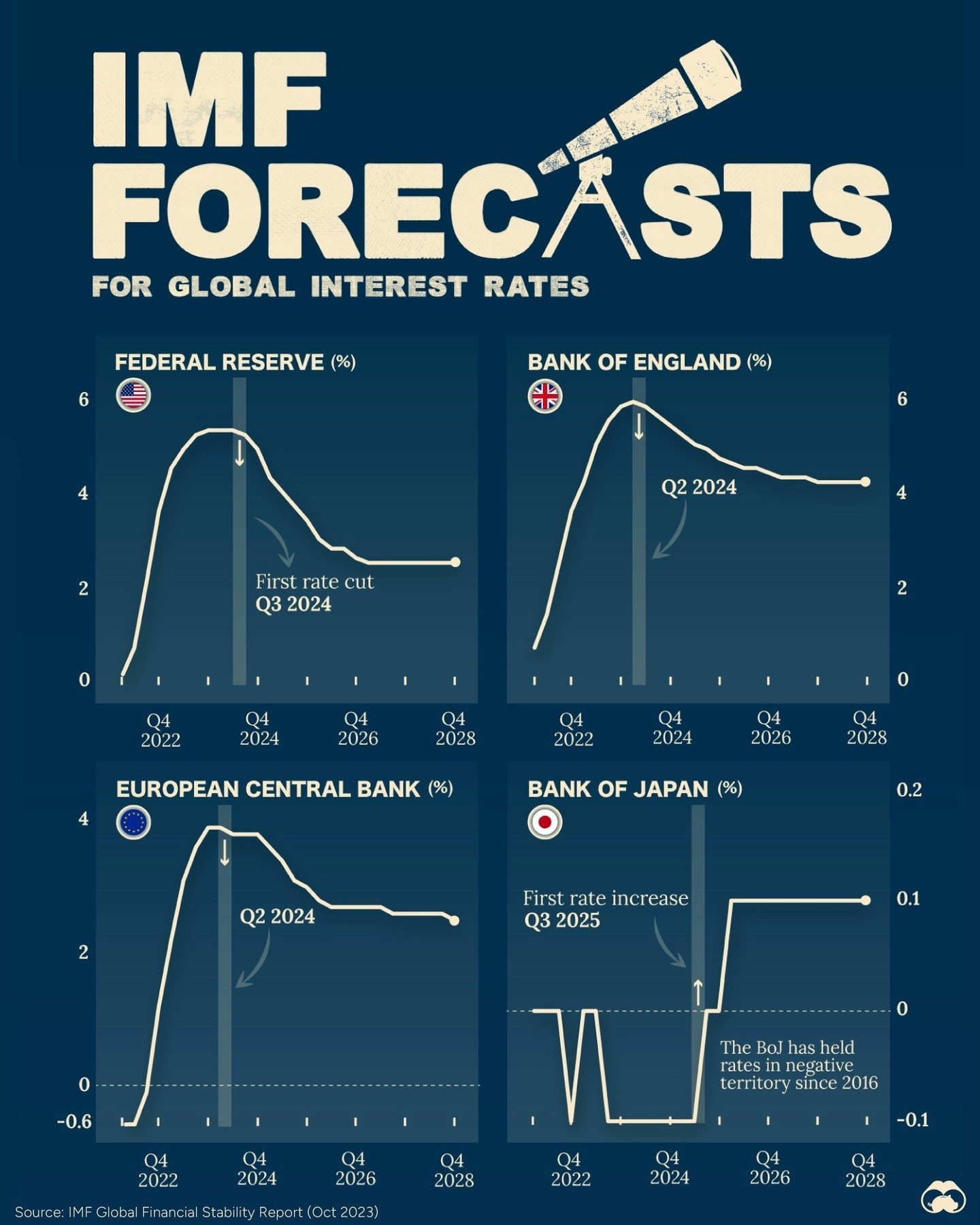
Inflation has significantly influenced markets and international interest rates for over a year. With the outlook on inflation remaining uncertain, global economic stability hinges on the actions of central banks. The International Monetary Fund (IMF) forecasts that most advanced economies will begin gradually easing interest rates by mid-2024. This article dives into the projected central bank policy rates for four major economies through 2028, using the World Economic Outlook forecast data as of October 2023.
Context: Why This Matters
Inflation and interest rates are interconnected economic indicators that can profoundly impact financial markets. Interest rates influence borrowing costs, investment decisions, and overall economic activity. As central banks navigate the complex landscape of inflation and economic growth, their policy decisions can either stimulate or stifle economic activity. Understanding the projected actions of the Federal Reserve, Bank of England, European Central Bank, and Bank of Japan provides valuable insights into the global economic outlook.
Main Discussion
The Economy's Current State
The IMF’s forecast data offers a detailed snapshot of the current economic environment. Inflation has been a persistent challenge, affecting market stability and economic growth. Central banks around the world have been grappling with how to manage inflation without stalling economic recovery. This balancing act involves adjusting interest rates to control inflation while fostering growth. The IMF’s projections reveal how different central banks plan to navigate this delicate task.
Projected Interest Rate Trends
Federal Reserve (United States)
The Federal Reserve, the central bank of the United States, is projected to make its first rate cut in Q3 2024. This move is anticipated as a response to the gradual easing of inflation and a need to spur economic growth. The Federal Reserve’s actions often set the tone for global markets, making its decisions highly influential. The projected rate movements for the Federal Reserve reflect a cautious approach, balancing the need to control inflation with the desire to support economic activity.
Bank of England
The Bank of England follows a similar trajectory, with projections indicating a rate cut in Q3 2024. Like the Federal Reserve, the Bank of England aims to manage inflation while promoting economic growth. The UK’s economic conditions are closely monitored, and the projected rate movements reflect the bank’s efforts to stabilize the economy. The Bank of England’s policies are crucial for the UK’s financial stability, and its rate decisions impact domestic and international markets.
European Central Bank
The European Central Bank (ECB) is also expected to ease interest rates by mid-2024. The ECB’s policy decisions affect the 19 countries that use the euro, making its actions pivotal for European economic stability. The projected rate movements for the ECB reflect a cautious approach, focusing on managing inflation while supporting economic recovery. The ECB’s policies are designed to ensure price stability and foster growth across the Eurozone.
Bank of Japan
The Bank of Japan (BoJ) presents a unique case, as it has held rates in negative territory since 2016. The BoJ’s projected rate increase in Q3 2025 indicates a shift in its long-term policy. This move reflects the BoJ’s efforts to stabilize the Japanese economy while addressing inflationary pressures. The BoJ’s policies are crucial for Japan’s economic health, and its rate decisions impact global financial markets. The projected rate movements for the BoJ highlight the bank’s focus on controlling inflation and supporting economic growth.
Practical Tips
Stay Informed
Keeping up with the latest economic forecasts and central bank policies is essential for investors, businesses, and individuals. Regularly reviewing reports from the IMF and other economic institutions can provide valuable insights into global economic trends. Understanding the projected interest rate movements can help in making informed financial decisions.
Diversify Your Portfolio
Diversifying your investment portfolio can mitigate risks associated with changes in interest rates. Spreading investments across different asset classes, geographies, and sectors can help protect against economic fluctuations and ensure stability in your financial portfolio.
Monitor Inflation Rates
Inflation rates are a critical economic indicator that can influence interest rates and economic policies. Monitoring inflation trends can provide clues about future central bank actions and their impact on the economy. Staying informed about inflation rates can help in making strategic financial decisions.
Important Takeaways
- Global Interest Rate Trends: The IMF projects that most advanced economies will begin easing interest rates by mid-2024. This move aims to manage inflation while fostering economic growth.
- Central Bank Policies: The Federal Reserve, Bank of England, and European Central Bank are expected to make significant rate adjustments in 2024, reflecting their efforts to stabilize their respective economies.
- Bank of Japan’s Shift: The BoJ’s projected rate increase in 2025 indicates a change in its long-term policy, focusing on controlling inflation and promoting growth.
- Economic Stability: Understanding the projected interest rate movements is crucial for investors, businesses, and individuals in making informed financial decisions.
- Staying Informed: Regularly reviewing economic forecasts and central bank policies can provide valuable insights into global economic trends and their impact on financial markets.
Conclusion
Inflation and interest rates remain pivotal factors in shaping global economic stability. The IMF’s projections offer a detailed outlook on central bank policies and their impact on the global economy. By understanding the projected interest rate movements for the Federal Reserve, Bank of England, European Central Bank, and Bank of Japan, investors and businesses can make informed decisions to navigate the complex economic landscape.
Watch the Reel
Questions readers ask
What is the expected timeline for interest rate cuts by major central banks?
According to the IMF, most advanced economies are expected to start gradually lowering their interest rates by mid-2024. This trend is projected to continue through 2028, with central banks like the Federal Reserve, the European Central Bank, the Bank of England, and the Bank of Japan adjusting their policies accordingly.
Which central banks does the IMF's 2024-2028 interest rate forecast cover?
The IMF's forecast includes projections for major central banks, namely the Federal Reserve in the United States, the European Central Bank, the Bank of England, and the Bank of Japan. These institutions are expected to play crucial roles in shaping global monetary policy over the coming years.
How does inflation influence the IMF's interest rate predictions?
Inflation is a key factor in the IMF's interest rate predictions. The uncertainty surrounding inflation has led the IMF to forecast a gradual easing of interest rates by mid-2024, as central banks aim to balance economic growth with stable prices. This approach is meant to contribute to global economic stability.
What can investors expect from the Federal Reserve's rate outlook through 2028?
Investors should anticipate a gradual reduction in interest rates by the Federal Reserve starting around mid-2024. This shift is expected to continue through 2028, with the Federal Reserve adjusting its policies in response to economic conditions and inflation trends, potentially impacting borrowing costs and investment returns.
What should we expect from the Bank of Japan's interest rate trends through 2028?
The IMF's forecast suggests that the Bank of Japan will also follow the trend of gradually lowering interest rates by mid-2024. This is in line with the broader projection for advanced economies, with the Bank of Japan continuing to adjust its monetary policy through 2028.
Recent articles
Fresh deep dives from the latest Reels we unpacked.




Comments
Be the first to comment.