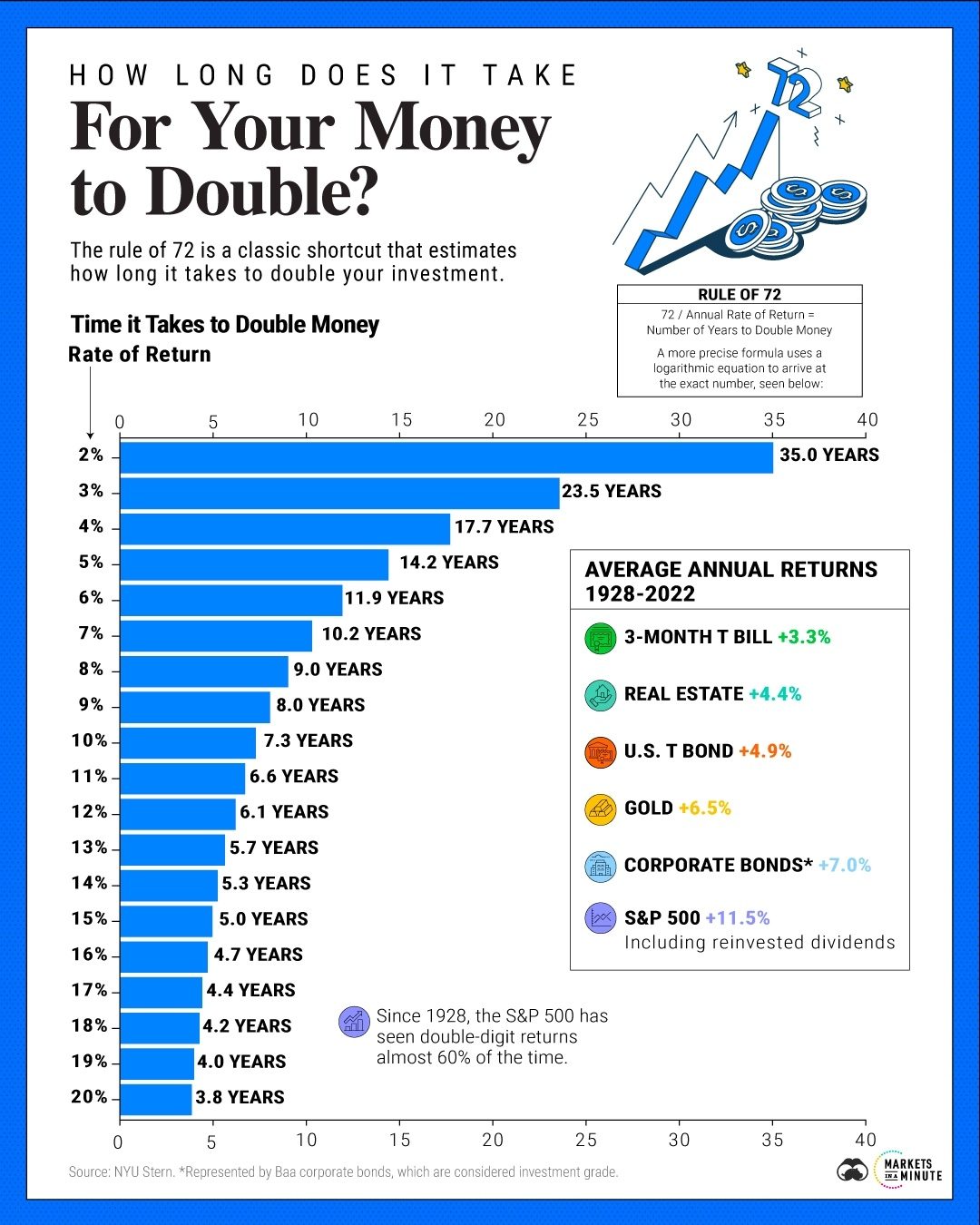
The Rule of 72
Investing can often feel like a complex world full of jargon and formulas, but understanding the basics can greatly enhance your financial decision-making. One such concept is the Rule of 72, a straightforward shortcut that helps estimate how long it will take for your investment to double.
Why This Matters
The Rule of 72 is a valuable tool for investors of all levels, from beginners to seasoned professionals. It provides a quick and easy way to evaluate the growth potential of different investment options, helping you make informed decisions about where to allocate your capital. By understanding this rule, you can better assess the impact of different rates of return on your investment goals.
Main Discussion
What is the Rule of 72?
The Rule of 72 is a simple formula that estimates the number of years required to double your money at a given annual rate of return. The formula is:
72 / Annual Rate of Return = Number of Years to Double Money
For example, if you have an investment with an annual return of 8%, it will take approximately 9 years for your money to double (72 / 8 = 9).
The Logarithmic Formula
While the Rule of 72 is a handy shortcut, it is not always precise. For a more accurate calculation, especially for higher interest rates, a logarithmic formula is used. This formula provides a closer estimate of the doubling time for your investment. The logarithmic formula is:
ln(2) / ln(1 + r) = Number of Years to Double Money
where r is the annual rate of return and ln represents the natural logarithm.
Practical Examples
Let's explore how the Rule of 72 and the logarithmic formula apply to different asset classes:
Real Estate
Real estate has historically offered a steady return on investment. With an average annual return of around 4.4%, it would take approximately 16.3 years for your investment to double (72 / 4.4 = 16.3).
U.S. T-Bonds
U.S. Treasury bonds are considered a low-risk investment. With an average annual return of about 4.9%, it would take roughly 14.7 years for your investment to double (72 / 4.9 = 14.7).
Gold
Gold has been a popular investment option for many years. With an average annual return of around 6.5%, it would take approximately 11.1 years for your investment to double (72 / 6.5 = 11.1).
Corporate Bonds
Corporate bonds, particularly BAA corporate bonds, which are considered investment-grade, offer a higher return compared to government bonds. With an average annual return of about 7%, it would take around 10.3 years for your investment to double (72 / 7 = 10.3).
S&P 500
The S&P 500 index, which includes stocks of 500 leading companies in the U.S., has historically seen robust returns. With an average annual return of about 11.5% (including reinvested dividends), it would take approximately 6.3 years for your investment to double (72 / 11.5 = 6.3).
Practical Tips
Choosing the Right Formula
For quick estimations, the Rule of 72 is incredibly useful. However, for more precise calculations, especially with higher rates of return, the logarithmic formula is recommended.
Analyzing Different Asset Classes
When considering where to invest, it's beneficial to compare the doubling times of different asset classes. For instance, while real estate offers steady growth, the S&P 500 may provide a quicker doubling time due to its higher average return.
Diversifying Your Portfolio
Understanding the Rule of 72 can also help in diversifying your portfolio. By allocating investments across assets with varying doubling times, you can balance risk and reward according to your financial goals.
Regularly Reviewing Your Investments
Investment returns can fluctuate over time. Regularly reviewing your portfolio and recalculating the doubling time using the Rule of 72 and the logarithmic formula can help you stay on track with your financial objectives.
Important Takeaways
The Rule of 72 is a Simple but Powerful Tool
The Rule of 72 provides a quick and easy way to estimate the doubling time of your investment, helping you make informed decisions. It's a valuable tool for both beginners and experienced investors.
The Logarithmic Formula Offers Precision
For more accurate estimates, especially at higher rates of return, the logarithmic formula is more precise. It can help you understand the exact doubling time for your investments.
Historical Returns Matter
Understanding the historical returns of different asset classes can help you make better investment decisions. For example, the S&P 500 has a higher average return compared to real estate, which can result in a shorter doubling time.
Diversification is Key
By comparing the doubling times of different asset classes, you can diversify your portfolio and balance risk and reward according to your financial goals.
Conclusion
The Rule of 72 is a straightforward and effective tool for estimating the time it takes for an investment to double. Whether you are a seasoned investor or just starting out, understanding this rule can help you make more informed decisions about where to allocate your capital. By combining the Rule of 72 with the more precise logarithmic formula, you can get a clearer picture of your investment's growth potential.
Watch the Reel
Questions readers ask
What is the Rule of 72 and how does it work?
The Rule of 72 is a simple calculation method that provides a quick estimate of how many years it will take for an investment to double, given a fixed annual interest rate. To use it, divide 72 by the annual interest rate. For example, if your investment has an interest rate of 6%, it will take approximately 12 years to double (72 / 6 = 12).
Can the Rule of 72 be used for investment options other than stocks?
Yes, the Rule of 72 can be applied to various investment options, including bonds, mutual funds, and even real estate. It is a versatile tool for comparing the growth potential of different assets, helping you make informed decisions about your investment choices.
What are the limitations of the Rule of 72?
While the Rule of 72 is a helpful shortcut, it has some limitations. It assumes a fixed interest rate and does not account for compounding frequency. Additionally, it is an estimation tool and may not provide precise results, especially for interest rates that are extremely high or low.
How can the Rule of 72 help in comparing investment options?
The Rule of 72 allows you to quickly compare different investment opportunities by estimating their doubling times. For instance, if you are considering two investments with interest rates of 8% and 10%, the Rule of 72 will tell you that the investment with the 8% rate will take 9 years to double, while the 10% rate will take 7.2 years, helping you make a more informed decision.
Why is the Rule of 72 particularly useful for beginners?
The Rule of 72 is particularly useful for beginners because it simplifies the process of understanding investment growth. It provides a straightforward way to grasp the impact of different interest rates on your investments, without requiring complex mathematical formulas or financial jargon.
Is the Rule of 72 applicable for investments with compounding interest?
The Rule of 72 is generally accurate for investments with compounding interest, but it does assume annual compounding. For investments that compound more frequently (e.g., monthly or quarterly), the actual doubling time may be slightly shorter. However, for a quick estimate, the Rule of 72 is still a valuable tool.
Recent articles
Fresh deep dives from the latest Reels we unpacked.




Comments
Be the first to comment.