Home Value vs. Gold Bars
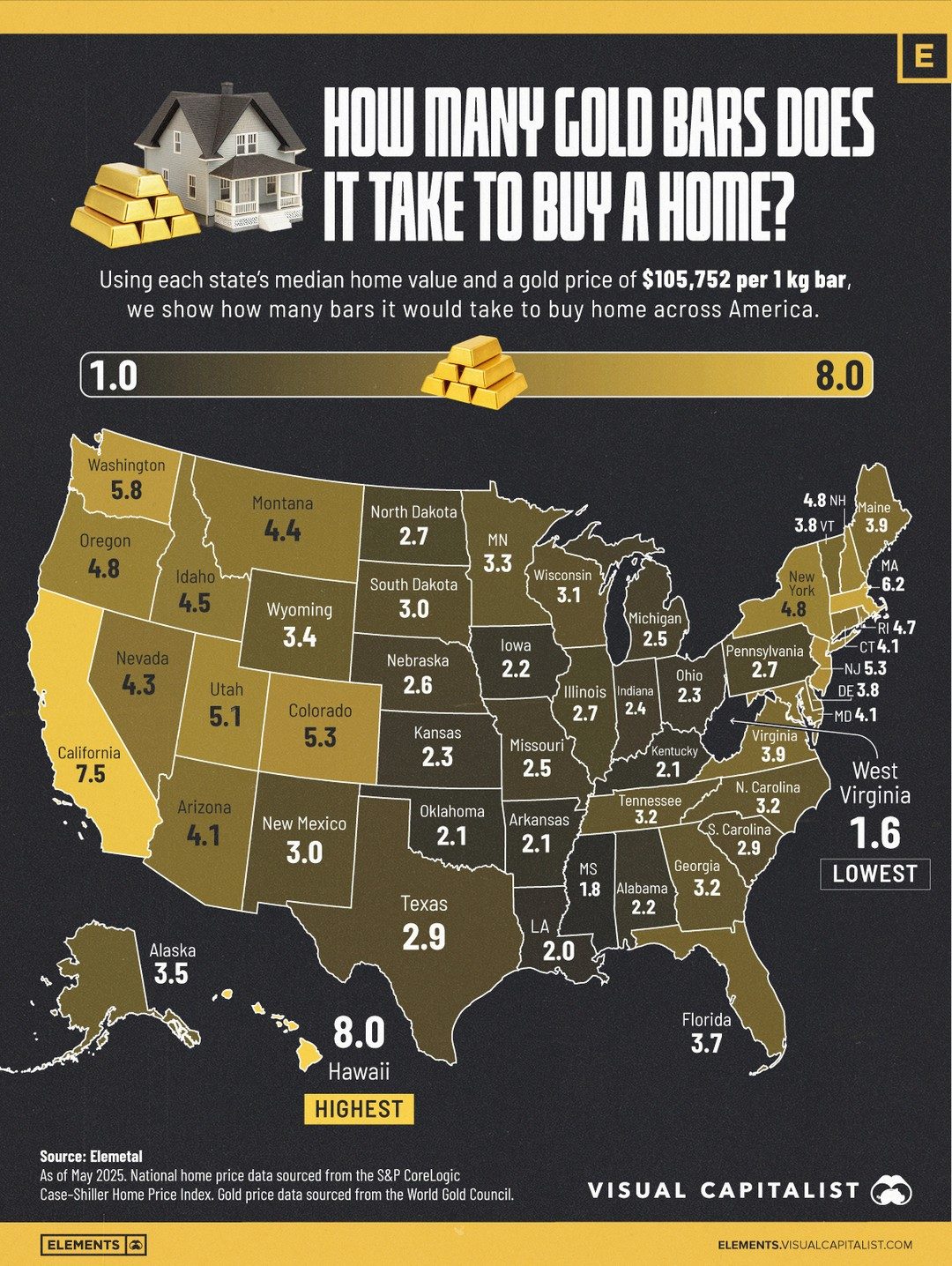
Exploring the value of a home in terms of gold bars provides a unique perspective on real estate prices. By using the median home value in each U.S. state and the price of a 1-kilogram gold bar, we can visualize just how many gold bars it takes to purchase a home in various regions. This approach offers a tangible way to understand the cost of housing, stripping away the abstract nature of currency and focusing instead on a valuable commodity. The data used for this comparison comes from Elemetal and Zillow, providing a reliable foundation for the analysis.
Why This Matters
In a world where financial markets can be volatile and currency values fluctuate, measuring home value in a stable commodity like gold can offer insights into the true cost of living in different regions. Gold, as a timeless and tangible asset, serves as a reliable benchmark for comparing the cost of real estate across the United States. This comparison helps reveal the relative affordability of housing in different states, as well as the potential impact of economic factors on real estate prices.
Main Discussion
Understanding the Data
The analysis leverages data from Elemetal and Zillow to determine the median home value in each U.S. state. The price of a 1-kilogram gold bar is set at $105,752, a significant figure that serves as the basis for calculating how many gold bars are needed to purchase a home. This calculation provides a straightforward way to assess the value of real estate in terms of gold, offering a clear and tangible perspective.
State-by-State Breakdown
- Hawaii: Requires the most gold bars (8.0) to buy a home, indicating that it is one of the most expensive states for real estate.
- West Virginia: Requires the fewest gold bars (1.6) to buy a home, making it one of the most affordable states in terms of housing costs.
- California: Needs 4.3 gold bars to buy a median-priced home, showing it is relatively expensive but more affordable than Hawaii.
- Texas: Requires 3.5 gold bars, indicating a moderate level of housing affordability compared to other states.
- New York: Requires 4.7 gold bars, reflecting the high cost of living in the state.
- Wyoming: Requires 4.4 gold bars, suggesting a relatively high cost of housing in this region.
The states are displayed on a map, each marked with a numerical value indicating the number of gold bars needed to purchase a home. This visual representation makes it easy to compare the cost of living across different regions, allowing for a quick assessment of housing affordability.
Factors Influencing Home Value
Several factors can influence the number of gold bars required to purchase a home in a given state. These factors include:
- Economic Conditions: The overall economic health of a state can impact housing prices. States with strong economies and job markets tend to have higher housing costs.
- Location and Desirability: Coastal and urban areas often have higher real estate prices due to their desirable locations and higher demand.
- Population Growth: States experiencing rapid population growth may see increased demand for housing, driving up prices.
- Local Regulations: Zoning laws, building restrictions, and other local regulations can affect the supply of housing and, consequently, the price.
Practical Tips
To gain a deeper understanding of the value of a home in terms of gold, consider the following tips:
- Research Local Real Estate Markets: Look into the median home values in different regions to get a sense of how many gold bars you might need.
- Monitor Gold Prices: Keep an eye on the price of gold to understand how fluctuations in the market may affect the value of real estate.
- Consider Economic Factors: Assess the economic conditions in a state, including job growth, population trends, and local regulations, to better understand housing affordability.
- Use Online Tools and Visuals: Utilize real estate websites and financial tools that offer data such as Zillow to get more specific and up-to-date information.
- Compare to Other Assets: Think about how the cost of housing in gold bars compares to other valuable assets, such as stocks or bonds, to get a broader perspective on wealth distribution.
Important Takeaways
Measuring the cost of buying a home in gold bars offers a unique and insightful way to understand housing affordability. Key takeaways from this analysis include:
- Gold Bars Provide a Tangible Measure: Using gold bars to measure home value gives a more concrete sense of what it takes to purchase a home, stripping away the abstract nature of currency.
- Historical Context: This method of comparison provides a historical perspective, as gold has been a valuable commodity for centuries.
- Regional Variations: The number of gold bars needed to buy a home varies significantly across different states, highlighting the vast differences in housing costs.
Conclusion
Evaluating home value in terms of gold bars offers a fresh perspective on real estate prices. By understanding the number of gold bars required to purchase a home in different states, we can gain valuable insights into housing affordability and the potential impact of economic factors on real estate prices. This method provides a tangible and historically relevant way to assess the true cost of living in various regions, making it a useful tool for anyone interested in understanding the housing market.
Watch the Reel
Questions readers ask
How is the number of gold bars needed to buy a home calculated?
The number of gold bars required to purchase a home is calculated by dividing the median home value in each state by the price of a 1-kilogram gold bar. This provides a tangible measure of home affordability using a stable commodity, gold.
Why is gold used to compare home values across different states?
Gold is used because it is a stable and valuable commodity that is not subject to the same fluctuations as currency. This provides a more consistent way to compare home values across different states, offering a clear perspective on the true cost of living.
Which states require the most gold bars to buy a home?
Typically, states with higher median home values, such as California, New York, or Hawaii, require more gold bars to purchase a home. These states often have higher costs of living and more expensive real estate markets.
How does the gold-to-home value ratio vary among different states?
The ratio varies significantly. In states with lower median home prices, like Mississippi or West Virginia, fewer gold bars are needed. Conversely, in states with higher median home prices, more gold bars are required, highlighting the disparity in housing affordability across the U.S.
What is the benefit of understanding home prices in terms of gold bars?
Understanding home prices in terms of gold bars offers a unique perspective by removing the variability of currency. It provides a more tangible and stable way to assess the true value of real estate, helping potential buyers and investors make more informed decisions.
How reliable is the data used in this analysis?
The data used in this analysis comes from trusted sources, including Elemetal for gold prices and Zillow for median home values. This ensures a reliable foundation for the comparison, making the results both accurate and insightful.
How can this information be useful for real estate investors?
For real estate investors, this information can provide a clearer picture of the true value of properties in different states. By understanding home prices in terms of gold, investors can make more informed decisions about where to allocate their resources, potentially leading to better investment outcomes.
Recent articles
Fresh deep dives from the latest Reels we unpacked.




Comments
Be the first to comment.