Interest Rate Easing Cycles and the USD
Understanding how interest rate easing cycles affect the U.S. dollar (USD) is crucial for anyone involved in forex trading, investment, or economic analysis. Historically, Federal Reserve rate cuts have exerted downward pressure on the USD. This article delves into the historical performance of the USD during past easing cycles and explores what these trends might mean for the future.
Why This Matters
Interest rate cycles significantly influence the value of the USD. By examining historical data, traders and investors can make more informed decisions. The Federal Reserve's monetary policy, particularly rate changes, is a key driver of currency movements. Analyzing past cycles helps in predicting future trends and preparing for potential market shifts.
Interest Rate Easing Cycles and USD Performance
Historical Data Analysis
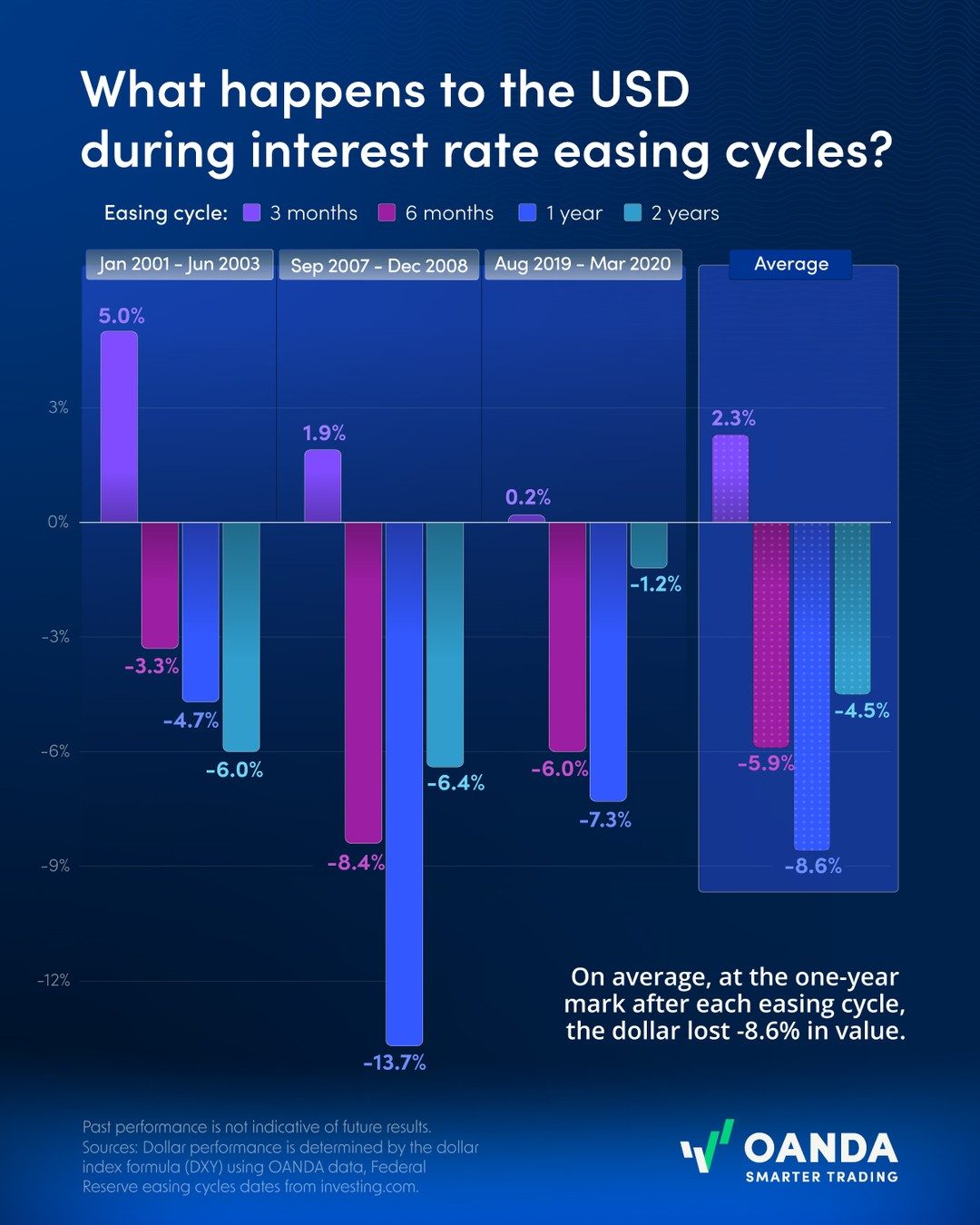
The period from 2001 to 2020 saw several notable easing cycles. These cycles are characterized by the Federal Reserve lowering interest rates to stimulate economic growth. The impact of these cycles on the USD can be broken down into key intervals: 3 months, 6 months, 1 year, and 2 years after the start of the cycle.
Key Easing Cycles
-
January 2001 – June 2003:
- 3 Months: The USD saw a 5.0% increase.
- 6 Months: The USD declined by -3.0%.
- 1 Year: The dollar decreased by -4.7%.
- 2 Years: The USD dropped by -6.0%.
-
September 2007 – December 2008:
- 3 Months: The USD increased by 3.0%.
- 6 Months: The USD remained stable at 0%.
- 1 Year: The dollar decreased by -3.0%.
- 2 Years: The USD declined by -6.4%.
-
August 2019 – March 2020:
- 3 Months: The USD saw a 1.9% increase.
- 6 Months: The USD increased by 0.2%.
- 1 Year: The dollar decreased by -4.5%.
- 2 Years: The USD dropped by -13.7%.
Average Performance
On average, across these cycles, the USD exhibited the following trends:
- 3 Months: A slight average increase of 2.3%.
- 6 Months: A minimal average decline of -1.2%.
- 1 Year: A more significant average decline of -8.6%.
- 2 Years: A substantial average decline of -8.6%.
The data indicates that the most notable impact on the USD occurs around the one-year mark after the start of an easing cycle, with an average loss of -8.6% in value.
Factors Influencing USD Performance
Several factors contribute to the USD's performance during easing cycles:
- Inflation Expectations: Lower interest rates can lead to higher inflation expectations, which may weaken the USD.
- Risk Appetite: Easing cycles often coincide with increased risk appetite, leading investors to move away from safe-haven assets like the USD.
- Global Economic Conditions: The performance of other major economies and their central bank policies also play a significant role in USD movements.
Practical Tips for Navigating Easing Cycles
Monitoring Economic Indicators
Keeping a close eye on key economic indicators is essential. These include:
- Inflation Rates: High inflation can erode the value of the USD.
- Employment Data: Strong employment figures can indicate a robust economy, which may support the USD.
- GDP Growth: Positive GDP growth can lead to a stronger USD.
Diversifying Your Portfolio
Diversification is crucial during easing cycles. Consider allocating funds to different asset classes, including:
- Commodities: Gold and other precious metals often perform well during periods of economic uncertainty.
- International Equities: Investing in foreign markets can provide a hedge against USD depreciation.
- Fixed Income: High-yield bonds can offer a stable return during volatile periods.
Staying Informed
Staying up-to-date with the latest economic news and policy changes from the Federal Reserve is essential. OANDA, a leading provider of FX data and analysis, offers valuable insights and tools that can help you navigate these cycles more effectively.
Important Takeaways
- Historical Trends: Over the past two decades, the USD has shown a consistent pattern of depreciation, particularly around the one-year mark after the start of an easing cycle.
- Economic Factors: Inflation, risk appetite, and global economic conditions significantly influence the USD's performance.
- Practical Steps: Monitoring economic indicators, diversifying your portfolio, and staying informed can help you make better investment decisions during easing cycles.
Conclusion
The impact of interest rate easing cycles on the USD is a critical area of study for anyone involved in forex trading, investment, or economic analysis. By examining historical data and understanding the key factors that influence USD performance, traders and investors can better prepare for future market movements. Keeping an eye on economic indicators, diversifying portfolios, and staying informed with resources like OANDA can provide a strategic edge in navigating these cycles.
Watch the Reel
Questions readers ask
What typically happens to the USD when the Federal Reserve cuts interest rates?
The USD typically experiences downward pressure. When the Federal Reserve cuts interest rates, investors find other currencies potentially more attractive due to higher yields, leading to a decline in the USD's value.
How does the USD behave during long-term interest rate easing cycles?
During extended interest rate easing cycles, the USD often shows a sustained depreciation trend. This is due to prolonged lower yields making the USD less appealing to investors seeking higher returns in other currencies.
What historical trends show the impact of Fed rate cuts on the USD?
Historical data indicates that the USD usually declines in value following Federal Reserve rate cuts. This trend is evident in various periods, including the early 2000s and the aftermath of the 2008 financial crisis.
Why is it important for traders to understand the relationship between rate cuts and the USD?
Understanding this relationship helps traders anticipate market movements and adjust their strategies accordingly. By analyzing historical trends, traders can make informed decisions about when to buy or sell the USD.
How do interest rate cycles influence the value of the USD?
Interest rate cycles significantly impact the USD's value. Lower interest rates make the USD less attractive to foreign investors, leading to a decrease in demand and a subsequent drop in the USD's value. Conversely, higher interest rates can strengthen the USD.
What are the long-term effects of rate cuts on the dollar's valuation?
Long-term effects of rate cuts on the dollar's valuation include sustained depreciation and potential loss of investor confidence. The USD may remain weak for extended periods, making it vulnerable to further declines if other economic indicators are unfavorable.
How can investors prepare for potential changes in the USD value after a Federal Reserve rate cut?
Investors should closely monitor economic indicators and Federal Reserve communications. Staying informed about upcoming rate changes and their potential impact can help investors mitigate risks and capitalize on opportunities in the forex market.
Recent articles
Fresh deep dives from the latest Reels we unpacked.




Comments
Be the first to comment.