Understanding the Perimeter of Composite Geometric Shapes
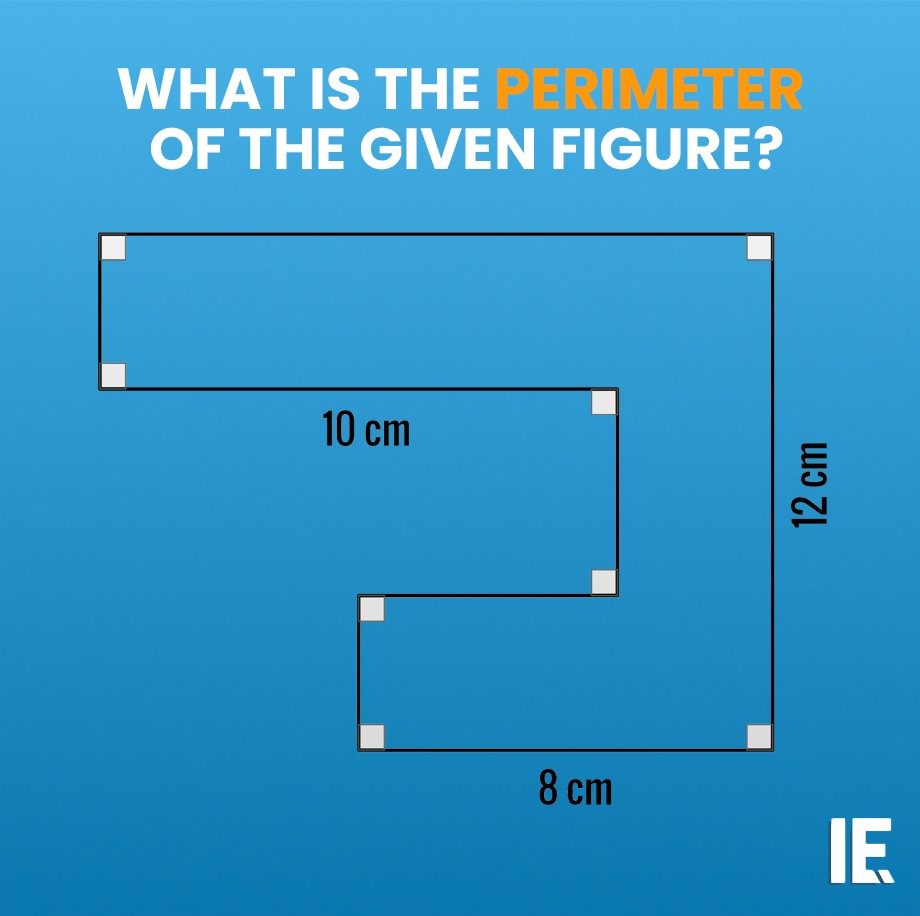
Perimeter calculations are fundamental in geometry, but things can get tricky when dealing with composite shapes. Let's break down how to determine the perimeter of a specific composite figure with given dimensions: 10 cm, 12 cm, and 8 cm, resembling a staircase or L-shape.
Why This Matters
Understanding how to calculate the perimeter of composite shapes is crucial for various fields, including architecture, engineering, and design. Accurately determining the perimeter helps in estimating material requirements, understanding spatial relationships, and making informed decisions in practical applications.
Main Discussion
Identifying the Composite Shape
The given figure is a composite shape that resembles a staircase or an L-shape. This type of figure consists of multiple straight lines connected at different angles. The dimensions provided are 10 cm, 12 cm, and 8 cm. To find the perimeter, we need to sum the lengths of all the sides that form the outer boundary of the shape.
Breaking Down the Dimensions
Let's break down the dimensions and their placement within the figure:
- 10 cm: This could represent the length of one of the vertical or horizontal sides.
- 12 cm: This could be the length of another vertical or horizontal side.
- 8 cm: This could be the length of the remaining vertical or horizontal side.
Calculating the Perimeter
To calculate the perimeter, we need to sum the lengths of all the outer sides. Since the figure is a composite shape, we need to consider all the individual sides that form the boundary.
- Identify all sides: Determine the lengths of each side that forms the outer boundary. For an L-shaped figure, there are typically four sides.
- Sum the lengths: Add the lengths of all these sides to get the total perimeter.
Given the dimensions 10 cm, 12 cm, and 8 cm, we need to visualize how these lengths fit into the L-shape. Assuming the L-shape has the following configuration:
- Two vertical sides of 10 cm and 8 cm.
- Two horizontal sides of 12 cm and the remaining part of the L-shape (which could be the difference between the horizontal sides).
The perimeter calculation would be:
Perimeter = 10 cm + 12 cm + 8 cm + (remaining length)
To find the remaining length, we need to consider the configuration of the L-shape. If the 12 cm side is the longer horizontal side and the 8 cm side is the shorter vertical side, the remaining length would be the difference between the horizontal sides, which is 12 cm - 8 cm = 4 cm.
Therefore, the perimeter calculation would be:
Perimeter = 10 cm + 12 cm + 8 cm + 4 cm = 34 cm
Verifying the Calculation
To ensure accuracy, it's essential to double-check the configuration and the lengths of each side. The perimeter of an L-shape should always be the sum of all the outer sides, and the given configuration should match the dimensions provided.
Practical Tips
- Visualize the Shape: Before performing any calculations, visualize the composite shape. Sketch it out if necessary to understand how the dimensions fit together.
- Identify All Sides: Ensure you account for all sides that form the outer boundary of the shape. Missing a side can lead to incorrect calculations.
- Sum the Lengths: Add the lengths of all identified sides to get the total perimeter. Double-check your calculations to avoid errors.
Important Takeaways
- Composite Shapes: Understanding composite shapes and their configurations is crucial for accurate perimeter calculations.
- Dimensions: Carefully consider the placement and lengths of each dimension in the shape.
- Summing Sides: The perimeter is the sum of all the outer sides. Ensure you account for all sides in your calculations.
Conclusion
Calculating the perimeter of a composite geometric shape can be straightforward if you carefully consider the dimensions and the configuration of the shape. By visualizing the shape, identifying all sides, and summing their lengths, you can accurately determine the perimeter. This knowledge is valuable in various fields, including architecture, engineering, and design, where precision is key.
Watch the Reel
Questions readers ask
What is the perimeter of a composite shape?
The perimeter of a composite shape is the total length of all the outer sides of the shape. It is calculated by summing the lengths of these sides, regardless of the shape's complexity.
How do I calculate the perimeter of an L-shaped figure?
To calculate the perimeter of an L-shaped figure, measure the lengths of all the outer sides. Add these lengths together. For example, if an L-shape has sides of 10 cm, 12 cm, and 8 cm, the perimeter would be 10 + 12 + 8 = 30 cm.
What are the steps to calculate the perimeter of a staircase shape?
To calculate the perimeter of a staircase shape, first identify all the outer sides. Measure each side and sum their lengths. This includes the vertical and horizontal sides that form the steps and any additional sides that enclose the shape.
Why is it important to calculate the perimeter of composite shapes accurately?
Accurately calculating the perimeter of composite shapes is crucial for precise measurements in various fields. This helps in estimating material needs, designing layouts, and making informed decisions in architecture, engineering, and design.
How does knowing the perimeter of a composite shape help in design?
Knowing the perimeter of a composite shape helps in understanding the spatial relationships and dimensions of the shape. This knowledge is essential for making precise design decisions, such as fitting components together or determining the amount of material needed for a project.
Can the perimeter of a composite shape change if the shape is rearranged?
Yes, the perimeter of a composite shape can change if the shape is rearranged. The perimeter is dependent on the specific configuration and lengths of the outer sides. Any alteration in these dimensions or the arrangement of the sides will result in a different perimeter.
Related deep dives
Similar reads based on topic and creator.


Recent articles
Fresh deep dives from the latest Reels we unpacked.




Comments
Be the first to comment.