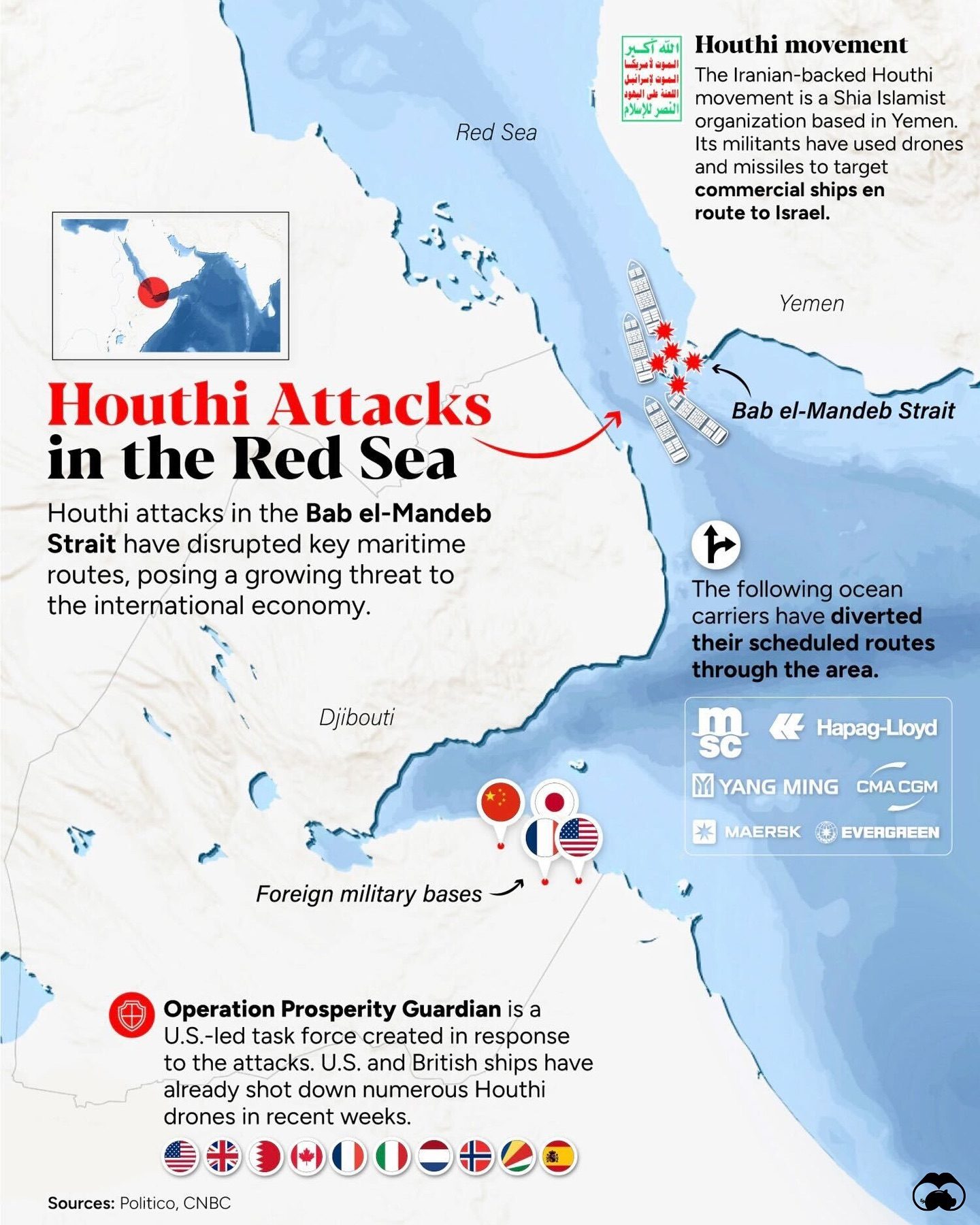
Houthi Attacks in the Red Sea and Impact on Maritime Trade
Introduction
Houthi militants in Yemen have significantly disrupted maritime trade in the Red Sea. Since October 7th, their attacks have targeted commercial cargo ships, forcing shipping companies to reroute away from the Red Sea. This has restricted access to the Suez Canal, a critical waterway for global maritime trade.
Why This Matters
The Red Sea, in particular the Bab el-Mandeb Strait, is a vital artery for global trade. Almost 12% of global maritime traffic passes through the Suez Canal, making it a linchpin in the supply chain for goods and resources. The attacks have not only disrupted trade routes but also posed a growing threat to international economies.
Understanding the Impact
Disrupted Trade Routes
The Bab el-Mandeb Strait, connecting the Red Sea to the Gulf of Aden and the Indian Ocean, is a strategic choke point for maritime trade. Houthi attacks have forced several major shipping companies, including Hapag-Lloyd, YANG MING, CMA CGM, and MAERSK, to divert their routes. This rerouting has significant implications for shipping costs, delivery times, and operational logistics.
Economic Threats
The rerouting of ships has increased fuel consumption and operational costs. Companies are forced to take longer routes around the Cape of Good Hope, adding significant time and expense to their journeys. Economies reliant on timely shipping, such as those in Europe and Asia, are facing supply chain disruptions, potentially leading to shortages and price increases.
Security Measures
In response to the escalating threat, the U.S. has initiated Operation Prosperity Guardian, a task force dedicated to protecting maritime routes and countering Houthi attacks. The operation involves U.S. and British military assets, including ships that have successfully shot down numerous Houthi drones. This intervention aims to secure the Red Sea, ensuring safer passage for commercial vessels.
Geopolitical Implications
The Houthi attacks have broader geopolitical implications. Djibouti and other countries bordering the Red Sea are crucial for foreign military bases, supporting operations in the region. The conflict in Yemen, and the resulting disruption to maritime trade, could exacerbate tensions in an already volatile region, potentially drawing in other global powers.
The Strategic Importance of the Red Sea
The Red Sea is essential for trade between the Middle East, Europe, and Asia. It serves as a gateway for shipping goods, including oil, natural gas, and manufactured products. The disruption to this route can have far-reaching economic consequences, affecting industries and consumers globally.
Critical Infrastructure and Foreign Military Bases
The Bab el-Mandeb Strait is a bottleneck for global trade and a crucial strategic location. The presence of foreign military bases in Djibouti underscores the region's strategic importance. These bases are critical for maintaining stability and ensuring the security of maritime routes. The ongoing conflict in Yemen and the Houthi attacks add layers of complexity, requiring international cooperation to safeguard this critical route.
Global Implications
The disruption to maritime trade has broader implications for global supply chains. The rerouting of vessels through the Cape of Good Hope increases travel time and fuel consumption, resulting in higher transportation costs. These costs can be passed on to consumers, leading to price increases for a wide range of goods.
Practical Tips and Precautions for the Shipping Industry
In light of these challenges, the shipping industry must take proactive measures to minimize disruptions. Here are some practical tips:
Stay Informed
- Real-Time Updates: Keep abreast of the latest developments and security advisories. Utilize resources like Politico and CNCB for real-time updates on the situation in the Red Sea and Yemen.
Adopt Flexible Routing Strategies
- Diversified Routes: Plan for multiple alternative routes to avoid congested or dangerous areas. Diversification can help mitigate risks and ensure that goods reach their destinations on time.
- Risk Assessment: Conduct regular risk assessments to identify potential threats and vulnerabilities in current shipping routes.
Strengthen Security Measures
- Onboard Security: Enhance onboard security measures, including increased surveillance and the deployment of security personnel.
- Collaboration: Engage with international maritime security initiatives, such as Operation Prosperity Guardian, to leverage collective resources and expertise.
Important Takeaways
The Houthi attacks in the Red Sea are a growing concern for the global maritime industry. The disruption of key trade routes can have far-reaching economic and geopolitical implications. Companies must stay informed, adopt flexible routing strategies, and strengthen security measures to navigate these challenges effectively. Collaboration with international initiatives, such as Operation Prosperity Guardian, can help mitigate risks and ensure the safety of maritime trade.
Conclusion
The Houthi attacks in the Red Sea present a significant challenge to global maritime trade. By disrupting critical routes, the attacks have forced shipping companies to reroute through longer, more expensive paths. The formation of Operation Prosperity Guardian and the coordinated efforts of international allies are crucial steps in securing these vital trade routes. Companies that navigate these challenges with informed strategies and enhanced security measures will be better positioned to weather the storm and maintain their supply chains. The situation underscores the need for ongoing vigilance, flexibility, and global cooperation to ensure the continued flow of goods and resources that underpin the world's economy.
Watch the Reel
Questions readers ask
What are the primary targets of the Houthi attacks in the Red Sea?
The primary targets of the Houthi attacks in the Red Sea are commercial cargo ships. These attacks have forced major shipping companies to reroute their vessels away from the Red Sea, particularly around the Bab el-Mandeb Strait, to avoid potential threats, leading to significant disruptions in global maritime trade.
How have the Houthi attacks affected global maritime trade?
The Houthi attacks have led to increased costs and delivery delays for shipping companies, as they are forced to use longer, alternative routes to circumvent the Red Sea. This has posed economic threats to countries that rely heavily on the Suez Canal for timely shipping, impacting the global supply chain.
What is the significance of the Bab el-Mandeb Strait in global trade?
The Bab el-Mandeb Strait is a critical waterway for global trade, connecting the Red Sea to the Gulf of Aden and the Arabian Sea. Nearly 12% of global maritime traffic passes through this strait, making it a vital link in the supply chain for goods and resources, particularly for trade between Europe and Asia.
Why are shipping companies rerouting around the Red Sea?
Shipping companies are rerouting around the Red Sea due to the ongoing Houthi attacks, which have targeted commercial cargo ships. This rerouting is necessary to ensure the safety of vessels and crews, as the attacks have made the Red Sea a high-risk area for maritime trade. By avoiding the Red Sea, companies can minimize the risk of damage, delays, and potential loss of life.
What are the economic implications of the Houthi attacks for countries reliant on the Suez Canal?
For countries reliant on the Suez Canal for timely shipping, the Houthi attacks present significant economic challenges. The disruptions in maritime trade can lead to increased costs, delays in the delivery of goods, and potential shortages of critical resources. This can negatively impact various industries, including manufacturing, retail, and logistics, as well as affect the overall economic stability of these countries.
What measures are being taken to mitigate the impact of the Houthi attacks on shipping routes?
Shipping companies are implementing various measures to mitigate the impact of the Houthi attacks, including rerouting vessels around the Red Sea, increasing security measures, and collaborating with international maritime authorities. Additionally, some countries and organizations are working to address the conflict in Yemen, which is the root cause of the Houthi attacks, in an effort to restore stability and security to the region.
Recent articles
Fresh deep dives from the latest Reels we unpacked.




Comments
Be the first to comment.