Remittance Costs Around the World
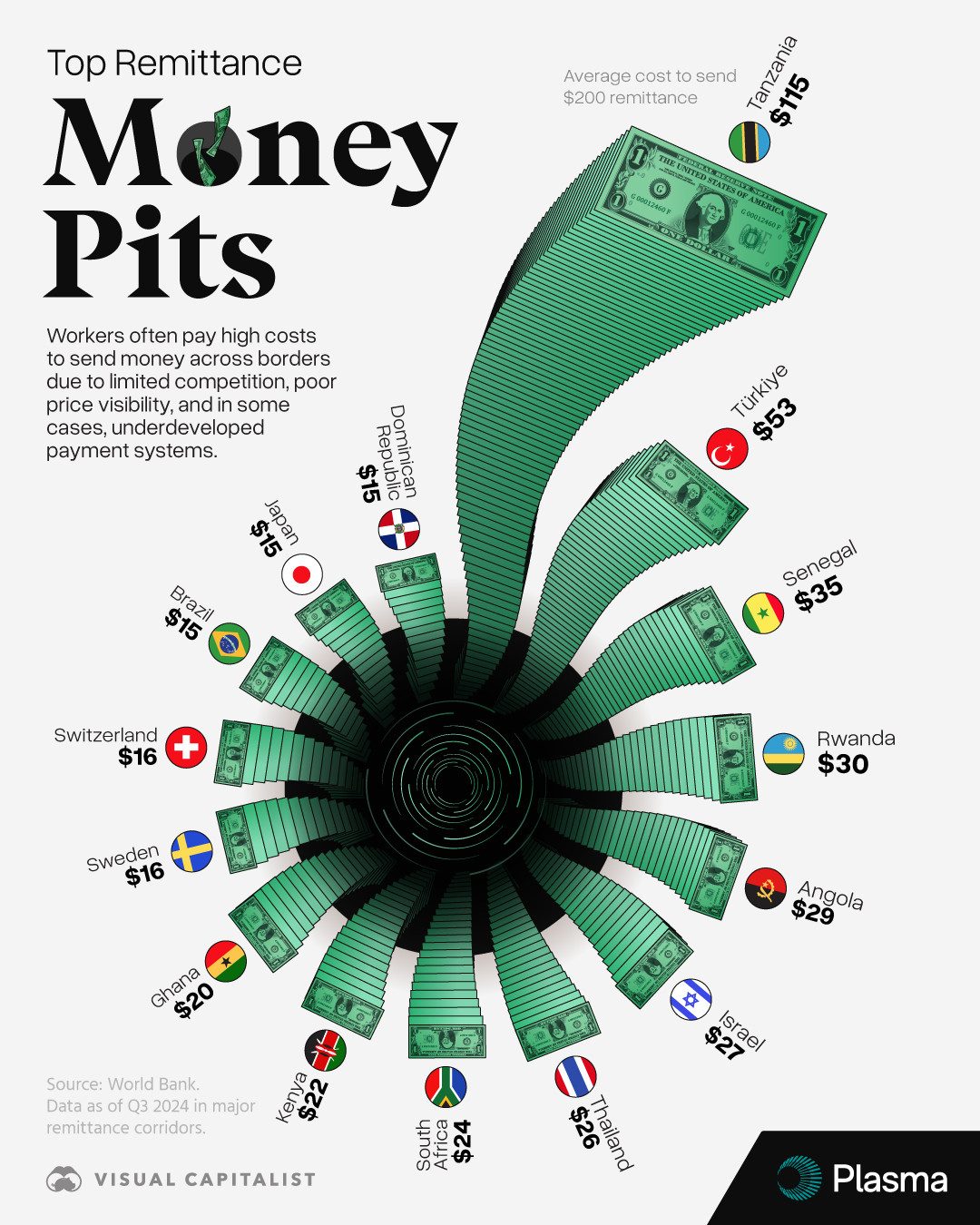
Remittances are a critical lifeline for many families around the world, providing essential financial support and helping to lift people out of poverty. However, the cost of sending remittances can vary significantly from one country to another, impacting the amount of money that actually reaches the intended recipients. This article explores the costs associated with sending $200 in remittances to various countries, highlighting the reasons behind these costs and how innovative solutions like stablecoins might offer relief.
Why This Matters
Understanding the costs of remittances is crucial for both senders and recipients. High remittance costs can significantly reduce the amount of money that reaches the intended recipients, often those in dire need. By delving into the factors that contribute to these costs, we can identify potential solutions to make the remittance process more efficient and cost-effective.
Main Discussion
The Global Landscape of Remittance Costs
The cost of sending remittances varies widely across different countries, with some nations facing disproportionately high fees. For instance, sending $200 to a family in Tanzania incurs a staggering $115 in fees, making it one of the most expensive countries for remittances. Other countries, such as Türkiye, fare better with remittance fees of only $53 for the same amount.
Key Factors Driving High Remittance Costs
Several factors contribute to the high costs of remittances. Limited competition among financial service providers, poor price visibility, and underdeveloped payment systems are major culprits. These issues often result in higher overhead costs, which are then passed on to the consumers. In countries where financial regulations are stringent or the market is dominated by a few players, the costs can be particularly steep.
Regional Variations
Africa
Africa is home to some of the highest remittance costs. For example, in Tanzania and Senegal, the fees for sending $200 are $115 and $35, respectively. These high costs can be attributed to the region's underdeveloped financial infrastructure and limited competition in the remittance market.
Asia
In Asia, the situation is mixed. Countries like Japan and Brazil have relatively low fees, with costs around $15 for a $200 remittance. However, other countries such as Thailand and Kenya have higher costs, with fees of $27 and $24, respectively. The variation in costs within the region highlights the diverse financial landscapes and regulatory environments.
Europe
In Europe, the remittance costs are generally lower compared to Africa and some parts of Asia. For example, Switzerland, Sweden, and Italy have fees of around $16-$22 for a $200 remittance. These lower costs can be attributed to more developed financial systems and higher competition among remittance service providers.
The Role of Stablecoins
Stablecoins, a type of cryptocurrency designed to minimize price volatility, offer a promising solution to high remittance costs. By using stablecoins, individuals can transfer funds more efficiently and at lower costs. Stablecoins eliminate the need for intermediaries, reducing transaction fees and increasing speed. This can be particularly beneficial in countries with underdeveloped financial systems.
Practical Tips
To minimize the cost of remittances, consider the following practical tips:
-
Compare Providers: Research and compare different remittance service providers to find the one offering the lowest fees and best exchange rates.
-
Use Stablecoins: Explore the use of stablecoins for cross-border transfers. Platforms like Plasma offer secure and cost-effective solutions for remittances.
-
Check for Promotions: Many remittance services offer promotions or discounts for new users. Keep an eye out for these to save on fees.
-
Leverage Technology: Utilize mobile apps and digital platforms that offer lower fees and more transparent pricing.
-
Plan Transactions: Plan your transactions to avoid unnecessary fees. For example, sending larger sums less frequently can sometimes reduce overall costs.
Important Takeaways
-
Global Disparities: The cost of remittances varies significantly across different countries, with some facing exorbitant fees.
-
Key Drivers: Limited competition, poor price visibility, and underdeveloped payment systems are key factors contributing to high remittance costs.
-
Regional Differences: Africa and some parts of Asia face higher remittance costs compared to more developed regions like Europe.
-
Innovative Solutions: Stablecoins offer a promising way to reduce remittance costs and improve efficiency.
Conclusion
Understanding the costs and drivers of remittances is essential for optimizing the process and ensuring that more money reaches the intended recipients. Whether through traditional methods or innovative solutions like stablecoins, there are ways to mitigate the financial burden of remittances. By leveraging technology, comparing providers, and being mindful of transaction costs, individuals can ensure that their hard-earned money goes further.
Watch the Reel
Questions readers ask
What are remittance fees and why do they vary by country?
Remittance fees are the charges associated with sending money internationally. They vary by country due to factors like local regulations, competition among money transfer services, and the infrastructure of the financial system. For instance, sending $200 to Tanzania incurs high fees due to the local banking infrastructure and regulatory environment.
How much can I expect to pay to send $200 abroad?
The cost to send $200 abroad can range significantly. In some countries, like Tanzania, fees can exceed $115. In contrast, other countries may have much lower fees, sometimes as low as $5.
What is the cheapest way to send money abroad?
The cheapest way to send money abroad often involves using online money transfer services. These services typically offer more competitive rates than traditional banks. Additionally, using stablecoins can further reduce costs by eliminating currency exchange fees.
How do remittance fees impact the amount received?
High remittance fees can significantly reduce the amount of money that reaches the recipient. For example, if it costs $115 to send $200, the recipient will only receive $85. This is particularly impactful for families relying on these funds for essential needs.
What are stablecoins and how can they help with remittance costs?
Stablecoins are a type of cryptocurrency designed to minimize price volatility. They can help reduce remittance costs by eliminating currency exchange fees, which are often a significant portion of the total cost. However, it is crucial to ensure the recipient can easily convert stablecoins back into local currency.
Why is it important to compare money transfer costs?
Comparing money transfer costs is essential for maximizing the amount of money that reaches the recipient. By choosing a service with lower fees, senders can ensure that more of their money goes towards supporting their families and loved ones, particularly those in low-income situations.
What are some tips for minimizing remittance fees?
To minimize remittance fees, consider using online money transfer services and compare rates from different providers. Additionally, sending larger amounts less frequently can sometimes reduce the overall percentage of fees paid. Lastly, be aware of any hidden fees, such as exchange rate markups.
Recent articles
Fresh deep dives from the latest Reels we unpacked.




Comments
Be the first to comment.