Market Timing: The Cost of Trying to Predict the Best Days
Market timing, the strategy of buying when prices are low and selling when they are high, can seem straightforward in theory. However, the reality of market timing is far more complex. Investors often face significant challenges, such as selling too early and missing out on a potential rally or feeling uncertain about investing during market downturns. This analysis will delve into the challenges of market timing, using data from JP Morgan to illustrate the potential costs and benefits of staying invested.
The Risks of Market Timing
Timing the market effectively requires predicting both the best times to buy and the best times to sell. However, market volatility can make this extremely difficult. Investors may sell their assets too early, missing out on significant gains, or they may be too hesitant to invest during market declines, missing out on opportunities for growth.
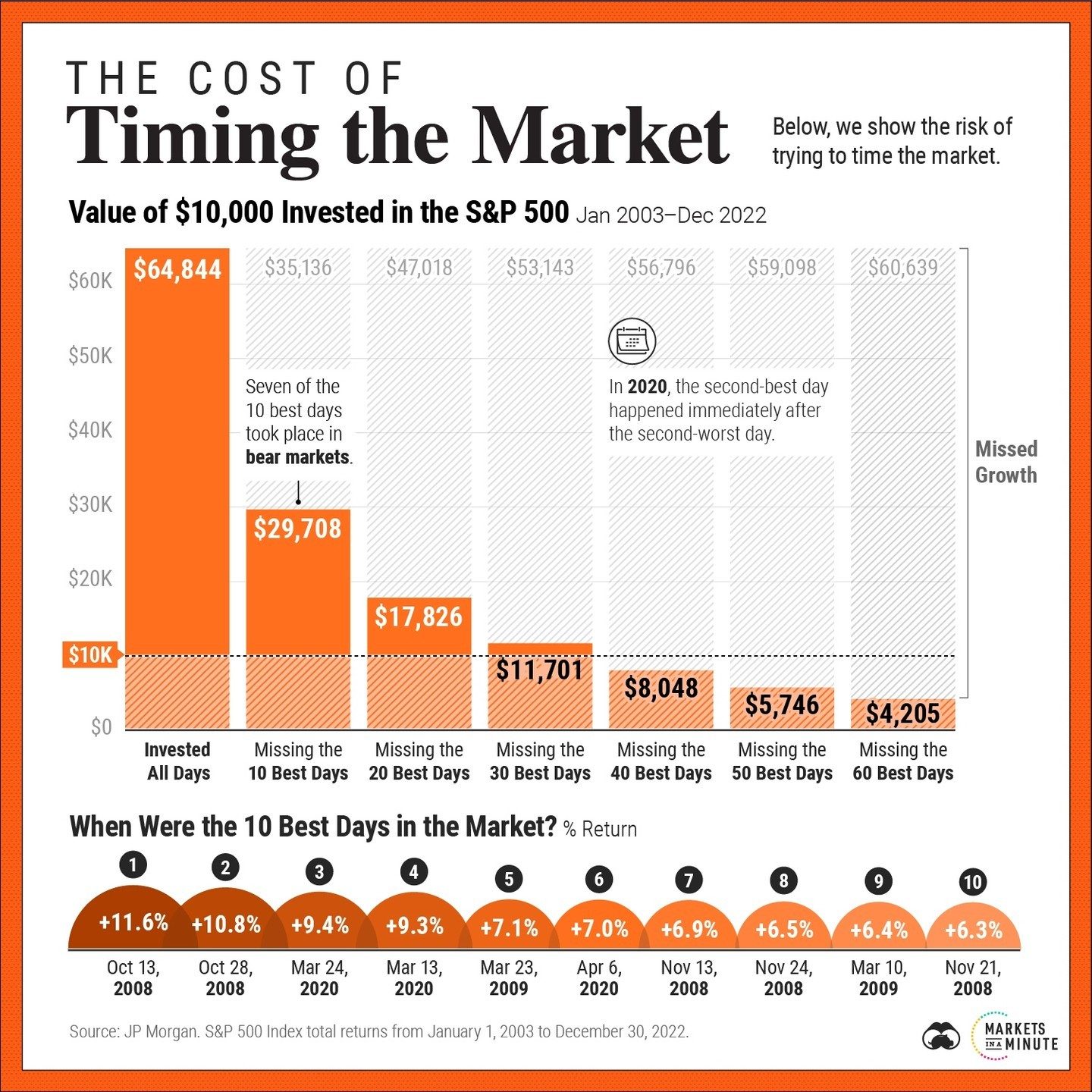
According to data from JP Morgan, missing out on just a few of the best market days can significantly impact the overall return on investment. For example, a $10,000 investment in the S&P 500 from January 2003 to December 2022 would have grown to $64,844. However, if an investor missed the ten best days during this period, the investment would only grow to $47,018. Missing just the 10 best days results in a loss of more than $17,000 in growth.
The Cost of Timing the Market
The potential loss from missing out on the best days becomes even more apparent when examining specific periods. For instance, between 2003 and 2022, seven of the ten best days in the S&P 500 occurred during bear markets. This highlights the importance of staying invested, even during market downturns, as some of the best opportunities for growth can occur during these periods.
The data also shows the dramatic impact of missing just a few key days. If an investor missed the 30 best days, the growth would drop to $29,708. Missing the 60 best days would result in a growth of $17,826, and missing the 90 best days would leave the investor with just $8,048 in growth. These figures underscore the significant potential losses from attempting to time the market.
Bear Markets and Market Timing
One of the most surprising findings from the JP Morgan data is that many of the best days in the market occur during bear markets. For example, in 2020, the second-best day for the market occurred just one day after the second-worst day. This volatility highlights the unpredictability of the market and the difficulty of timing investments accurately.
The unpredictability of bear markets makes it even more challenging for investors to time their investments effectively. Missing just a few days during a bear market can result in significant losses. Therefore, staying invested through market highs and lows can be a more effective strategy for long-term growth.
Key Market Days and Their Impact
The analysis identifies the specific dates of the ten best days in the market, highlighting the unpredictability of market timing. These days are:
- October 28, 2008: +11.6%
- March 2, 2008: +10.8%
- March 23, 2020: +9.4%
- April 6, 2020: +7.1%
- November 13, 2020: +7.0%
- November 24, 2009: +6.9%
- March 10, 2009: +6.5%
- November 21, 2008: +6.4%
- March 2, 2008: +6.3%
These percentages show that some of the best days in the market occurred during significant market events, such as the 2008 financial crisis and the 2020 COVID-19 market downturn. This underscores the importance of staying invested, even during times of uncertainty, as market recoveries can happen quickly and significantly.
The Importance of Long-Term Investment
While market timing can be tempting, the data shows that staying invested through both highs and lows is a more effective strategy for long-term growth. By remaining invested, investors can capture the best days in the market and avoid the potential losses from trying to time their investments.
Long-term investing allows for compounding returns, which can significantly increase the value of an investment over time. This strategy can help investors achieve their financial goals more effectively than trying to time the market.
Practical Tips
To make the most of long-term investing, consider the following tips:
- Diversify Your Portfolio: Diversification can help mitigate risks and increase the likelihood of capturing gains during market upswings.
- Regularly Invest: Automation helps maintain a consistent investment strategy, ensuring that you don't miss out on potential opportunities.
- Stay Informed: Keeping up with market trends can help you make informed decisions, but avoid acting on short-term fluctuations.
- Be Patient: Market timing often involves impulsive decisions, while long-term investing requires patience and a steady hand.
Important Takeaways
Market timing can be enticing, but the data from JP Morgan clearly shows that trying to time the market can result in significant losses. Missing just a few of the best days can dramatically reduce the growth of an investment. On the other hand, staying invested through both highs and lows can generate competitive returns, especially over longer periods. This highlights the importance of a long-term investment strategy that focuses on consistency and diversification.
Conclusion
The challenges of market timing are evident, and the potential costs of trying to predict the best days to buy and sell can be significant. By staying invested through market volatility and focusing on a long-term strategy, investors can improve their chances of achieving competitive returns. The data from JP Morgan underscores the importance of this approach, showing that some of the best days in the market occur during bear markets and that missing just a few of these days can significantly impact investment growth.
Watch the Reel
Questions readers ask
What are some common market timing mistakes investors make with the S&P 500?
Common market timing mistakes include selling investments too early, missing out on significant market rallies, and hesitating to invest during market downturns. These errors can lead to lower overall returns and reduced long-term gains.
How did missing the best days to invest in 2020 impact S&P 500 returns?
In 2020, the S&P 500 experienced significant volatility due to the global pandemic. Missing even a few of the best days to invest could have substantially reduced returns. For instance, missing just the 10 best days in 2020 could have halved an investor's annual return.
What are the specific challenges of market timing during a recession?
During a recession, market timing can be particularly challenging due to increased volatility and uncertainty. Investors may be tempted to sell out of fear, missing potential recovery gains. Conversely, timing the market correctly to buy during a recession can be difficult since the exact timing is uncertain.
Why is it difficult to predict the best days to time the market, especially in 2022?
Predicting the best days to time the market is challenging due to the unpredictable nature of market movements. In 2022, factors such as geopolitical events, inflation, and economic policy changes added to market volatility, making it nearly impossible to consistently time the market effectively.
What are the potential costs of staying invested in the S&P 500, compared to market timing?
Staying invested in the S&P 500 can lead to higher long-term returns, as it allows investors to capture gains from market upswings. Market timing, on the other hand, often results in lower returns due to the risk of missing significant market gains and the challenges of accurately predicting market movements.
How does market timing impact overall investment returns?
Market timing can significantly impact overall investment returns by causing investors to miss out on periods of strong market performance. For example, an investor who successfully times the market might see better short-term gains but at the risk of missing long-term growth and increased returns through consistent investment.
What are the risks of attempting to time the market during downturns?
Attempting to time the market during downturns can be risky because it often involves selling at a loss and waiting for a recovery that may not come as expected. This strategy can lead to missed opportunities for gains during the recovery, potentially resulting in lower overall returns compared to staying invested.
Recent articles
Fresh deep dives from the latest Reels we unpacked.




Comments
Be the first to comment.