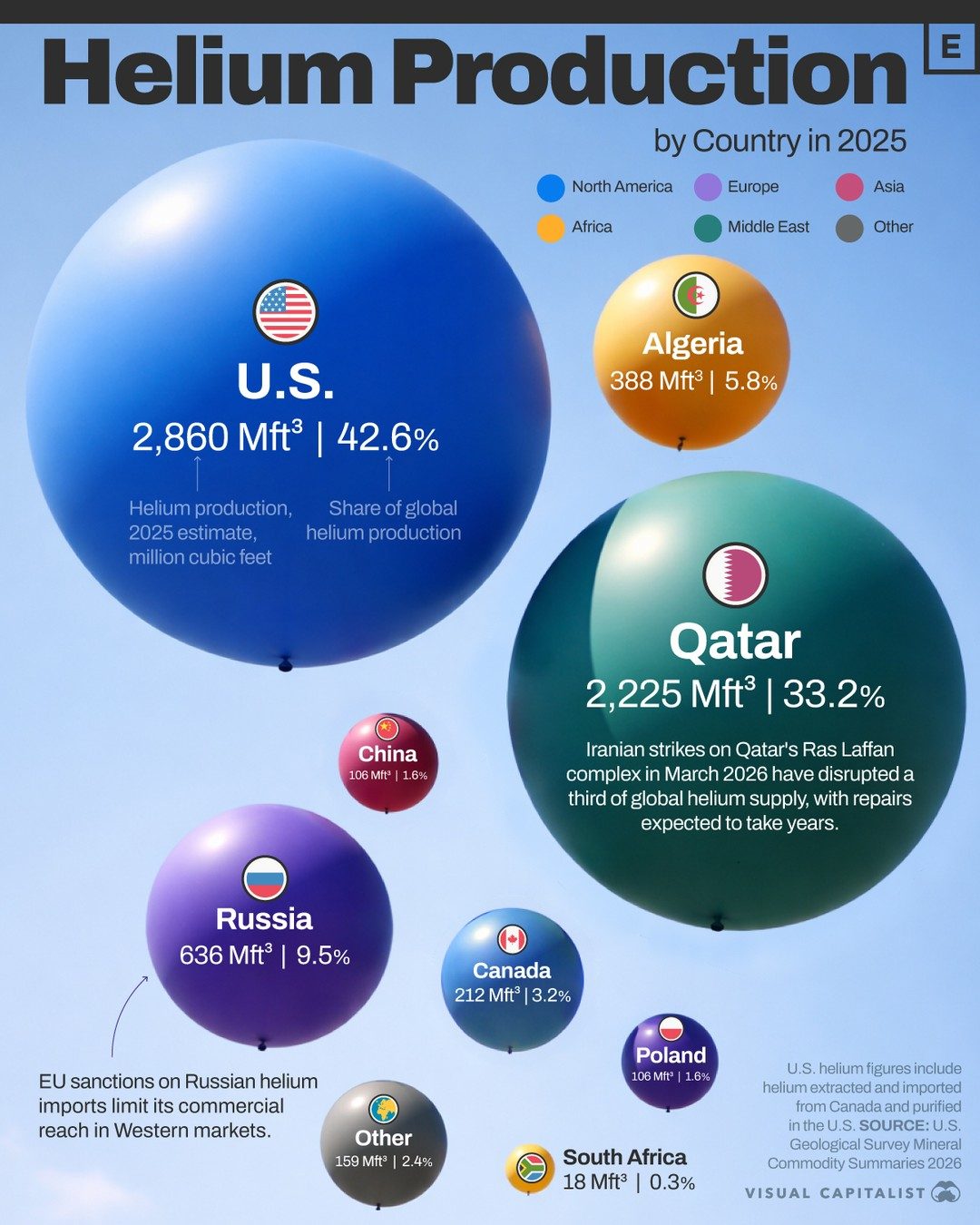
Helium Production by Country
Helium is far more than just a gas used to fill party balloons. It plays a critical role in various high-tech industries, including semiconductors, MRI machines, aerospace systems, and advanced manufacturing. The production and supply of helium are therefore crucial for modern technology and healthcare. The U.S. and Qatar are the dominant players in this market, producing more than 75% of the world’s helium. Other significant producers include Algeria, China, Russia, Canada, Poland, and South Africa. This article delves into the global helium production landscape, highlighting key contributors and recent disruptions.
Context / Why this matters
Helium is not just important for scientific experiments and medical equipment; it is also essential for the production of semiconductors, which are the building blocks of modern electronics. MRI machines rely on helium to maintain the superconducting magnets required for their operation. In aerospace, helium is used for cooling and pressurization in rocket engines. Advanced manufacturing processes, particularly those involving welding and metal refining, also depend on helium for its inert properties.
The global supply of helium is influenced by geopolitical factors, technological advancements, and market dynamics. Understanding the sources and production volumes of helium is vital for industries that rely on this non-renewable resource. Disruptions in helium supply can have far-reaching consequences, affecting everything from medical diagnostics to technological innovations.
Main discussion
Global Production Overview
The U.S. is the largest producer of helium, contributing 42.6% of the global supply with 2,860 million cubic feet (Mft³). Qatar follows closely with 33.2% (2,225 Mft³). Together, these two countries account for over 75% of the world’s helium supply. Other significant producers include Algeria (388 Mft³ or 5.8%), China (106 Mft³ or 1.6%), Russia (636 Mft³ or 9.5%), Canada (212 Mft³ or 3.2%), Poland (106 Mft³ or 1.6%), and South Africa (159 Mft³ or 2.4%).
Key Producing Countries
The United States
The U.S. has long been a leader in helium production, thanks to its extensive natural gas reserves and advanced extraction technologies. The U.S. Geological Survey’s Mineral Commodity Summaries 2026 indicates that the U.S. figures include helium extracted domestically and imported from Canada, which is then purified in the U.S. This highlights the intricate supply chain and strategic importance of helium in the U.S.
Qatar
Qatar is the second-largest producer of helium, with significant reserves of natural gas that contain helium as a byproduct. However, recent geopolitical events, such as Iranian strikes on Qatar’s Ras Laffan complex in March 2026, have disrupted a third of the global helium supply. These disruptions have raised concerns about the stability of the helium market and the need for alternative sources.
Russia
Russia is another major producer of helium, contributing 9.5% of the global supply. However, European Union (EU) sanctions on Russian helium have limited its reach in Western markets. This has led to a shift in the supply chain, with other countries potentially increasing their production to meet demand.
Other Producers
Algeria, China, Poland, Canada, and South Africa also play significant roles in global helium production. These countries contribute varying percentages to the global supply, and their production volumes are influenced by a range of factors, including natural gas reserves, extraction technologies, and market demands.
Supply Chain Challenges
The global helium supply chain is subject to various challenges, including geopolitical tensions, technological limitations, and market dynamics. Disruptions in key production regions, such as Qatar and Russia, can have significant impacts on the availability and pricing of helium. For instance, the Iranian strikes on Qatar’s Ras Laffan complex have led to supply disruptions, while EU sanctions on Russian helium have limited its reach in Western markets.
Additionally, the extraction and purification of helium from natural gas reserves require advanced technologies and infrastructure. Countries with limited resources or technological capabilities may face challenges in maintaining or increasing their production volumes.
Practical Tips
For industries that rely on helium, it is crucial to diversify supply sources and invest in advanced extraction technologies. Here are some practical tips for managing helium supply:
-
Diversify Supply Sources: Relying on a single source for helium can be risky. Companies should aim to diversify their supply sources to mitigate the impacts of disruptions.
-
Invest in Technology: Advanced extraction and purification technologies can help increase the efficiency and yield of helium production. Investing in these technologies can enhance a country’s competitiveness in the global helium market.
-
Monitor Market Trends: Keeping track of market trends, geopolitical developments, and technological advancements can help companies make informed decisions about their helium supply.
-
Collaborate with Suppliers: Building strong relationships with helium suppliers can help ensure a stable supply and facilitate timely communication in case of disruptions.
-
Explore Alternative Sources: Researching and developing alternative sources of helium, such as rare earth minerals or other helium-bearing deposits, can provide long-term solutions to supply challenges.
Important Takeaways
- The U.S. and Qatar are the dominant producers of helium, accounting for more than 75% of the global supply.
- Geopolitical tensions and technological limitations can disrupt the helium supply chain, affecting industries that rely on this critical resource.
- Diversifying supply sources, investing in advanced technologies, and collaborating with suppliers are essential for managing helium supply.
- Monitoring market trends and exploring alternative sources can provide long-term solutions to supply challenges.
Conclusion
Helium is a vital resource for various high-tech industries, and its production and supply are influenced by a range of factors. Understanding the global helium production landscape and the challenges it faces is crucial for industries that rely on this non-renewable resource. By diversifying supply sources, investing in technology, and exploring alternative sources, companies can ensure a stable and reliable supply of helium. This will help maintain the advancement of technology and healthcare, which depend heavily on this precious gas.
Watch the Reel
Questions readers ask
What are the primary uses of helium in high-tech industries?
Helium is crucial for cooling in semiconductors, MRI machines, and other medical technologies. It is also essential for welding in aerospace and maintaining stable environments in advanced manufacturing.
Why do the U.S. and Qatar lead global helium production?
The U.S. and Qatar have the largest helium reserves and well-established infrastructure for helium extraction and purification. The U.S. has significant reserves in Texas, while Qatar has large reserves in the North Field.
Which other countries significantly contribute to global helium supply?
Other notable helium-producing countries include Algeria, China, Russia, Canada, Poland, and South Africa. These countries have varying levels of production and reserves, contributing to the global helium supply.
What role does helium play in modern technology and healthcare?
Helium is vital for cooling superconductor magnets in MRI machines, ensuring safe welding in aerospace manufacturing, and creating stable environments for semiconductor production.
What is the expected global helium supply and demand by 2026?
The global helium supply is expected to remain tight due to increasing demand from industries like semiconductors and aerospace. While production is expected to grow, it may not keep pace with demand in 2026.
How does helium production in Africa contribute to the global supply?
Africa has significant helium reserves, particularly in countries like Algeria and South Africa. These reserves are crucial in meeting global demand, with Algeria being one of the world's largest helium producers.
Recent articles
Fresh deep dives from the latest Reels we unpacked.




Comments
Be the first to comment.