World Happiness Report: The Divergence in Happiness Between Youth and Elderly
Many young adults in North America report being significantly less happy than their counterparts who are 60 or older. This disparity is influenced by several factors, including unaffordable housing, climate change anxiety, and retirement uncertainties. North America is not unique in this phenomenon; the World Happiness Report 2024 reveals similar trends in various countries around the world.
Context / Why This Matters
The World Happiness Report is an annual publication that ranks global happiness based on factors such as GDP per capita, social support, healthy life expectancy, freedom to make life choices, generosity, and perceptions of corruption. The 2024 report highlights a stark contrast in happiness levels between younger and older adults. Understanding these differences can provide insights into the unique challenges and stressors faced by younger generations.
Main Discussion
The Global Picture
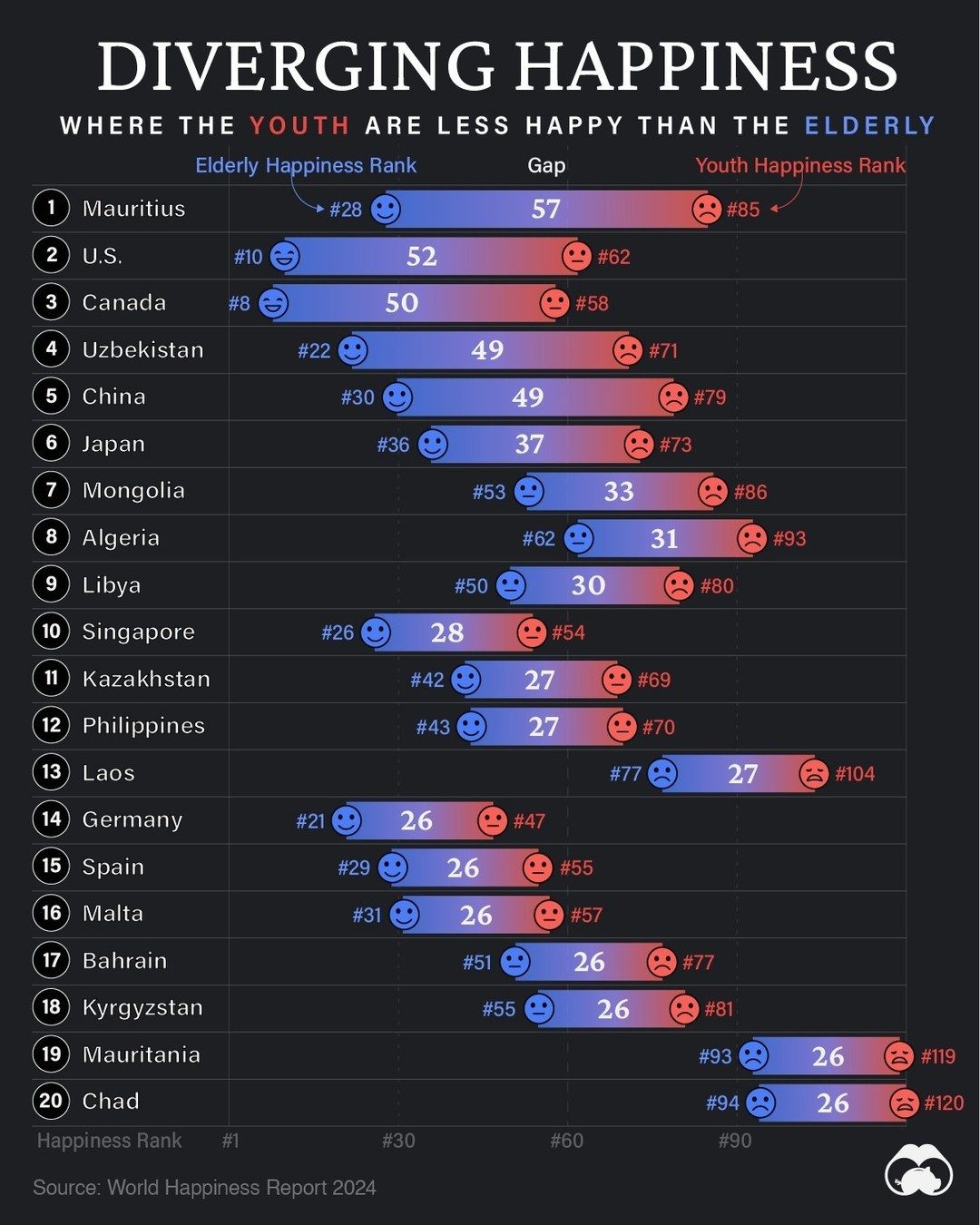
The infographic based on the World Happiness Report 2024 shows a clear divergence in happiness rankings between younger adults and older adults. Countries like Mauritius, the U.S., and Canada, for example, show significant gaps in happiness levels between these age groups. Mauritius, ranked #93 in youth happiness, is #85 among the elderly. The U.S., known for its high standard of living, ranks #10 for the elderly but drops to #62 for younger adults. Similarly, Canada, with a reputation for high quality of life, has a ranking of #8 for the elderly but #58 for the youth.
Key Factors Influencing Happiness
Several key factors contribute to the happiness gap between younger and older adults. Unaffordable housing is a significant stressor for many young adults, making it difficult for them to establish financial stability and independence. Climate change anxiety adds another layer of stress, as young people are more concerned about the environmental changes and their long-term impact. Additionally, retirement uncertainties, including the lack of savings and job security, further exacerbate the situation.
Regional Variations
The happiness gap is not uniform across all regions. Some countries, like Uzbekistan, China, and Japan, show smaller discrepancies between the happiness rankings of their younger and older populations. Uzbekistan, for instance, ranks #22 for the elderly and #71 for the youth, indicating a more consistent happiness level across age groups. Similarly, China and Japan show relatively smaller gaps, suggesting that cultural and societal factors may play a role in mitigating the happiness divide.
Specific Country Insights
Mauritius
In Mauritius, the happiness rankings between the elderly and youth show a significant gap. The country ranks #93 for youth happiness and #85 for the elderly, highlighting a notable disparity. This suggests that while older adults in Mauritius may enjoy a higher quality of life, younger adults face considerable challenges that impact their overall happiness.
United States
The United States showcases a substantial difference in happiness rankings, with the elderly ranking #10 and the youth ranking #62. This gap underscores the unique stressors that young Americans face, including economic instability, healthcare costs, and educational debt. The high cost of living, particularly in major cities, adds to the financial pressure, affecting the overall well-being of younger adults.
Canada
Canada, known for its high standards of living, also shows a significant gap in happiness levels. The elderly rank #8, while the youth rank #58. This disparity could be attributed to factors such as housing affordability, job market competitiveness, and rising living costs, which disproportionately affect younger adults.
Other Notable Countries
Countries like Uzbekistan, China, and Japan exhibit smaller happiness gaps. Uzbekistan, ranked #22 for the elderly and #71 for the youth, shows a more consistent happiness level. Similarly, China and Japan, with rankings of #30 and #36 for the elderly and #79 and #73 for the youth, respectively, indicate a smaller difference. This suggests that cultural factors, economic stability, and social support systems may contribute to a more balanced happiness level across age groups.
Practical Tips
For young adults navigating these challenges, it's crucial to prioritize mental health and seek support. Engaging in community activities, maintaining a healthy lifestyle, and seeking financial advice can help mitigate some of the stressors. Additionally, advocating for policies that address housing affordability, climate change, and retirement security can contribute to overall happiness and well-being.
Important Takeaways
The World Happiness Report 2024 highlights a significant gap in happiness levels between young adults and older adults. Factors such as unaffordable housing, climate change anxiety, and retirement uncertainties play a significant role in this disparity. Recognizing these challenges and advocating for supportive policies can help bridge the happiness gap, promoting overall well-being for all age groups.
Conclusion
The World Happiness Report 2024 provides valuable insights into the happiness levels of different age groups across various countries. While younger adults face unique challenges that impact their overall happiness, understanding these disparities can pave the way for targeted solutions. By addressing key stressors and promoting supportive policies, we can work towards a more balanced and happier global population.
Watch the Reel
Questions readers ask
Which regions are experiencing the most significant happiness gap between young adults and seniors?
The happiness gap is particularly noticeable in North America, with young adults in the U.S. and Canada reporting significantly lower happiness levels compared to their seniors. This trend is also observed in other countries like Mauritius, indicating a broader global phenomenon.
What are the primary factors contributing to lower happiness levels among young adults?
Several factors are contributing to the decreased happiness among young adults. Key issues include unaffordable housing, which creates significant financial stress, and climate change anxiety, which adds a layer of uncertainty and worry about the future.
How does the World Happiness Report measure global happiness?
The World Happiness Report evaluates global happiness based on six key factors: GDP per capita, social support, healthy life expectancy, freedom to make life choices, generosity, and perceptions of corruption. Each of these factors plays a crucial role in determining a country's overall happiness ranking.
Why are young adults more anxious about climate change compared to seniors?
Young adults are more anxious about climate change because they are more aware of the long-term impacts and will live with these consequences for a longer period. This awareness, coupled with the uncertainty about future environmental conditions, contributes significantly to their overall stress levels.
What are the differences in happiness levels among young adults and the elderly globally in 2024?
The 2024 World Happiness Report reveals a noticeable divergence in happiness levels between young adults and the elderly. Young adults report lower happiness levels due to factors like housing affordability and climate anxiety, while seniors generally report higher happiness.
Which countries are the best for overall happiness, according to the World Happiness Report 2024?
The World Happiness Report 2024 ranks countries based on various factors that contribute to overall well-being. While the specific rankings can vary, countries that typically top the list include those with strong social support systems, higher GDP per capita, and lower perceptions of corruption.
What can be done to address the happiness gap between young adults and seniors?
Addressing the happiness gap requires a multi-faceted approach. Policies aimed at improving housing affordability, reducing climate anxiety through actionable initiatives, and promoting social support can significantly enhance well-being. Additionally, fostering a sense of community and purpose can be beneficial for both young and old
Related deep dives
Similar reads based on topic and creator.




Recent articles
Fresh deep dives from the latest Reels we unpacked.




Comments
Be the first to comment.