Google’s Dominance in the Search Engine Market
Google is a staple in the daily routines of billions of people worldwide, with a strong presence in online search, maps, and various other services. Its dominance in the search engine market is so pronounced that it has attracted the attention of regulatory bodies, including the U.S. Justice Department, which has launched a civil antitrust lawsuit. This legal action aims to address what the department views as anticompetitive and exclusionary conduct.
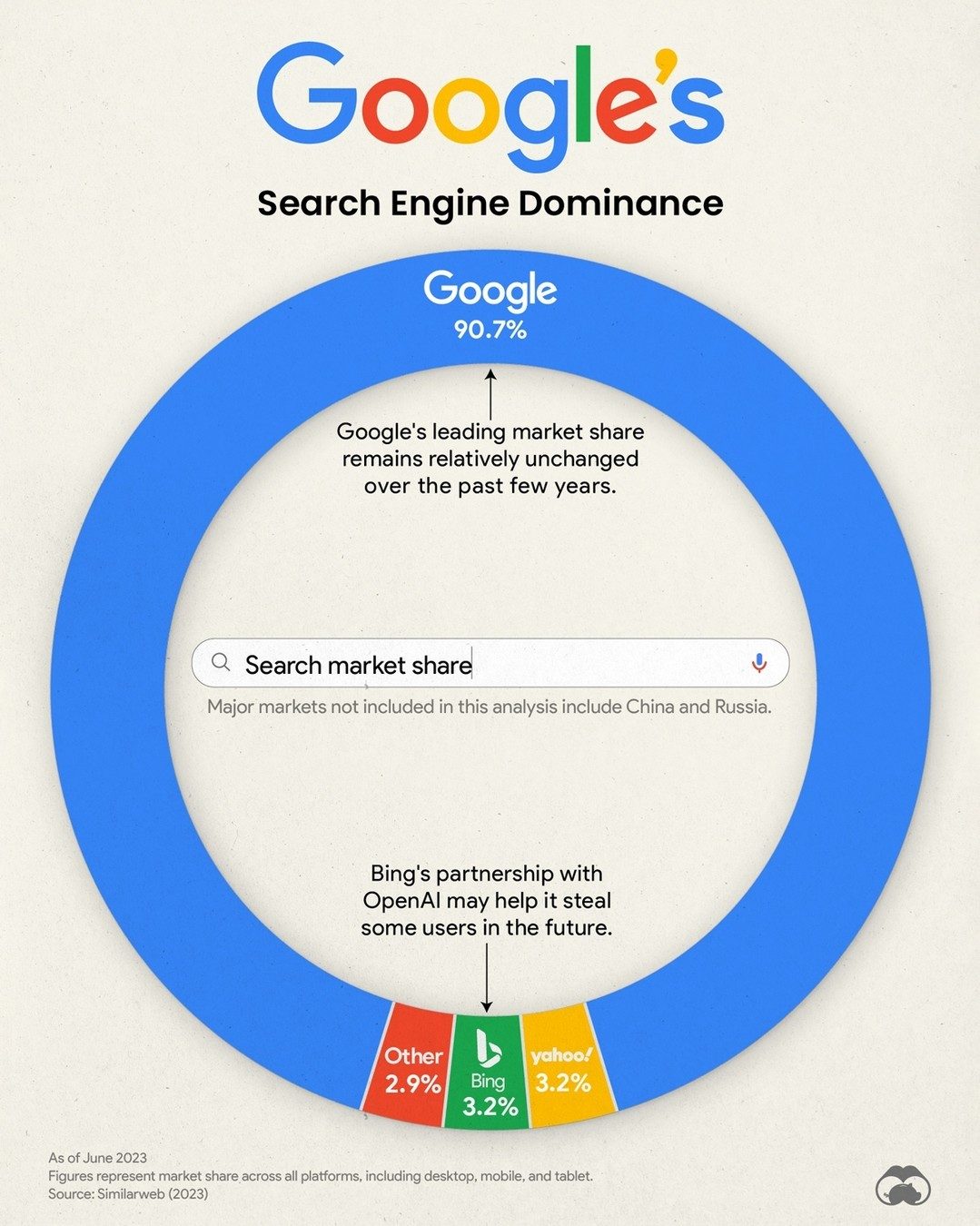
The data, sourced from Similarweb, reveals that Google holds a staggering 90.7% of the search engine market share. This dominance leaves Bing and Yahoo with a mere 3.2% each, while the remaining 2.9% is distributed among other search engines. These figures represent market share across all platforms, including desktop, mobile, and tablet, as of June 2023. It is important to note that major markets like China and Russia are not included in this analysis.
Why This Matters
Understanding the current landscape of search engines is crucial for several reasons. For businesses, it provides insights into where to invest marketing efforts. For consumers, it highlights the options available and the potential impact of market dynamics on user experience. Additionally, regulators and policymakers use this information to evaluate fairness and competition in the digital landscape, as seen in the recent antitrust lawsuit filed by the U.S. Justice Department.
Google’s Market Dominance
Google’s Overwhelming Lead
Google's 90.7% market share is a testament to its ubiquity and the trust users place in its search capabilities. This dominance is not just about the sheer volume of searches; it also encompasses the integration of Google services into various aspects of daily life, from email to mapping services. This integration creates a seamless experience that keeps users within the Google ecosystem, reinforcing its market position.
Bing and Yahoo’s Struggle to Compete
Bing and Yahoo, despite their significant historical presence, lag far behind Google. Bing's 3.2% market share is bolstered by its partnership with Microsoft and the integration of Bing search into various Microsoft products. Similarly, Yahoo’s 3.2% share benefits from its long-standing reputation and various online services. However, both face an uphill battle in overtaking Google's commanding lead.
Emerging Competitors and Future Market Dynamics
The search engine market, while currently dominated by Google, is not stagnant. Bing’s partnership with OpenAI, for example, could potentially shake up the market. OpenAI's advanced AI capabilities could enhance Bing's search algorithms, providing more accurate and intuitive search results. This could help Bing attract users who are looking for more sophisticated search solutions. However, it remains to be seen how effective these enhancements will be in challenging Google's supremacy.
The Role of Other Players
The remaining 2.9% of the market share is held by a variety of other search engines, including DuckDuckGo, which focuses on privacy, and Ecosia, which emphasizes sustainability. These niche players often attract users who prioritize specific values over the broad capabilities of larger search engines. However, their collective market share is minuscule compared to Google’s and is unlikely to pose a significant threat to its dominance in the near future.
Practical Tips for Navigating the Search Engine Market
For Businesses
Businesses should tailor their marketing strategies to account for Google’s dominance. This includes optimizing for Google’s search algorithms and considering targeted advertising through Google Ads. However, businesses should also keep an eye on emerging trends and potential shifts in the market, such as Bing’s advancements with OpenAI.
For Consumers
For consumers, understanding the market landscape can help in making informed choices. While Google is the go-to for most users, exploring other search engines like Bing or DuckDuckGo can provide alternative search experiences that may offer unique benefits, such as enhanced privacy or sustainability.
For Regulators
Regulators should continue to monitor the search engine market to ensure fair competition. This includes evaluating the impact of partnerships like Bing and OpenAI on market dynamics and considering the potential for smaller players to gain traction. Regulatory actions, such as the antitrust lawsuit, highlight the importance of maintaining a competitive landscape in the digital age.
Important Takeaways
- Google’s 90.7% market share underscores its dominance in the search engine market.
- Bing and Yahoo each hold a 3.2% share, indicating significant room for growth.
- The partnership between Bing and OpenAI could potentially impact future market dynamics.
- Understanding the market landscape is crucial for businesses, consumers, and regulators alike.
Conclusion
Google's dominance in the search engine market is undeniable, and its impact on daily life is profound. While competitors like Bing and Yahoo struggle to gain ground, the market is not without potential for change. Bing’s partnership with OpenAI and the emergence of niche search engines offer glimpses into a future where users might have more varied and specialized search options. However, for now, Google remains the undisputed leader, shaping the digital landscape and influencing how billions of people access information.
Watch the Reel
Questions readers ask
Why is Google's 90.7% market share significant?
Google's 90.7% market share is significant because it indicates that nearly everyone using a search engine opts for Google. This level of dominance influences how businesses approach marketing and affects the overall digital experience for users, making it a focal point for regulatory attention.
What is the current market share of Bing and Yahoo?
As of the latest data, Bing and Yahoo each hold 3.2% of the search engine market share. This is a small fraction compared to Google, highlighting the vast market gap between Google and its competitors.
Why has Google's market dominance attracted regulatory scrutiny?
Google's market dominance has attracted regulatory scrutiny, including a civil antitrust lawsuit by the U.S. Justice Department. Regulators are concerned about potential anticompetitive behaviors that could stifle innovation and limit consumer choice.
How does Google's market share impact digital marketing strategies?
Given Google's overwhelming market share, businesses often prioritize Google in their search engine optimization (SEO) and pay-per-click (PPC) strategies. This focus ensures that businesses reach the broadest audience possible, as the majority of users rely on Google for their search needs.
What are the implications of Google's dominance on consumer digital experiences?
Google's dominance influences the digital experience by shaping user behavior and expectations. Most users are accustomed to Google's interface and functionalities, which can create barriers for competitors to gain traction. For consumers, this means a familiar and consistent search experience, but it may also limit exposure to different search functionalities.
What is Google's market strategy that contributes to its dominance?
Google's market strategy includes continuous innovation, a user-friendly interface, and extensive partnerships. These efforts ensure high user satisfaction and retention, making Google the go-to search engine for most users.
How does Google's market share compare to other search engines like DuckDuckGo or Yandex?
Google's market share of 90.7% significantly outpaces other search engines, including DuckDuckGo and Yandex. These competitors hold a much smaller percentage of the market, with the combined share of all other search engines totaling less than 10%.
Related deep dives
Similar reads based on topic and creator.


Recent articles
Fresh deep dives from the latest Reels we unpacked.




Comments
Be the first to comment.