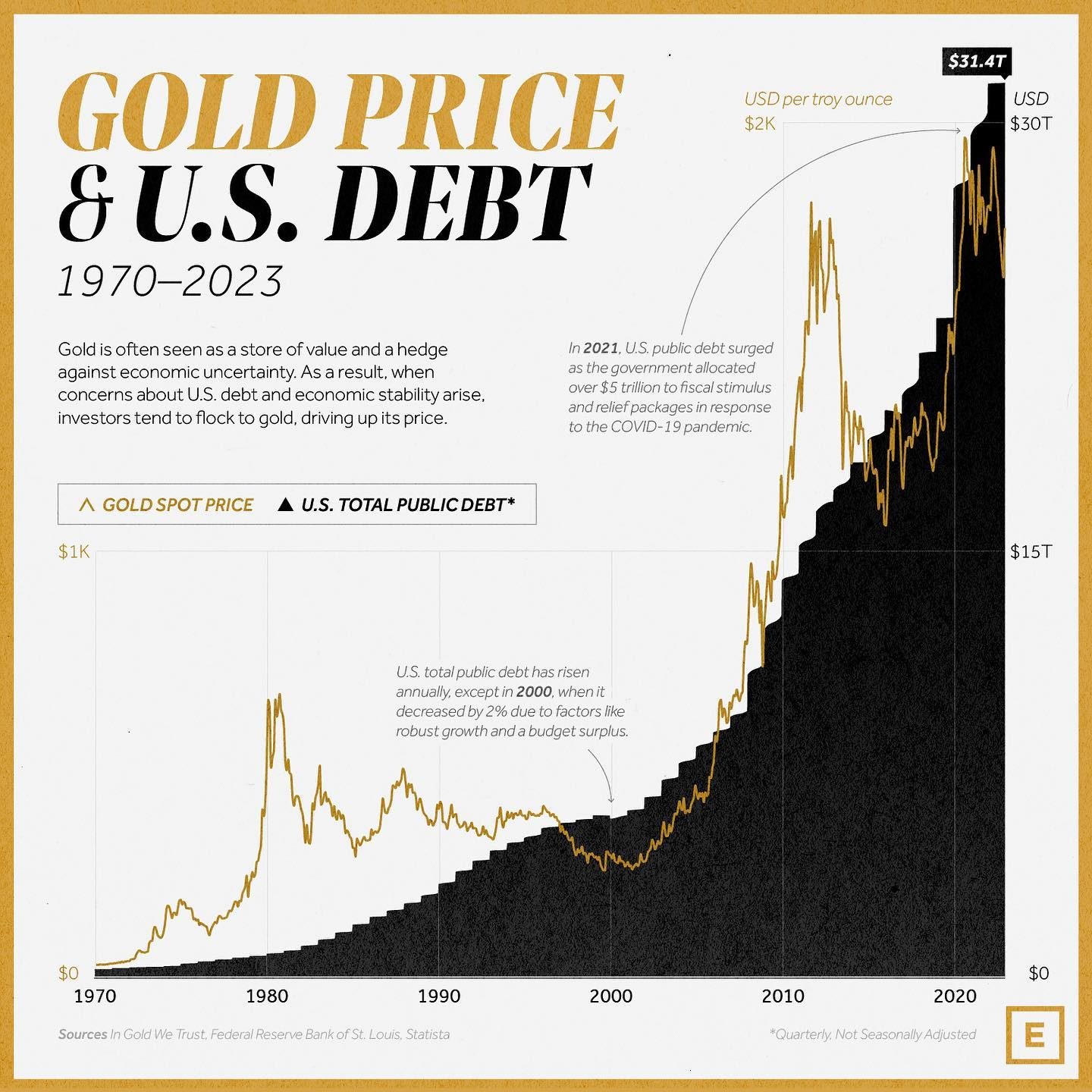
Gold Price & U.S. Debt
Gold has long been recognized as a store of value and a safe haven during times of economic uncertainty. Its price movements often reflect broader economic trends, and one of the most significant factors influencing gold prices is the level of U.S. public debt. By examining the relationship between gold prices and U.S. debt, investors can gain valuable insights into economic conditions and potential market movements.
Context / Why this matters
Gold and U.S. debt are intricately linked. Gold is frequently seen as a hedge against economic uncertainty and inflation. During periods of high debt and economic instability, investors often turn to gold as a safe asset, driving up its price. Conversely, when economic conditions are stable, and debt levels are manageable, other investment opportunities may become more attractive, potentially leading to a decrease in gold prices.
The period from 1970 to 2023 offers a comprehensive view of this relationship, marked by significant economic events and fluctuations in both gold prices and U.S. public debt.
Main discussion
Historical overview
Early 1970s to 1980s
In the early 1970s, the U.S. government implemented policies that led to substantial increases in public debt. Concurrently, gold prices experienced significant volatility, driven by economic instability, including the oil collapses in 1973 and 1979, which triggered inflation and economic uncertainty. This period saw a sharp rise in gold prices as investors sought refuge in the precious metal. By the 1980s, both gold prices and U.S. public debt had reached new highs, reflecting the economic turbulence of the time.
1990s and 2000s
The 1990s marked a period of relative economic stability and growth. The U.S. economy benefited from a robust job market, technological advancements, and fiscal prudence. This stability contributed to a decrease in gold prices as investors shifted towards equities and other higher-yielding assets. However, the public debt continued to rise, albeit at a slower pace. Notably, in 2000, the U.S. public debt decreased by 2% due to robust economic growth and a budget surplus, a rare occurrence in this timeframe.
2010s to present
The 2010s brought renewed economic challenges, including the 2008 financial crisis and the COVID-19 pandemic. The pandemic, in particular, led to unprecedented fiscal stimulus and relief packages, increasing the U.S. public debt. Gold prices surged in response to the economic uncertainty, further amplified by inflation concerns and monetary policy responses. The period from 2020 to 2023 saw significant volatility in both gold prices and public debt, reflecting the global economic landscape.
Key economic events and their impact
2008 Financial Crisis
The 2008 financial crisis had a profound impact on both gold prices and U.S. public debt. The crisis led to a massive injection of liquidity by central banks, including the Federal Reserve, to stabilize financial markets. This liquidity injection, combined with concerns about inflation and economic stability, drove gold prices to new highs. Simultaneously, U.S. public debt surged as the government implemented fiscal stimulus measures to tackle the economic fallout.
COVID-19 Pandemic
The COVID-19 pandemic brought about another significant economic shock. The U.S. government allocated over $5 trillion to fiscal stimulus and relief packages, causing a surge in public debt. This surge was accompanied by a rise in gold prices, as investors sought safety in the precious metal amidst unprecedented economic uncertainty and inflation concerns.
Practical tips
Investing in gold
When considering gold investments, it's essential to understand the broader economic context, including levels of public debt and economic uncertainty. Gold can be a valuable addition to a diversified portfolio, particularly during periods of high debt and economic instability. However, it's crucial to monitor economic indicators and market conditions to make informed investment decisions. Some practical tips include:
- Diversification: Include gold as part of a diversified investment portfolio to hedge against economic uncertainty and inflation.
- Monitor Economic Indicators: Stay informed about public debt levels, inflation rates, and other economic indicators that can influence gold prices.
- Long-Term Perspective: Consider gold as a long-term investment, as its value tends to appreciate over extended periods, especially during times of economic turbulence.
Public Debt Considerations
Understanding the relationship between public debt and gold prices can provide insights into potential market movements and economic stability. Here are some considerations:
- Fiscal Policy: Pay attention to fiscal policy changes and government spending, as these can significantly impact public debt and, consequently, gold prices.
- Monetary Policy: Monitor central bank policies, including interest rates and quantitative easing, which can influence gold prices and economic conditions.
- Economic Reports: Regularly review economic reports and data releases, such as GDP growth, employment rates, and inflation, to gauge the economic environment and its potential impact on gold prices.
Important takeaways
Gold prices and U.S. public debt are closely intertwined, reflecting broader economic trends and investor sentiment. Key takeaways from this relationship include:
- Gold as a Hedge: Gold serves as a store of value and a hedge against economic uncertainty and inflation.
- Economic Indicators: Monitoring economic indicators, such as public debt, inflation, and fiscal policy, can provide valuable insights into gold price movements.
- Investment Strategy: Incorporating gold into a diversified investment portfolio can help mitigate risks associated with economic turbulence.
Conclusion
The relationship between gold prices and U.S. public debt offers valuable insights into economic conditions and potential market movements. By understanding this relationship, investors can make informed decisions and develop effective investment strategies. Whether you're a seasoned investor or just starting, recognizing the interplay between gold and public debt can help navigate the complexities of the financial landscape.
Watch the Reel
Questions readers ask
What is the historical relationship between gold prices and U.S. debt levels?
Historically, gold prices have shown a tendency to rise during periods of high U.S. debt levels. For example, from 1970 to 2023, there have been notable increases in gold prices during times of significant debt growth, reflecting investors' desire for a safe haven asset.
Why do investors turn to gold during times of high U.S. debt?
Investors view gold as a reliable store of value and a hedge against economic uncertainty, inflation and potential currency devaluation. When U.S. debt levels rise, it can signal economic instability, prompting investors to move their assets into gold to preserve wealth.
How does a graph of gold prices versus U.S. debt levels typically look?
A graph plotting gold prices against U.S. debt levels often shows a positive correlation, meaning that as debt levels increase, gold prices tend to rise as well. This trend is particularly visible during periods of significant debt growth and economic turmoil.
What are some key events that illustrate the relationship between U.S. debt and gold prices?
Key events include the 2008 financial crisis and the periods following significant U.S. debt ceiling debates. During these times, gold prices surged as investors sought safety, and the total U.S. debt increased, highlighting the close relationship between the two factors.
How can investors use the relationship between gold and U.S. debt to inform their strategies?
Investors can monitor U.S. debt levels and economic indicators to anticipate potential shifts in gold prices. By understanding this relationship, investors can make informed decisions about when to buy or sell gold, aligning their strategies with broader economic trends and market movements.
What are the long-term trends in gold prices and how do they relate to U.S. public debt?
Long-term trends in gold prices often correlate with increases in U.S. public debt. Since the 1970s, gold prices have experienced significant upward trends during periods of high debt, reflecting sustained investor interest in gold as a safe haven during economic uncertainty.
How does investor behavior regarding gold change with fluctuations in U.S. debt levels?
When U.S. debt levels rise, investor behavior typically shifts towards gold as a safe asset. This increased demand drives up gold prices. Conversely, when debt levels stabilize or decrease, investor behavior may shift back to other assets, leading to potential decreases in gold prices.
Recent articles
Fresh deep dives from the latest Reels we unpacked.




Comments
Be the first to comment.