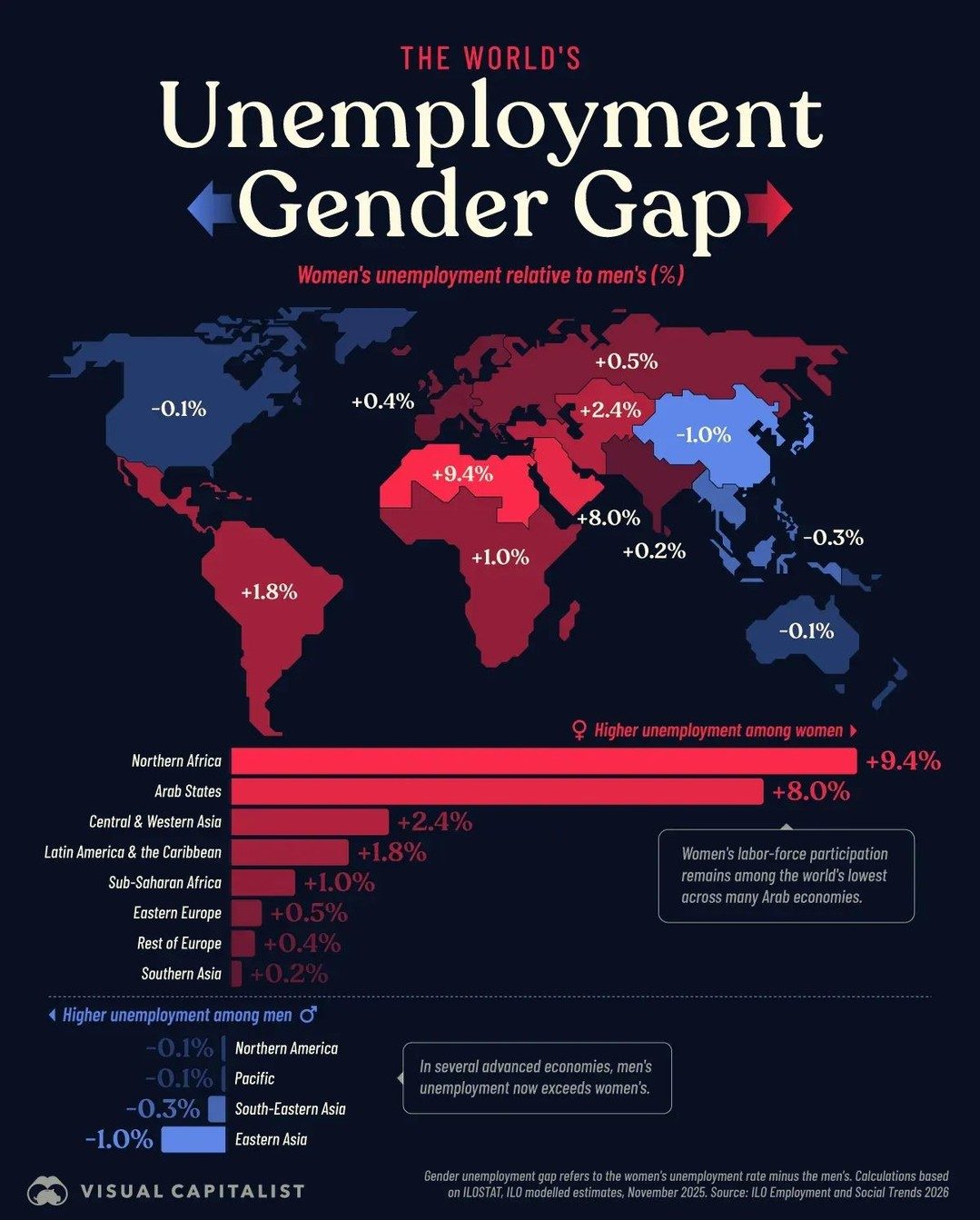
Unemployment Gender Gap
The unemployment gender gap is a persistent issue across the globe, with women often facing higher unemployment rates than men. This disparity varies significantly by region, influenced by economic, social, and cultural factors. To understand this phenomenon, let's explore the data from the International Labour Organization (ILO) and delve into the regional variations and underlying causes.
Context / Why this matters
The unemployment gender gap is more than just a statistic; it reflects broader economic and social inequalities. Addressing this gap is crucial for achieving gender equality and fostering more inclusive economies. By examining the data, we can identify regions where women face the highest barriers to employment and understand the factors driving these disparities. This information is essential for policymakers, economists, and advocates working towards gender equality and sustainable development.
Main discussion
Global trends
Women's unemployment rates tend to be higher than men’s in most regions. This gap is particularly pronounced in certain areas, highlighting the need for targeted interventions. The ILO data provides a comprehensive view of these disparities, showing how the gap varies across different parts of the world.
Regional variations
North Africa and Arab States
North Africa and the Arab States have the largest unemployment gender gaps, with women facing unemployment rates 9.4% and 8.0% higher than men, respectively. Several factors contribute to this disparity, including lower labor force participation rates among women. In many Arab economies, women's labor force participation remains among the world's lowest. Cultural norms, lack of access to education and training, and limited job opportunities in sectors traditionally dominated by men are significant barriers. Addressing these challenges requires a multifaceted approach, including policy reforms, investment in education and training, and promoting gender-sensitive job creation.
Central and Western Asia, Latin America, and the Caribbean
Central and Western Asia, as well as Latin America and the Caribbean, also show significant unemployment gender gaps, with women facing 2.4% and 1.8% higher unemployment rates than men, respectively. These regions face similar challenges, such as limited access to education, job market discrimination, and unequal distribution of household and childcare responsibilities. Policies aimed at improving access to education, promoting equal pay, and providing childcare support can help reduce these gaps.
Sub-Saharan Africa and Southern Asia
In Sub-Saharan Africa and Southern Asia, the unemployment gender gaps are 1.0% and 1.8% respectively, indicating a moderate but still notable disparity. As seen in other regions, these gaps are influenced by socioeconomic factors and traditional gender roles. Economic instability, limited job opportunities, and social norms that restrict women's participation in the labor force are key challenges. Increasing women's access to economic opportunities, promoting gender equality in education, and supporting women entrepreneurs can help narrow these gaps.
Rest of Europe, Eastern Asia
The unemployment gender gap is less pronounced in the Rest of Europe and Eastern Asia, with women experiencing 0.2% to 0.3% higher unemployment rates than men. These regions have made more progress in promoting gender equality and providing equal access to education and employment opportunities. However, even in these areas, there is still room for improvement, particularly in addressing subtle forms of discrimination and promoting equal representation in leadership roles.
North America and Parts of Asia-Pacific
In a few regions, such as North America and parts of the Asia-Pacific, the unemployment gender gap is actually positive, with men facing slightly higher unemployment rates than women. This trend reflects broader economic and social changes, such as the shifting job market in advanced economies and the impact of technological advancements on traditionally male-dominated sectors.
Labor force participation in Arab economies
Women's labor force participation across many Arab economies remains among the world's lowest. The barriers to entry are numerous, including social and cultural norms that restrict women from fully participating in the labor market. In addition, limited access to quality education, training, and job opportunities further exacerbate the issue. Governments and organizations in these regions are increasingly recognizing the importance of promoting gender equality and are implementing policies and programs to enhance women's economic empowerment.
Differences in advanced economies
In several advanced economies, the unemployment rate for men now exceeds that for women. This shift can be attributed to various factors, including the growth of service-sector jobs, which are often more accessible to women, and the impact of economic downturns on traditionally male-dominated industries, such as manufacturing and construction. However, it is important to note that even in these advanced economies, women still face challenges related to wage disparities, career advancement, and work-life balance.
Practical tips
Policy makers
Policy makers can take several steps to address the unemployment gender gap. These include implementing gender-sensitive economic policies, providing equal access to education and training, promoting equal pay, and supporting women entrepreneurs. Additionally, governments can work to eliminate discriminatory practices in the labor market and ensure that women have equal opportunities for career advancement.
Employers
Employers also play a crucial role in reducing the unemployment gender gap. They can promote diversity and inclusion in the workplace by adopting gender-blind hiring practices, providing equal opportunities for career advancement, and supporting work-life balance initiatives. Employers should also strive to create an inclusive work environment that values and respects all employees, regardless of gender.
Individuals
Individuals can contribute to addressing the unemployment gender gap by advocating for gender equality, supporting women in their pursuit of education and employment, and challenging gender stereotypes. By promoting a culture of inclusivity and respect, individuals can help create a more equitable society where everyone has the opportunity to thrive.
Important takeaways
The unemployment gender gap is a complex issue with regional variations and underlying socioeconomic factors. Addressing this gap requires a multifaceted approach that includes policy reforms, investment in education and training, and promoting gender-sensitive job creation. By understanding the regional differences and the factors driving these disparities, we can work toward creating more inclusive and equitable economies.
Conclusion
The unemployment gender gap is a persistent issue that varies significantly by region. By examining the data from the ILO, we can gain a deeper understanding of the factors driving these disparities and identify regions where women face the highest barriers to employment. Addressing this gap requires a concerted effort from policymakers, employers, and individuals to promote gender equality and create more inclusive economies. Through targeted interventions and a commitment to gender equality, we can work towards a future where everyone has equal opportunities for employment and economic empowerment.
Watch the Reel
Questions readers ask
What is the unemployment gender gap and why does it matter?
The unemployment gender gap refers to the difference in unemployment rates between men and women. It matters because it highlights broader economic and social inequalities, and addressing it is key to promoting gender equality and fostering inclusive economies.
Which regions have the most significant unemployment gender gaps?
The unemployment gender gap varies significantly by region. According to the International Labour Organization, regions like the Arab states and North Africa often have the most pronounced gender gaps in unemployment, while other regions like North America and parts of Europe show comparatively smaller gaps.
What factors contribute to the unemployment gender gap in different regions?
Factors contributing to the unemployment gender gap include economic conditions, social norms, and cultural practices. For instance, in some regions, women may face barriers such as limited access to job opportunities, inadequate childcare support, or societal expectations that limit their participation in the workforce.
How do unemployment rates for women compare to those for men globally?
Globally, women often face higher unemployment rates than men. This disparity is influenced by various factors, including occupational segregation, where women are often concentrated in sectors with higher unemployment rates, and the impact of global crises, which can disproportionately affect women's employment.
What can be done to reduce the unemployment gender gap?
To reduce the unemployment gender gap, policies and initiatives should focus on improving women's access to job opportunities, providing adequate childcare support, and promoting gender equality in the workplace. Additionally, addressing occupational segregation and ensuring equal pay can help narrow the gap.
How does the unemployment gender gap affect different age groups?
The unemployment gender gap can affect different age groups in varying ways. For example, younger women may face higher unemployment rates due to limited work experience or barriers to entering the job market, while older women may encounter age discrimination and challenges re-entering the workforce after taking time off for caregiving responsibilities.
What role do economic policies play in addressing the unemployment gender gap?
Economic policies play a crucial role in addressing the unemployment gender gap. Governments can implement measures such as targeted training programs, supportive labor market policies, and fiscal incentives to encourage women's employment. Additionally, promoting gender equality in economic policies can help create more equitable labor markets.
Recent articles
Fresh deep dives from the latest Reels we unpacked.




Comments
Be the first to comment.