Global Stock Market Visualization
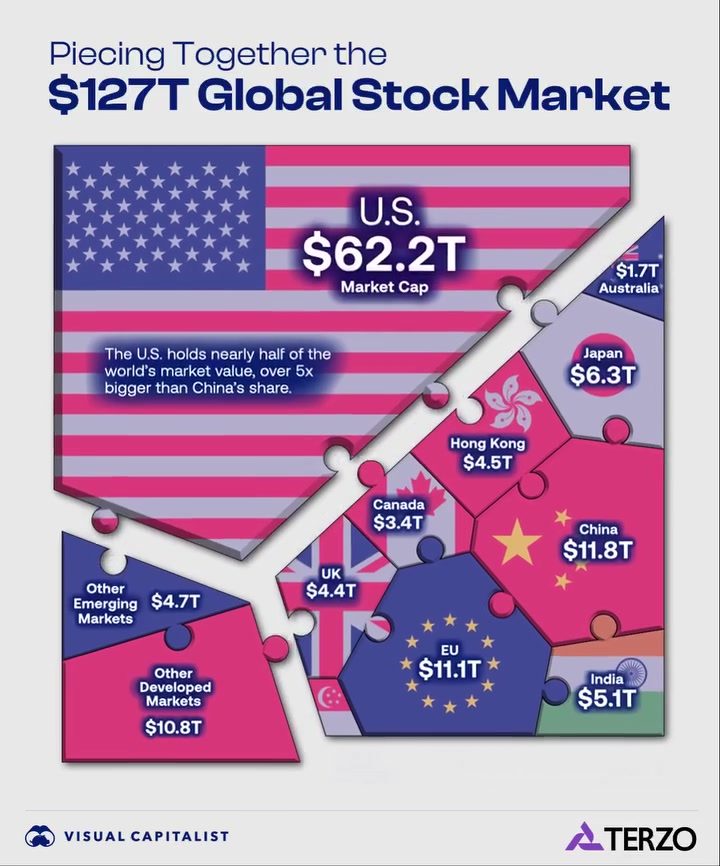
Global stock markets are the backbone of modern economies, facilitating investment, economic growth, and wealth distribution. The total value of global equity markets stands at a staggering $127 trillion. This immense figure reflects the collective market capitalization of listed companies worldwide. However, this value is not evenly distributed. The U.S., for instance, holds a significant portion of the global market capitalization, with other major economies contributing varying shares.
Why This Matters
Understanding the distribution of global stock market value is crucial for investors, policymakers, and economists. It provides insights into economic power dynamics, investment opportunities, and potential risks. For investors, knowing where the bulk of the market value lies can help in making informed decisions about where to allocate capital. For policymakers, this information is vital for crafting regulations and policies that foster economic growth and stability.
Main Discussion
The Dominance of the U.S. Market
The U.S. stock market is the largest in the world, holding nearly half of the global market value. With a market capitalization of $62.2 trillion, the U.S. market is over five times larger than China's, the second-largest market. This dominance can be attributed to several factors, including the size and diversity of the U.S. economy, the strength of its regulatory framework, and the depth of its capital markets. The U.S. market's robustness and stability make it a preferred destination for both domestic and international investors.
Key Factors Driving U.S. Market Dominance
-
Economic Size and Diversity: The U.S. economy is the largest in the world, encompassing a wide range of industries from technology to healthcare, finance to manufacturing. This diversity provides ample opportunities for investment and growth.
-
Regulatory Framework: The U.S. has a well-established and transparent regulatory framework, which enhances investor confidence and facilitates smooth market operations.
-
Capital Market Depth: The U.S. capital markets are among the deepest and most liquid in the world, providing ample liquidity and stability for investors.
The Role of Other Major Economies
While the U.S. holds the largest share, other major economies also contribute significantly to the global stock market value. These include China, Japan, the European Union, and several other countries and regions.
China
China's stock market, with a market capitalization of $11.8 trillion, is the second-largest in the world. Despite its size, China's market is still less than a fifth of the U.S. market. China's rapid economic growth and increasing integration into the global economy have driven its market growth. However, regulatory risks and market volatility pose challenges for investors.
Japan
Japan's stock market, valued at $6.3 trillion, is the third-largest in the world. Japan's market is characterized by a mature economy with a strong focus on technology, manufacturing, and finance. The country's aging population and economic stagnation in recent decades have posed challenges, but Japan remains a significant player in the global market.
European Union
The EU, with a combined market capitalization of $11.1 trillion, is another major player in the global stock market. The EU's diverse economy, comprising 27 member states, offers a wide range of investment opportunities. However, regulatory complexities and economic disparities among member states can pose challenges for investors.
Other Notable Markets
Several other countries and regions also hold significant shares of the global market capitalization. These include:
- Hong Kong: With a market capitalization of $4.5 trillion, Hong Kong is a major financial hub and a gateway to the Chinese market.
- India: India's market, valued at $5.1 trillion, is one of the fastest-growing in the world, driven by rapid economic growth and a young, tech-savvy population.
- UK: The UK's market, valued at $4.4 trillion, is another major financial center with a strong focus on finance, technology, and healthcare.
- Canada: Canada's market, valued at $3.4 trillion, is known for its resource-rich economy and stable political environment.
- Singapore: With a market capitalization of $0.6 trillion, Singapore is a major financial hub in Southeast Asia, known for its strong regulatory framework and business-friendly environment.
Emerging and Developed Markets
In addition to the major economies, other emerging and developed markets also contribute to the global stock market value. These markets, while smaller in size, offer unique investment opportunities and risks.
Emerging Markets
Emerging markets, with a combined market capitalization of $4.7 trillion, include countries in Asia, Latin America, and Africa. These markets are characterized by rapid economic growth, increasing integration into the global economy, and significant investment opportunities. However, they also pose higher risks due to regulatory uncertainties, political instability, and economic volatility.
Developed Markets
Other developed markets, with a combined market capitalization of $10.8 trillion, include countries like Australia, Switzerland, and South Korea. These markets are characterized by mature economies, stable political environments, and well-established regulatory frameworks. They offer a range of investment opportunities, particularly in sectors like technology, healthcare, and finance.
Practical Tips
For investors looking to navigate the global stock market, here are some practical tips:
-
Diversify Your Portfolio: Diversifying across different regions and sectors can help mitigate risks and maximize returns. Consider allocating investments across the U.S., EU, China, and other major economies, as well as emerging markets.
-
Stay Informed: Keep up with economic and political developments in different regions, as these can significantly impact market performance. Regularly review market data, economic indicators, and regulatory changes.
-
Consider Long-Term Investments: Long-term investments can help ride out short-term market volatility and capture long-term growth opportunities. Focus on sectors with strong growth potential and stable regulatory environments.
-
Leverage Financial Advisors: Working with financial advisors who have expertise in global markets can provide valuable insights and help in making informed investment decisions.
-
Manage Risks: Assess and manage risks associated with investments in different regions, including regulatory risks, political instability, and currency fluctuations. Implement risk management strategies to protect your portfolio.
Important Takeaways
Understanding the distribution of global stock market value is essential for investors, policymakers, and economists. The U.S. market holds nearly half of the global market value, making it a dominant player. However, other major economies, including China, Japan, and the EU, also contribute significantly. Emerging and developed markets offer unique investment opportunities and risks. By diversifying portfolios, staying informed, considering long-term investments, leveraging financial advisors, and managing risks, investors can navigate the complexities of the global stock market.
Global stock markets are dynamic and ever-evolving. Keeping abreast of market trends, economic developments, and regulatory changes can help in making informed investment decisions. For those interested in delving deeper, consulting the full article and comprehensive data provided by the infographic can offer invaluable insights into the global equity landscape.
Conclusion
The global stock market, valued at $127 trillion, is a complex and interconnected network of different countries and regions. The U.S. market holds the largest share, followed by China, Japan, the EU, and other major economies. Emerging and developed markets also contribute significantly, offering unique investment opportunities and risks. By understanding the distribution of global stock market value and implementing strategic investment approaches, investors can navigate this dynamic landscape and achieve their financial goals.
Watch the Reel
Questions readers ask
How much of the global stock market value does the U.S. hold?
The U.S. stock market holds nearly 50% of the global market value. This means the U.S. holds about $63.5 trillion of the $127 trillion total global stock market value. This makes it the largest stock market in the world.
What is the total value of the global equity markets?
The total value of global equity markets amounts to $127 trillion. This figure represents the combined market capitalization of all publicly traded companies around the world.
Why is it important to understand the distribution of global stock market value?
Understanding the distribution of global stock market value is essential for investors, policymakers, and economists. It helps in identifying economic power shifts, assessing investment opportunities, and recognizing potential risks. For investors, this information is crucial for making informed decisions about where to allocate their capital.
How does the U.S. stock market compare to other major economies like China and Japan?
The U.S. stock market significantly outpaces other major economies. While the U.S. holds nearly half of the global market value, China and Japan contribute smaller but still substantial shares. Japan's stock market has a larger market capitalization than China.
What trends are currently influencing the global stock market?
Global stock markets are influenced by various trends, including economic policies, technological advancements, and geopolitical events. Emerging markets are showing strong growth, while developed markets continue to be stable.
How does the dominance of the U.S. stock market influence worldwide investment and economic stability?
The U.S. stock market's dominance means it plays a pivotal role in worldwide investment and economic stability. Its performance can significantly impact global financial markets, influencing investment strategies and economic policies.
Recent articles
Fresh deep dives from the latest Reels we unpacked.




Comments
Be the first to comment.