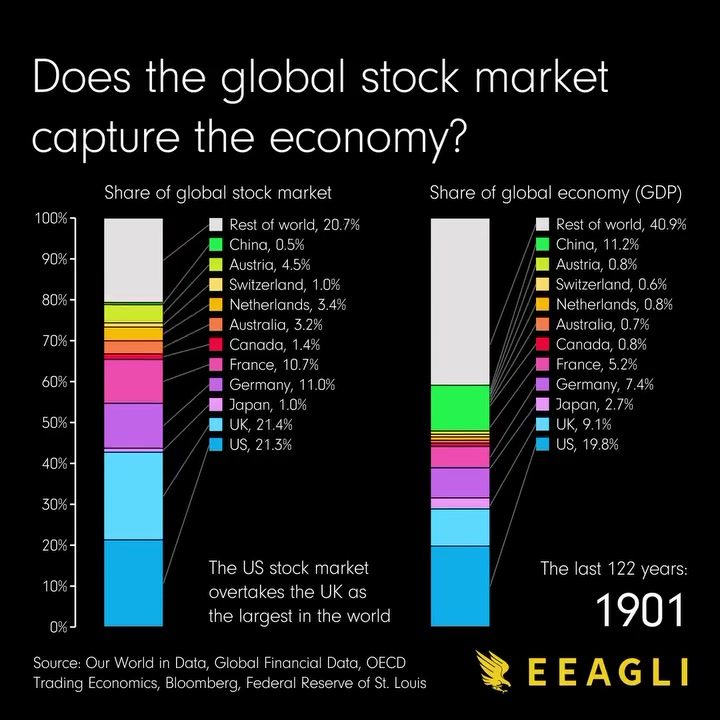
Global Stock Market vs. Economy: A Historical Perspective
The relationship between the global stock market and the global economy, often measured by Gross Domestic Product (GDP), is complex and dynamic. Understanding this relationship provides insights into economic trends, investment opportunities, and global financial dynamics. This article explores how the share of the global stock market and the global economy has evolved over time, highlighting key periods and countries.
Why This Matters
The disparity between stock market performance and economic growth is a critical indicator of economic health and investor sentiment. Stock markets can reflect investor expectations and confidence, while GDP measures actual economic output. Analyzing the historical trends of these two metrics helps investors and policymakers make informed decisions and predict future economic trajectories.
Historical Overview
1900: The Early 20th Century
In the early 20th century, the global stock market was dominated by a few key countries. The US held a significant share, with approximately 49.4% of the global stock market, while the UK and Germany followed with 15.0% and 3.4%, respectively. The rest of the world, including countries like France, Switzerland, and Japan, had relatively smaller shares. This period marked the beginning of the US's rise as a financial superpower, reflecting its industrial growth and economic expansion.
1932: The Great Depression
The 1930s were a challenging time for the global economy, marked by the Great Depression. During this period, the US stock market share increased significantly to 63.6%, while the UK's share dropped to 8.4%. Germany's share remained relatively stable at 3.4%. The rest of the world, including countries like Japan, France, and Australia, saw their shares decline. This period highlighted the resilience of the US economy and its significant role in global finance.
1963: Post-War Recovery
By 1963, the global economy had recovered from the aftermath of World War II. The US continued to dominate the global stock market with a 35.1% share, while Japan emerged as a significant player with 28.4%. Germany and the UK had 3.6% and 9.4% shares, respectively. This period marked the beginning of Japan's economic rise, driven by its industrialization and export-oriented policies.
1995: The Asian Financial Crisis
In 1995, Japan briefly surpassed the US in terms of stock market share. However, this period was also marked by the Asian Financial Crisis, which affected many economies in the region. The US retained a significant share of 19.3%, while Japan's share reached 2.8%. The UK, Germany, and France also maintained notable shares of 9.1%, 7.4%, and 5.3%, respectively. This period highlighted the volatility of the global economy and the interconnectedness of financial markets.
2022: The Modern Era
As of 2022, the global stock market and economy have seen significant shifts. The US continues to hold a substantial share of the global stock market at 16.8%, while the UK and Germany maintain notable shares of 23.3% and 11.8%, respectively. Japan, Switzerland, and Australia also have significant shares of 1.0%, 1.1%, and 3.5%. This period reflects the ongoing dominance of developed economies in the global stock market and the increasing role of emerging markets.
Key Countries and Their Shifts
United States
The US has consistently been a dominant player in the global stock market, reflecting its economic strength and financial stability. Its share has fluctuated over the years but has consistently remained high. The US economy, measured by GDP, also represents a large portion of the global economy, highlighting its significant role in global financial dynamics.
United Kingdom
The UK has shown resilience in the global stock market, maintaining a significant share over the years. Despite economic challenges, such as Brexit, the UK continues to be a key player in global finance. Its share of the global economy has also been notable, reflecting its historical economic strength and financial influence.
Japan
Japan's emergence as a significant player in the global stock market began in the mid-20th century. Its share peaked in 1995, briefly surpassing the US. However, Japan's economy has faced challenges, including the burst of the asset price bubble and the recent economic stagnation. Despite these challenges, Japan remains a crucial player in the global economy.
Germany
Germany has consistently maintained a significant share of the global stock market, reflecting its economic strength and industrial prowess. Its share of the global economy has also been notable, highlighting its role as a key player in the European financial landscape.
Emerging Markets
Countries like China, India, and Brazil have seen significant growth in their shares of the global stock market and economy. As emerging markets continue to develop, their influence on global financial dynamics is expected to increase.
Practical Tips
For investors, understanding the historical trends of the global stock market and economy can provide valuable insights. Here are some practical tips:
- Diversify Your Portfolio: Investing in a diversified portfolio that includes stocks from various countries can help mitigate risks associated with economic fluctuations.
- Stay Informed: Keep up with global economic trends and developments. Understanding the economic policies and financial regulations of different countries can help you make informed investment decisions.
- Consider Long-Term Trends: Historical trends can provide insights into long-term investment opportunities. For example, the rise of emerging markets like China and India highlights the potential for long-term growth.
- Monitor Political and Economic Stability: Economic stability and political climate are crucial for stock market performance. Investing in stable countries with strong economic policies can help minimize risks.
- Analyze Sectoral Performance: Different sectors perform differently across countries. For example, technology and healthcare sectors may perform better in developed markets, while infrastructure and manufacturing sectors may offer more opportunities in emerging markets.
Important Takeaways
The historical trends of global stock market and economy shares highlight several key takeaways:
- The US has consistently been a dominant player in the global stock market and economy, reflecting its economic strength and financial stability.
- The UK, Japan, and Germany have maintained significant shares, highlighting their roles as key players in global finance.
- Emerging markets, including China, are expected to play an increasingly significant role in global financial dynamics.
- Diversifying investments across countries and sectors can help mitigate risks associated with economic fluctuations.
- Staying informed about global economic trends and developments is crucial for making informed investment decisions.
Conclusion
The dynamic relationship between the global stock market and the global economy reflects the interconnectedness of financial markets and economic activities. Understanding historical trends and current developments can provide valuable insights for investors, policymakers, and economists. As the global economy continues to evolve, staying informed about these trends will be crucial for navigating the complexities of the global financial landscape.
Watch the Reel
Questions readers ask
How has the US's dominance in the global stock market changed over time?
The US has historically been the largest player in the global stock market. However, its dominance has waned over time as other countries have experienced significant economic growth and market development. For instance, the rise of China and other emerging markets has led to a shift in the global stock market landscape.
What impact have global financial crises had on the relationship between the global stock market and the global economy?
Global financial crises, such as the 2008 crisis, have significantly affected both the global stock market and the economy. During these periods, stock markets often experience sharp declines, while economic growth can slow down or even contract. However, the speed and magnitude of recovery can vary between the two, leading to temporary disconnections between stock market performance and economic growth.
How has China's global stock market share evolved in recent years?
China's global stock market share has grown substantially in recent years, driven by the country's economic expansion and market reforms. As China's economy has become more integrated into the global financial system, its stock markets have attracted increasing investment, making China a major player in the world stock market trends.
What does the correlation between stock market performance and GDP tell us about global economy trends?
The correlation between stock market performance and GDP provides insights into global economy trends. While stock markets can reflect investor sentiment and expectations, they do not always perfectly mirror economic output. Analyzing this correlation can help identify periods of market optimism or pessimism, as well as potential misalignments between investor expectations and actual economic performance.
How have world economy data and stock market trends in Europe compared to those in the US and Asia?
European stock market share has historically been significant, but it has faced challenges due to economic stagnation and crises like the Eurozone debt crisis. In comparison, the US and Asia, particularly China, have shown robust stock market growth. World economy data indicates that while Europe remains an important player, its influence has been overshadowed by the rapid growth of Asian economies in recent decades.
Recent articles
Fresh deep dives from the latest Reels we unpacked.




Comments
Be the first to comment.