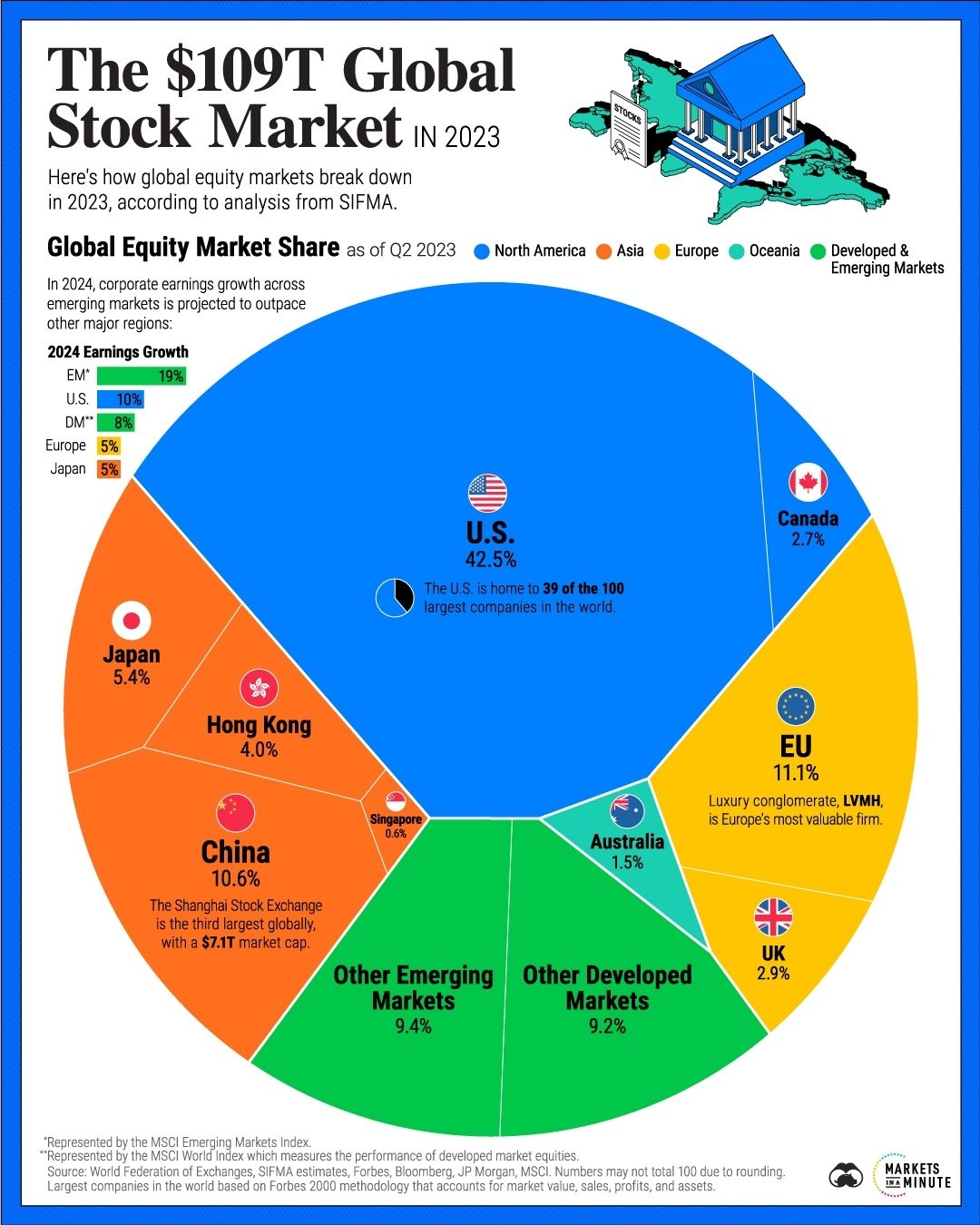
The global stock market has grown significantly, reaching a total market capitalization of $109 trillion in 2023. This growth has been driven by an increase in the money supply and ultra-low interest rates, which have supported rising asset values across various economies. Let's delve into the current state of the global equity markets, examining key regions and the factors contributing to their growth.
Why This Matters
Understanding the global stock market landscape is crucial for investors, economists, and policymakers. The dynamics of equity markets influence economic policies, investment strategies, and the overall financial health of nations. As of Q2 2023, global equity markets have shown substantial growth, reflecting broader economic trends and monetary policies.
Main Discussion
Global Equity Market Share by Region
The global equity market is dominated by a few key regions, each with its unique economic characteristics and market dynamics. According to analysis from the Securities Industry and Financial Markets Association (SIFMA), here’s a breakdown of the global equity market share as of Q2 2023:
The United States
The United States holds a commanding 42.5% of the global equity market share. This dominance is underpinned by several factors, including a robust economy, strong corporate governance, and a stable political environment. The U.S. is home to 39 of the 100 largest companies in the world, highlighting its significance in the global market. Key sectors driving this growth include technology, healthcare, and finance.
Europe
Europe accounts for 11.1% of the global equity market share. The region's largest company is LVMH, a luxury conglomerate that exemplifies the strength of Europe's luxury goods sector. Europe's market is characterized by diverse economic policies and a focus on sustainability and innovation. The region's equity market growth is supported by strong regulatory frameworks and a well-developed financial infrastructure.
Asia-Pacific
The Asia-Pacific region, particularly China and Japan, plays a pivotal role in the global equity market. China’s Shanghai Stock Exchange is the third-largest globally, with a market cap of $7.1 trillion. This reflects China's rapid economic growth and its increasing integration into the global financial system. Japan, on the other hand, holds 4.0% of the global equity market share, driven by its strong manufacturing sector and technological advancements. Hong Kong, with 10.6% of the market share, is another significant player in the region, serving as a key financial hub connecting East and West.
Other Regions
Other emerging and developed markets also contribute significantly to the global equity market. For instance, Hong Kong, with 10.6%, is a major financial hub. Australia and the UK hold 1.5% and 2.9% of the market share, respectively. These regions, along with other emerging markets, which collectively account for 9.4%, are characterized by high growth potential and increasing investor interest.
Earnings Growth Prospects
Earnings growth is a critical factor in the performance of equity markets. As of 2023, the projected earnings growth for the global market stands at 10%. This growth is driven by various factors, including increased consumer spending, technological innovation, and favorable monetary policies. The United States, with a projected earnings growth of 10%, continues to be a leader in this domain, supported by robust corporate earnings and a strong economic recovery.
Major Players and Market Cap
The global equity market is dominated by a handful of large corporations that significantly influence market trends. The United States, for example, is home to 39 of the 100 largest companies globally, highlighting its market dominance. In Europe, LVMH stands out as the most valuable firm, showcasing the region's strength in the luxury goods sector. The Shanghai Stock Exchange, with a market cap of $7.1 trillion, represents China's growing influence in the global financial landscape.
Practical Tips
Investing in the global equity market requires a strategic approach. Here are some practical tips to help navigate this complex landscape:
Diversify Your Portfolio
Diversification is key to mitigating risk in the global equity market. By spreading investments across different regions and sectors, investors can reduce the impact of market volatility on their portfolios. Focus on regions with strong economic fundamentals and growth potential, such as the United States, Europe, and key Asian markets.
Stay Informed
Keep up with the latest economic trends, policy changes, and market developments. Understanding the drivers of market growth and the potential risks can help in making informed investment decisions. Regularly consult reliable sources of financial data, such as the World Federation of Exchanges (WFE) and the Securities Industry and Financial Markets Association (SIFMA).
Leverage Financial Data Tools
Use financial data visualization tools, such as those provided by MSCI, to gain insights into market trends and performance. These tools can help in identifying growth opportunities and assessing the risk-reward ratio of different investments.
Consider Emerging Markets
Emerging markets, while riskier, offer high growth potential. Regions like Asia-Pacific and other emerging markets are experiencing rapid economic growth and increasing market integration. Investing in these regions can provide significant returns, but it is essential to conduct thorough research and risk assessment.
Important Takeaways
The global equity market has grown substantially, reaching $109 trillion in total market capitalization. Key regions, including the United States, Europe, and Asia-Pacific, play pivotal roles in this growth. Investors should focus on diversification, staying informed, and leveraging financial data tools to navigate the complex dynamics of the global market. Understanding the factors driving market growth and the potential risks can help in making informed investment decisions.
Conclusion
The global stock market's growth and dynamics reflect broader economic trends and monetary policies. As of 2023, key regions like the United States, Europe, and Asia-Pacific are driving this growth, each with its unique economic characteristics and market dynamics. By staying informed, diversifying portfolios, and leveraging financial data tools, investors can navigate this complex landscape and make strategic investment decisions.
Watch the Reel
Questions readers ask
Which regions have the most significant impact on the global stock market size of $109 trillion in 2023?
The United States and Europe are the most influential regions. The U.S. stock market, in particular, has a large share of the global market and has experienced significant growth. Europe is another major contributor, with its own unique dynamics and substantial market capitalization.
How have low interest rates contributed to the 2023 stock market growth?
Low interest rates have made borrowing cheaper, encouraging both businesses and consumers to spend and invest more. This increased spending and investment has driven up the prices of assets, including stocks, leading to a rise in the overall market capitalization.
What is the significance of the global stock market reaching $109 trillion in 2023?
This milestone indicates robust economic activity and confidence in global equity markets. It reflects broader economic trends and monetary policies, providing insights for investors, economists, and policymakers to make informed decisions about future investment strategies and financial regulations.
Which stock market, among the largest, has the most significant growth in 2023?
The US stock market, has shown remarkable growth, contributing significantly to the overall increase in the global stock market size. This growth is driven by a combination of factors such as increased money supply and favorable economic policies.
How does the European stock market compare to the US stock market in 2023?
The European stock market is another major player, with a substantial market capitalization. While the US stock market is larger, Europe's market has its own growth dynamics, driven by regional policies and economic trends.
Related deep dives
Similar reads based on topic and creator.

Recent articles
Fresh deep dives from the latest Reels we unpacked.




Comments
Be the first to comment.