Space Launch Sites and Their Global Impact
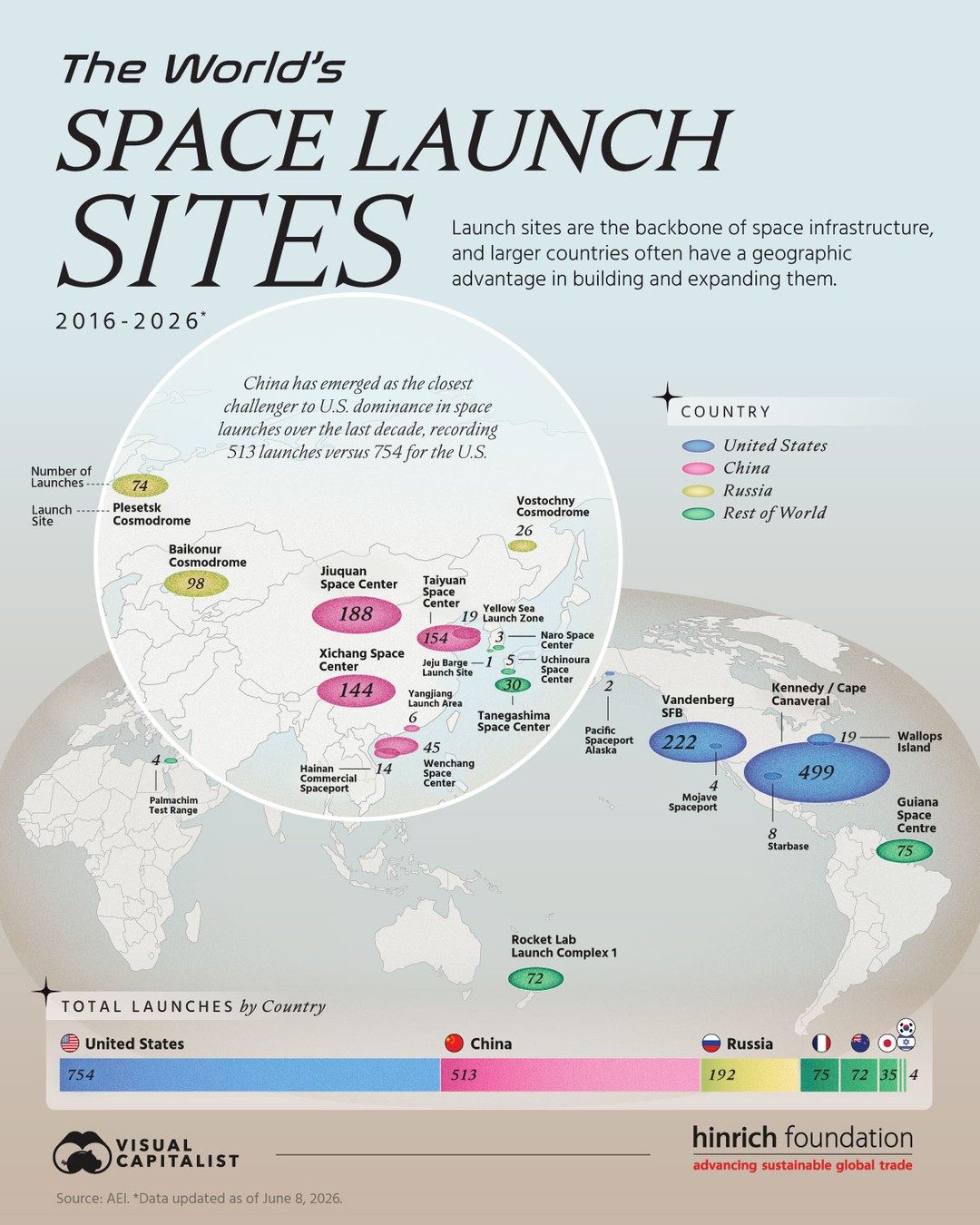
Space launch sites are pivotal infrastructure hubs that facilitate the expansion of space exploration and commercialization. These sites serve as the launching pads for satellites, space probes, and human spaceflight missions. The U.S. and China have been particularly active in this domain, accounting for more than 1,200 orbital launches since 2016. Understanding the distribution and capabilities of these launch sites is crucial for grasping the broader implications for global trade and technological advancement.
Why This Matters
The strategic importance of space launch sites cannot be overstated. These sites are the backbone of space infrastructure, and larger countries often have a geographic advantage in building and expanding them. Launch sites are not merely points on a map; they are essential components of a global network that supports scientific research, communication networks, and economic development. The proliferation of space launch capabilities is reshaping global trade and influencing geopolitical dynamics.
The Global Landscape of Space Launch Sites
The United States
The United States has long been a dominant player in the space launch industry. With a total of 754 launches between 2016 and 2026, the U.S. has the most advanced and diverse set of launch sites globally. Key launch sites in the U.S. include:
- Kennedy Space Center (KSC) in Florida: This is one of the most well-known space launch sites, having hosted historic missions like the Apollo moon landings and the Space Shuttle program. KSC is operated by NASA and supports both government and commercial space missions.
- Vandenberg Space Force Base in California: This site is strategically located for launching satellites into polar orbits, making it ideal for Earth observation and scientific missions.
- Cape Canaveral Space Force Station in Florida: Located adjacent to KSC, this site supports a wide range of launches, including those for the Department of Defense and commercial enterprises.
China
China has emerged as the closest challenger to U.S. dominance in space launches, recording 513 launches over the last decade. China's rapid growth in space capabilities is driven by strategic investments in infrastructure and technology. Key launch sites in China include:
- Jiuquan Satellite Launch Center: Located in the Gobi Desert, this is one of China's most active launch sites, supporting a variety of missions, including manned spaceflights and satellite launches.
- Taiyuan Satellite Launch Center: Situated in Shanxi Province, this site is known for launching remote sensing and communications satellites into polar orbits.
- Xichang Satellite Launch Center: Located in Sichuan Province, this site is primarily used for launching communications and navigation satellites into geostationary orbits.
Russia
Russia has a long history of space exploration and continues to be a significant player in the global space launch industry. Key launch sites in Russia include:
- Baikonur Cosmodrome in Kazakhstan: Although located in Kazakhstan, this site is leased by Russia and is one of the most historic and active launch sites globally. It has hosted numerous Soviet and Russian missions, including the first human spaceflight by Yuri Gagarin.
- Plesetsk Cosmodrome: Located in northern Russia, this site is used for launching military and scientific satellites.
The Rest of the World
Beyond the U.S., China, and Russia, several other countries have developed space launch capabilities. These include:
- Europe: The European Space Agency (ESA) operates the Guiana Space Centre in French Guiana, which is strategically located near the equator for efficient launches into geostationary orbits.
- India: The Indian Space Research Organization (ISRO) operates several launch sites, including the Satish Dhawan Space Centre in Sriharikota, which supports a range of satellite and interplanetary missions.
- Japan: The Japan Aerospace Exploration Agency (JAXA) operates the Tanegashima Space Center, which is known for launching scientific satellites and interplanetary probes.
The Role of Space Infrastructure in Global Trade
Space infrastructure, including launch sites, plays a crucial role in shaping the future of global trade. Satellites launched from these sites enable global communication networks, Earth observation, and navigation systems, all of which are essential for modern commerce and logistics. The strategic location of launch sites can provide economic advantages, such as reduced fuel requirements for launches into specific orbits.
Economic Impact
Space infrastructure supports various economic sectors, including telecommunications, agriculture, meteorology, and defense. The data and services provided by satellites launched from these sites are integral to modern business operations and national security. For example, satellite-based navigation systems like GPS are indispensable for logistics and transportation, enabling real-time tracking and routing of goods.
Technological Advancements
Space launch sites are hubs of technological innovation. The development and operation of these sites drive advancements in rocket technology, materials science, and automation. These technological spinoffs often find applications in other industries, contributing to broader economic growth and development.
Geopolitical Implications
Space launch capabilities are also a significant factor in geopolitical dynamics. Countries with advanced space infrastructure gain a strategic advantage in areas such as surveillance, communication, and defense. The competition among major space-faring nations, particularly the U.S. and China, reflects broader geopolitical rivalries and influences global power dynamics.
Practical Tips for Understanding Space Launch Sites
Stay Informed
Keeping up-to-date with the latest developments in space launch technology and infrastructure is essential for understanding their impact on global trade and geopolitics. Follow reputable sources for news and analysis on space missions and technological advancements.
Explore Interactive Maps
Utilize interactive maps and visualizations that detail the locations and capabilities of major space launch sites. These tools can provide a comprehensive overview of the global space launch infrastructure and help contextualize its significance.
Engage with Industry Experts
Engaging with industry experts and attending conferences or webinars on space exploration and infrastructure can provide deeper insights into the technical and strategic aspects of space launch sites. Networking with professionals in the field can also offer practical knowledge and perspectives.
Analyze Global Trends
Analyzing global trends in space launch activity can provide valuable insights into future developments and potential disruptions in the industry. Pay attention to trends in launch frequencies, technological advancements, and geopolitical shifts to stay ahead of emerging opportunities and challenges.
Important Takeaways
- U.S. and China Dominance: The U.S. and China are the leading countries in space launch activity, with China rapidly closing the gap in terms of launch capabilities.
- Strategic Importance: Space launch sites are critical for scientific research, communication networks, and global trade.
- Geopolitical Influence: The strategic location and capabilities of space launch sites influence geopolitical dynamics and national security.
- Global Impact: The proliferation of space launch capabilities is reshaping global trade, economic development, and technological innovation.
Conclusion
Space launch sites are more than just physical locations; they are the foundation of the global space infrastructure that drives scientific discovery, economic growth, and geopolitical influence. The U.S. and China's dominance in this arena, along with the contributions of other major players, highlights the strategic importance of space launch capabilities. Understanding the distribution and capabilities of these sites is essential for navigating the complex landscape of global trade and technological advancement. By staying informed and engaged with the latest developments, individuals and organizations can leverage the opportunities presented by the evolving space infrastructure.
Watch the Reel
Questions readers ask
What are the primary factors contributing to the U.S. and China's dominance in global space launch activities?
The U.S. and China's dominance in space launches is attributed to their extensive investment in space infrastructure, advanced launch technologies, and strategic locations of their launch sites. These countries also have robust space programs that prioritize both scientific and commercial space activities, allowing them to execute a high number of lauches.
How do space launch sites influence global trade and geopolitics?
Space launch sites play a significant role in global trade by enabling satellite communication and navigation systems crucial for international business and finance. Geopolitically, controlling these sites allows nations to enhance their strategic capabilities, monitor global activities, and exert influence over international affairs. The distribution and capabilities of these sites can shift global power dynamics.
What are the key space launch sites in the U.S. and China?
The U.S. maintains several key launch sites, including Cape Canaveral Space Force Station and Kennedy Space Center in Florida, Vandenberg Space Force Base in California, and the Pacific Spaceport Complex in Alaska. China's primary launch sites are the Jiuquan Satellite Launch Center, Taiyuan Satellite Launch Center, Xichang Satellite Launch Center, and the Wenchang Spacecraft Launch Site.
What impact have space launch sites had on technological advancements?
Space launch sites drive technological advancements by serving as testbeds for new propulsion systems, materials, and launch vehicle designs. They also facilitate the deployment of satellites that advance Earth observation, climate monitoring, and telecommunications technologies, benefiting various industries and daily life.
How has the number of orbital launches by the U.S. and China evolved since 2016?
Since 2016, both the U.S. and China have significantly increased their orbital launch activities. This trend reflects their growing investment in space capabilities and their ambition to lead in space exploration and commercialization. The competition between these two nations has led to rapid advancements and a higher frequency of launches.
What are the strategic advantages of having multiple space launch sites?
Having multiple space launch sites provides redundancy and flexibility, ensuring that launches can proceed even if one site is unavailable due to weather or technical issues. Additionally, strategically located sites offer better coverage for different orbital inclinations, enhancing a country's ability to reach various destinations in space and serve diverse mission requirements.
What role do private companies play in the U.S. and China's space launch activities?
In the U.S., private companies like SpaceX, Blue Origin, and United Launch Alliance have become major players in space launch activities, bringing innovation and competition to the industry. In China, while the state-owned China Aerospace Science and Technology Corporation dominates, private enterprises are also emerging, contributing to the nation's growing space capabilities.
Related deep dives
Similar reads based on topic and creator.


Recent articles
Fresh deep dives from the latest Reels we unpacked.




Comments
Be the first to comment.