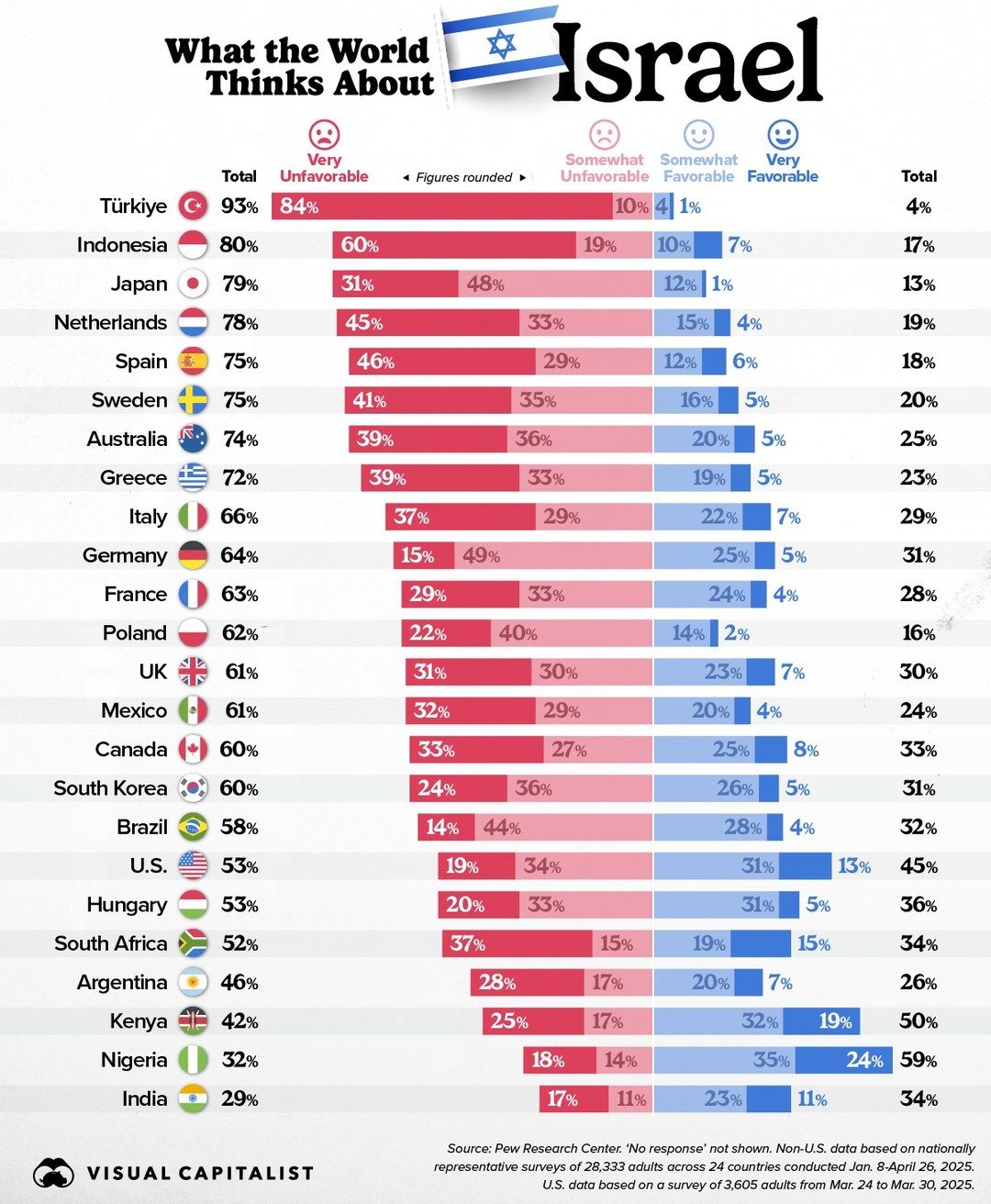
Global Opinions of Israel
The 2025 Pew Research Center survey reveals a global trend: the majority of countries hold a negative view of Israel. To understand the nuances and complexities of these sentiments, it's essential to delve deeper into the data.
Why This Matters
Global opinions can shape international relations, influence policy decisions, and affect the everyday lives of people in the region. Understanding public sentiment is crucial for gaining insight into the broader geopolitical landscape.
Main Discussion
Broad Trends
The 2025 survey encompassed 24 countries, providing a snapshot of international views towards Israel. The data reveals that more than half of the examined countries have a predominantly unfavorable view, marking a significant trend.
Positive Views
Only three countries within the surveyed group — India, Kenya, and Nigeria — hold more positive than negative views towards Israel. This offers a counterpoint to the broader trend and highlights the influence of unique cultural, historical, and diplomatic factors in these countries.
Negative Views
Most countries surveyed exhibit a predominantly unfavorable view. These sentiments vary in intensity, with some holding very unfavorable views and others showing somewhat unfavorable opinions. For a detailed perspective, the infographic categorizes sentiments into four groups: very unfavorable, somewhat unfavorable, somewhat favorable, and very favorable.
Contextual Insights
Japan
Japan shows one of the highest percentages of "very unfavorable" opinions, indicating deep-seated negative sentiments towards Israel. This aligns with broader geopolitical dynamics, where historical and strategic considerations play a significant role.
Türkiye
Türkiye displays a high percentage of "somewhat unfavorable" views, reflecting a nuanced stance towards Israel. This country's opinions might be influenced by its own geopolitical interests and regional dynamics.
Indonesia
Indonesia, similar to Türkiye, exhibits a mix of somewhat unfavorable and somewhat favorable opinions, suggesting a more balanced view compared to other nations in the survey.
Practical Tips for Understanding Global Sentiment
Analyze Key Factors
To comprehend global opinions, it's essential to consider the historical, cultural, and geopolitical factors at play. For instance, Japan’s historical relationship with Israel and the broader Middle East can shape public sentiment.
Conduct Comparative Studies
Comparing the survey data with historical trends can provide deeper insights. For example, understanding how opinions have evolved over time can help identify significant shifts and underlying causes.
Look Beyond the Numbers
Quantitative data is valuable, but qualitative analysis offers a more nuanced understanding. Considering the underlying reasons behind the sentiments can provide a more comprehensive view.
Important Takeaways
- Public opinion can vary widely between countries and is influenced by a mix of historical, cultural, and geopolitical factors.
- The majority of the surveyed countries hold unfavorable views of Israel, but there are notable exceptions, such as India, Kenya, and Nigeria.
- Sentiments towards Israel range from very unfavorable to very favorable, with most opinions falling into the somewhat unfavorable category.
- Understanding the complexities of global opinions requires a detailed analysis of the underlying factors.
Conclusion
The 2025 Pew Research Center survey provides a valuable snapshot of global opinions towards Israel. It highlights the broad trend of negative sentiments while also identifying countries with more positive views. By analyzing these data points and understanding the contextual factors, we gain a deeper insight into the geopolitical landscape and the multifaceted nature of international relations.
Watch the Reel
Questions readers ask
Which countries have the most negative views of Israel in 2025?
According to the 2025 Pew Research Center survey, Japan and Türkiye exhibit strong and nuanced negative views towards Israel. These countries stand out for their particularly unfavorable opinions compared to others in the survey.
How does India's view on Israel compare to global sentiments?
India presents a contrasting viewpoint to the global trend. While most countries hold negative opinions, India shows degrees of positivity towards Israel. This makes India an outlier in the survey's findings.
What is the significance of global opinions on Israel?
Global opinions on Israel can shape international relations, influence policy decisions, and impact the daily lives of people in the region. Understanding these sentiments provides valuable insights into the broader geopolitical landscape.
Which countries show favorable opinions of Israel in 2025?
Countries like India, Kenya, and Nigeria present varying degrees of positivity towards Israel. These countries stand out in the 2025 survey for their more favorable opinions compared to the global trend.
How widespread are negative opinions of Israel in 2025?
The 2025 survey indicates that more than half of the 24 countries examined hold predominantly unfavorable views of Israel. This trend highlights a significant global sentiment towards the country.
What method was used to gather data on global sentiments towards Israel?
The data on global sentiments towards Israel was gathered through a comprehensive survey conducted by the Pew Research Center in 2025. The survey encompassed 24 countries and provided a detailed snapshot of international views towards Israel.
How do Kenya and Nigeria view Israel compared to other countries?
Like India, Kenya and Nigeria also present varying degrees of positivity towards Israel. These countries offer a different perspective compared to the predominantly negative views held by many other countries in the survey.
Recent articles
Fresh deep dives from the latest Reels we unpacked.




Comments
Be the first to comment.