The Global Dominance of the U.S. Stock Market
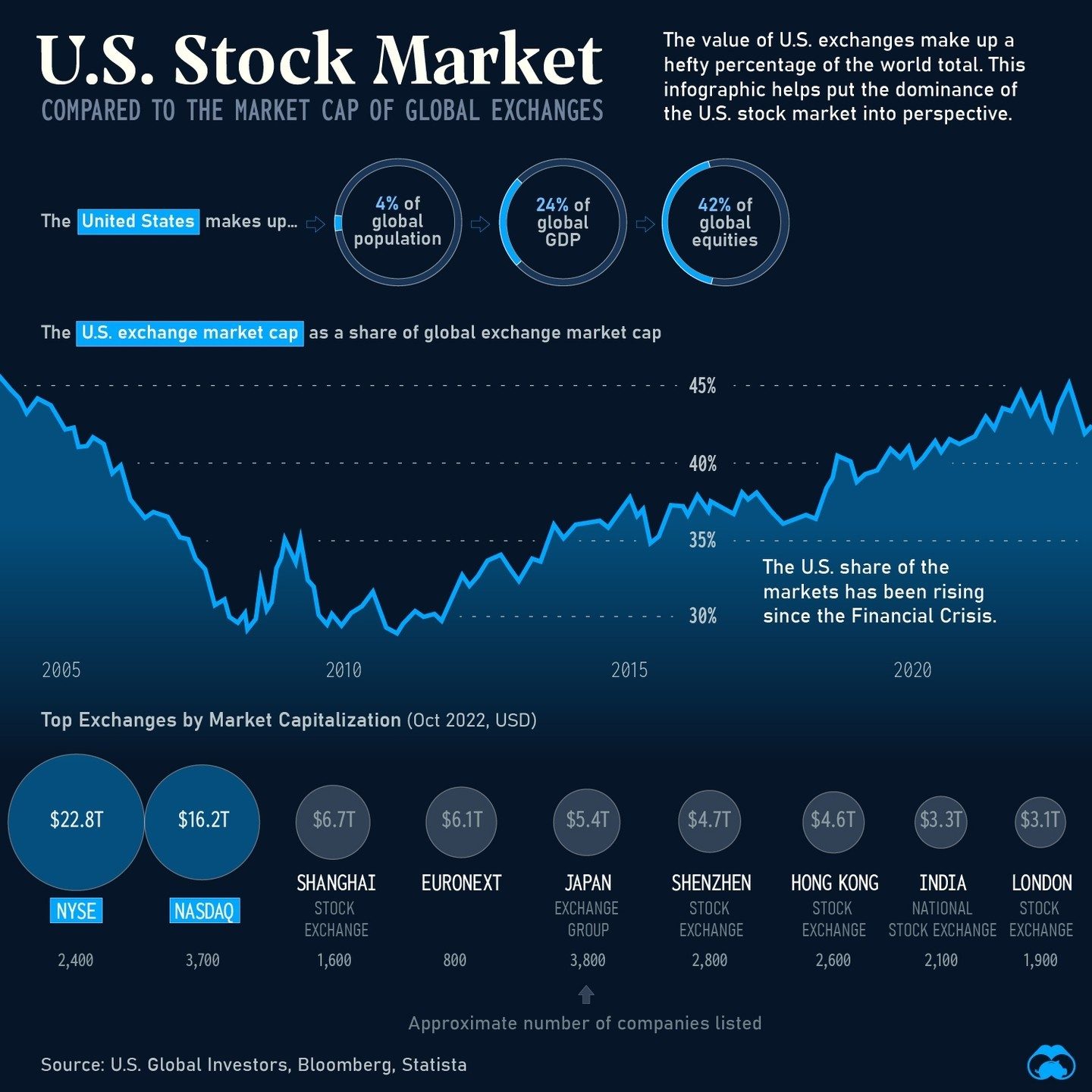
The U.S. stock market stands as a formidable presence in the global financial landscape. Representing 4% of the global population, the U.S. holds a staggering 24% of global equities. This financial power is most evident in the combined market capitalization of the New York Stock Exchange (NYSE) and NASDAQ, which together make up 45% of the global exchange market cap.
Context: Why This Matters
Understanding the U.S. stock market's global dominance is crucial for investors, policymakers, and economists. It provides insights into the American economy's resilience and influence, as well as the broader trends shaping global financial markets. The U.S. share of the market has been steadily rising since the Financial Crisis of 2008. This trend underscores the country’s economic recovery and its continued role as a global financial leader.
Main Discussion
The Rise of the U.S. Market
The Financial Crisis of 2008 marked a turning point for the U.S. stock market. Since then, the market capitalization of the NYSE and NASDAQ has grown significantly, reflecting the country’s economic resurgence. The U.S. share of the global market cap has been on an upward trajectory, reaching 45% as of 2022. This growth is a testament to the strength and attractiveness of the U.S. market, which continues to draw investments from around the world.
Top Exchanges by Market Capitalization
When comparing the U.S. market to global exchanges, it's essential to look at the top players. As of October 2022, the NYSE leads with a market capitalization of $22.8 trillion, followed by NASDAQ at $16.2 trillion. Other major exchanges include the Shanghai Stock Exchange at $6.7 trillion, Euronext Exchange at $6.1 trillion, and the Japan Exchange at $5.4 trillion. The Shanghai, Shenzhen, and Hong Kong exchanges collectively represent a significant portion of the global market, highlighting the growing influence of Asian markets. Additionally, the India National Stock Exchange and the London Stock Exchange contribute to the global landscape with market capitalizations of $4.7 trillion and $3.1 trillion, respectively.
A Global Perspective
While the U.S. market dominates, it's important to recognize the contributions of other exchanges. The Shanghai, Shenzhen, and Hong Kong exchanges together account for a considerable portion of the global market capitalization. Similarly, the Japan Exchange and Euronext Exchange play significant roles. This global perspective underscores the interconnected nature of financial markets and the importance of diversification in investment portfolios.
Comparative Analysis
An in-depth look at the number of companies listed on these exchanges provides further insights. The NYSE has approximately 2,400 companies, while NASDAQ lists around 3,700. In contrast, the Shanghai Stock Exchange has about 3,800 companies, and the Hong Kong Stock Exchange lists around 2,600. This variation in the number of companies listed reflects the different regulatory environments, economic structures, and industry focuses of these exchanges.
Practical Tips
Understanding Market Capitalization
To gain a deeper understanding of market capitalization, investors should focus on the total value of all publicly traded companies within an exchange. This metric provides a clear picture of the exchange's size and influence. Comparing market capitalizations between exchanges can help investors identify trends and opportunities in the global market.
Diversifying Investments
Given the dominance of the U.S. market, it's crucial for investors to diversify their portfolios. While the U.S. market offers significant opportunities, investing exclusively in U.S. stocks can expose investors to risks associated with market fluctuations and economic downturns. Diversifying into global markets, including those in Asia and Europe, can mitigate these risks and provide access to a broader range of investment opportunities.
Important Takeaways
The U.S. stock market's dominance is undeniable, with the NYSE and NASDAQ together representing 45% of the global exchange market cap. Since the Financial Crisis, the U.S. share of the market has been rising, reflecting the country’s economic strength and resilience. However, it's essential to recognize the contributions of other global exchanges, such as those in China, Japan, and Europe, which play significant roles in the global financial landscape. Diversifying investments across these markets can help investors manage risks and capitalize on global opportunities.
Conclusion
The global influence of the U.S. stock market is a testament to the country's economic power and the attractiveness of its financial markets. While the NYSE and NASDAQ dominate the global landscape, other exchanges, such as those in China, Japan, and Europe, also play crucial roles. Understanding the dynamics of these markets and diversifying investments accordingly can help investors navigate the complexities of the global financial landscape and achieve their investment goals.
Watch the Reel
Questions readers ask
Why does the U.S. stock market hold such a significant portion of global equities?
The U.S. stock market's size and influence can be attributed to several factors, including the strength of the American economy, the stability of its legal and regulatory environment, and the depth of its capital markets. This has allowed it to attract investments from around the world, contributing to its significant global share.
What are the NYSE and NASDAQ, and why are they important in this context?
The New York Stock Exchange (NYSE) and NASDAQ are two of the largest and most influential stock exchanges in the world. Together, they represent a significant portion of the global exchange market capitalization, making them key players in shaping global financial trends.
How has the U.S. stock market's share of the global market changed over time?
The U.S. stock market's share has been increasing since the 2008 Financial Crisis. This trend reflects the market's resilience and ability to attract investments, even during periods of global financial instability.
How does understanding the U.S. stock market's global reach benefit investors?
For investors, understanding the U.S. stock market's global reach and influence means gaining a better understanding of where to allocate assets, how global policies and events may impact their portfolios, and identifying opportunities for growth.
What are global equities, and why is the U.S. stock market's share of them important?
Global equities refer to the total value of all stocks across the world. The U.S. stock market's 24% share of this total is a testament to its size and influence, making it a key indicator of global economic health and a significant driver of global financial trends.
How do the NYSE and NASDAQ compare to other major global stock exchanges?
The NYSE and NASDAQ are among the top three stock exchanges globally by market capitalization. They are larger than any other individual exchange, including those in the United Kingdom, Japan, and China, making them central to global financial activity.
Recent articles
Fresh deep dives from the latest Reels we unpacked.




Comments
Be the first to comment.