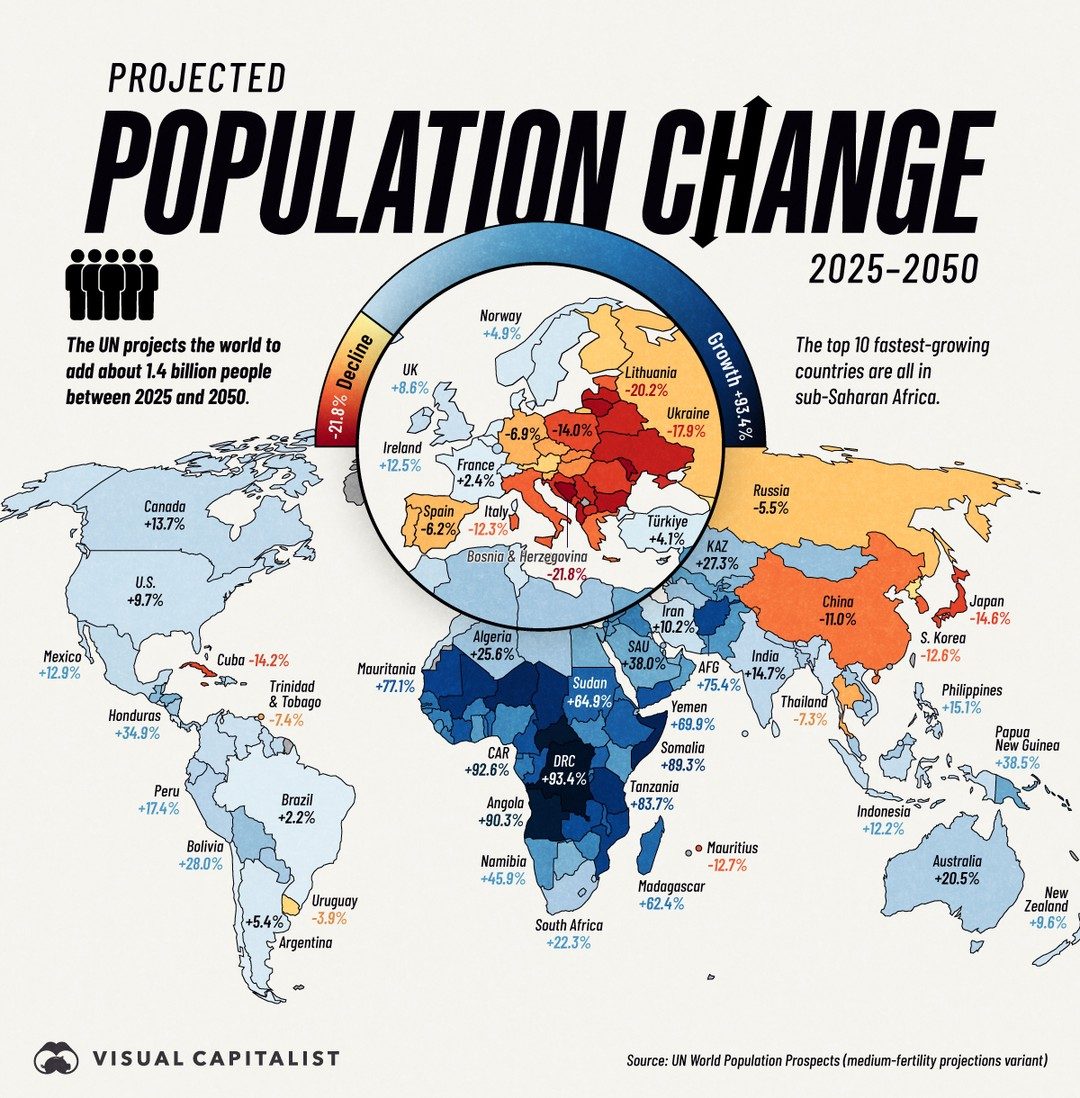
Population Change Projection
Over the next three decades, the world is projected to see significant shifts in population dynamics. By 2050, the global population is expected to increase by 1.4 billion people, with the bulk of this growth concentrated in sub-Saharan Africa. Major economies, on the other hand, are likely to experience population declines. This projection comes from the UN World Population Prospects 2024, which provides a detailed look at how populations are expected to change across various countries.
Why This Matters
Understanding these demographic shifts is crucial for policymakers, economists, and societies at large. Population growth and decline have far-reaching implications for resource allocation, economic development, and social infrastructure. For instance, countries experiencing rapid population growth will need to invest in education, healthcare, and job creation to support their expanding populations. Conversely, countries facing population decline may need to address issues related to an aging workforce and potential labor shortages.
Global Population Trends
Sub-Saharan Africa
Sub-Saharan Africa is poised to be the epicenter of global population growth. Countries like the Democratic Republic of Congo (DRC), Somalia, and Papua New Guinea are projected to see significant increases. The DRC, for example, could nearly double in size. This rapid growth presents both opportunities and challenges. On one hand, a large and growing population can drive economic growth and innovation. On the other, it places substantial pressure on resources and infrastructure.
Major Economies
Major economies, including Ukraine, Russia, and China, are projected to experience population declines. These declines can be attributed to factors such as low fertility rates, aging populations, and, in some cases, economic migration. For these countries, the focus will likely shift towards managing an aging population, ensuring adequate healthcare and pensions, and addressing potential labor shortages.
Regional Insights
Africa
Africa, particularly sub-Saharan Africa, will see the most dramatic changes. The top 10 fastest-growing countries are all located in this region. This growth is driven by high fertility rates and improving healthcare, which have led to increased life expectancy. Countries like Nigeria, Ethiopia, and Tanzania are expected to see substantial population increases, making them some of the most populous nations by 2050.
Asia
Asia, the world's most populous continent, will also experience significant changes. While countries like India and Pakistan are expected to see continued population growth, others like China and Japan will face declines. China, in particular, is anticipated to see a notable decrease due to its strict family planning policies in the past and an aging population.
Europe
Europe, like Asia, will see a mix of population growth and decline. Countries in Eastern Europe, such as Ukraine and Russia, are projected to experience population declines. In Western Europe, countries like Germany and Italy may see smaller increases or even stagnation due to low fertility rates and an aging population.
Practical Tips for Policy Makers
For countries facing rapid population growth, investment in infrastructure and social services will be critical. This includes building schools, hospitals, and housing, as well as creating job opportunities. Governments will need to implement policies that encourage economic growth and provide opportunities for their citizens. For instance, investing in education and vocational training can help prepare the workforce for future demands.
Conversely, countries facing population decline will need to focus on supporting their aging populations. This could involve increasing healthcare spending, reforming pension systems, and encouraging immigration to supplement the workforce. Policies aimed at boosting fertility rates, such as family-friendly policies and financial incentives, may also be considered.
Important Takeaways
- Rapid Growth in Sub-Saharan Africa: Countries in sub-Saharan Africa are expected to see the most significant population increases, with some nearly doubling in size. This presents both opportunities and challenges for economic and social development.
- Declines in Major Economies: Major economies like China, Russia, and Ukraine are projected to experience population declines, which will have implications for labor markets and social services.
- Investment Needed: Countries with rapid population growth will need to invest heavily in infrastructure and social services. Conversely, those with declining populations will need to support their aging populations and address labor shortages.
Conclusion
The projected population changes by 2050 highlight the need for strategic planning and policy-making. Whether a country is experiencing rapid growth or decline, the implications are vast and require careful consideration. By understanding these trends and preparing accordingly, countries can navigate the challenges and opportunities that lie ahead.
Watch the Reel
Questions readers ask
Why is Sub-Saharan Africa expected to lead global population growth by 2050?
Sub-Saharan Africa is expected to lead global population growth due to high fertility rates and a large youth population. With advancements in healthcare, life expectancy is also increasing, contributing to overall population growth. This concentrated growth will significantly impact the region's development and resource needs.
Which major economies are projected to experience population declines from 2025 to 2050?
Major economies like Russia, Ukraine, and China are projected to experience population declines. Factors contributing to these declines include low fertility rates and aging populations. These changes will present unique challenges for these countries, particularly in areas like workforce dynamics and economic growth.
How will global population shifts affect resource allocation and economic development?
Global population shifts will have significant impacts on resource allocation and economic development. Areas with high population growth, like Sub-Saharan Africa, may struggle with resource scarcity and infrastructure demands. Conversely, regions with declining populations, such as Russia, Ukraine, and China, will face labor shortages and economic restructuring challenges.
What are the primary factors influencing global population projections for 2050?
The primary factors influencing global population projections include fertility rates, life expectancy, and migration patterns. These factors vary significantly by region, leading to diverse growth and decline patterns. The UN World Population Prospects 2024 report provides detailed insights into these dynamics, which are crucial for policy planning and economic development strategies.
What will be the global population by 2050?
According to the UN World Population Prospects 2024, the global population is expected to reach approximately 9.7 billion by 2050, marking a 1.4 billion increase from current levels. This growth will be largely driven by population increases in regions like Sub-Saharan Africa, while other areas, particularly major economies, may see population declines.
Recent articles
Fresh deep dives from the latest Reels we unpacked.




Comments
Be the first to comment.