Language Status and Distribution
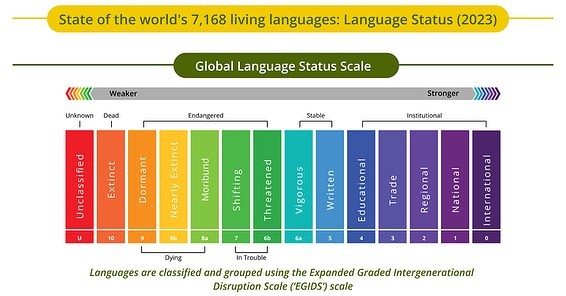
To gain a deep understanding of how languages are faring globally, it’s crucial to examine the current distribution and vitality of the world's 7,168 living languages. This analysis uses data from Ethnologue and breaks down the status of these languages into 12 states of vitality, which can be categorized into three broader groups: Endangered, Stable, and Institutional.
The Expanded Graded Intergenerational Disruption Scale (EGIDS) is a tool used to assess the vitality of languages. This scale ranges from 'Unknown' to 'International', with categories like 'Dead', 'Extinct', 'Endangered', 'Stable', and 'Institutional'. This classification helps us understand the current state of languages around the world, shedding light on their viability and the risks they face.
The State of Endangered Languages
Of the 7,168 living languages, a significant 43.0% are classified as 'Endangered', meaning they are at risk of becoming extinct. This translates to 3,078 languages that are endangered and at risk. The gravity of this situation becomes apparent when considering that 88.1 million people speak an endangered language as their primary 'mother tongue'.
Endangered languages span various regions, but notable examples include those spoken in indigenous communities in places like New Zealand and Hawaii. While these languages are at risk, efforts are being made worldwide to protect and revitalize them. These languages are at the most vulnerable end of the EGIDS scale, characterized by terms like 'Moribund' and 'Shifting', indicating limited intergenerational transmission.
Stable Languages and Their Distribution
On the other end of the spectrum, 50.2% of these living languages are classified as 'Stable'. This means that 3,600 languages have widespread social use across all age ranges. The EGIDS scale categorizes these languages as 'Vigorous' or 'Shifting', reflecting their robust presence in communities and societies. Stable languages are not at immediate risk of extinction and are actively used in everyday life, ensuring their intergenerational transmission.
A closer look reveals that 12.7% of language speakers use a Stable language in their homes and communities. This indicates a significant portion of the world's population relies on these languages for daily communication, preserving their cultural heritage without the immediate threat of extinction.
Institutional Languages: Global Dominance
Institutional languages make up the remaining 6.9% of the total. However, their significance lies in the fact that 81.9% of language speakers use an Institutional language. This dominance is due to the presence of languages like English, Spanish, Mandarin, and others that are widely spoken, taught, and recognized in various official capacities and media.
Institutional languages enjoy a high status in the EGIDS scale, primarily categorized as 'International' or 'National'. Their prevalence in literature, education, and international communication ensures their sustainability and widespread use. These languages have a global reach, influencing cultures and societies far beyond their traditional regions.
Distribution of Language Speakers
To fully grasp the dynamics, it's essential to compare the distribution of languages with the number of speakers. Although 43.0% of languages are endangered, only 16.9% of speakers primarily use these languages. This discrepancy underscores the vulnerability of these languages, despite a relatively smaller number of speakers.
Conversely, 50.2% of languages are stable, but only 12.7% of speakers primarily use them. Meanwhile, 6.9% of languages are institutional, but they are spoken by a vast 81.9% of the world's speakers. This distribution shows that while many languages are at risk, a significant portion of the world's population relies on a smaller set of languages for daily communication.
Practical Tips for Language Preservation
Efforts to preserve endangered languages require a multifaceted approach. Here are some practical tips for individuals and communities aiming to safeguard their linguistic heritage:
-
Documentation and Archiving: Documenting language texts, speeches, and traditional stories can preserve linguistic heritage. Collaborations with linguists and language archivists are crucial in this process.
-
Language Revitalization Programs: Establishing educational programs that teach endangered languages to younger generations is essential. Community-led initiatives can ensure that language learning is integrated into daily activities, making it more appealing to children.
-
Incorporation in Media: Encouraging the use of endangered languages in media, such as radio, television, and digital platforms, can increase their visibility and relevance, making them more appealing to younger generations.
-
Government and Institutional Support: Seeking support from government bodies and international organizations can provide the necessary resources, legal frameworks, and recognition for language preservation efforts.
-
Digital Technologies: Utilizing digital platforms and apps for language learning and practice can attract younger audiences and make learning more accessible and engaging.
Important Takeaways
The state of the world's languages underscores the urgent need for action in preserving linguistic diversity. While 43.0% of languages are endangered, efforts to revitalize and protect them are gaining traction. Recognizing the significance of preserving endangered languages is crucial for maintaining cultural heritage and fostering a more inclusive global community.
The dominance of institutional languages, with 81.9% of speakers using them, highlights the importance of balancing linguistic diversity with cultural dominance. While these languages play a vital role in global communication, preserving the diversity of less-spoken languages is essential.
Conclusion
Understanding the status and distribution of the world's 7,168 living languages provides a comprehensive view of global linguistic trends. The current data from Ethnologue and Visual Capitalist underscores the need for concerted efforts in preserving endangered languages and promoting linguistic diversity. The global community must recognize the value of linguistic heritage and take proactive measures to safeguard it.
Watch the Reel
Questions readers ask
What are the 12 language vitality states used in the article?
The 12 language vitality states range from 'Unknown' to 'International'. The key categories include 'Dead', 'Extinct', 'Endangered', 'Stable', and 'Institutional'. These states help assess the current health and risk of the world's languages.
Which organization provides the language data used in the article?
The article uses data from Ethnologue, a comprehensive reference work cataloging all of the world's known living languages. It provides statistics and information on the status and distribution of these languages.
How many languages are currently considered endangered?
Out of the 7,168 living languages, 3,078 are considered endangered. This means that nearly 43% of the world's languages are at risk of disappearing.
What is the Expanded Graded Intergenerational Disruption Scale (EGIDS)?
The EGIDS is a tool used to assess the vitality of languages. It categorizes languages based on their intergenerational transmission and use, ranging from 'Unknown' to 'International', with specific categories for 'Dead', 'Extinct', 'Endangered', 'Stable', and 'Institutional' languages.
What are the top three broader groups used to categorize language vitality?
The three broader groups used to categorize language vitality are Endangered, Stable, and Institutional. These groups help simplify the understanding of language statuses and their intergenerational transmission.
What is the significance of intergenerational language transmission in language preservation efforts?
Intergenerational language transmission is crucial for language preservation. Languages showing limited intergenerational transmission are at higher risk of endangerment. Supporting the transfer of languages from one generation to the next is vital for maintaining global language diversity.
How many people speak an endangered language as their primary mother tongue?
Approximately 88.1 million people speak an endangered language as their primary mother tongue. This highlights the significant number of individuals affected by language endangerment and the importance of preservation efforts.
Recent articles
Fresh deep dives from the latest Reels we unpacked.




Comments
Be the first to comment.