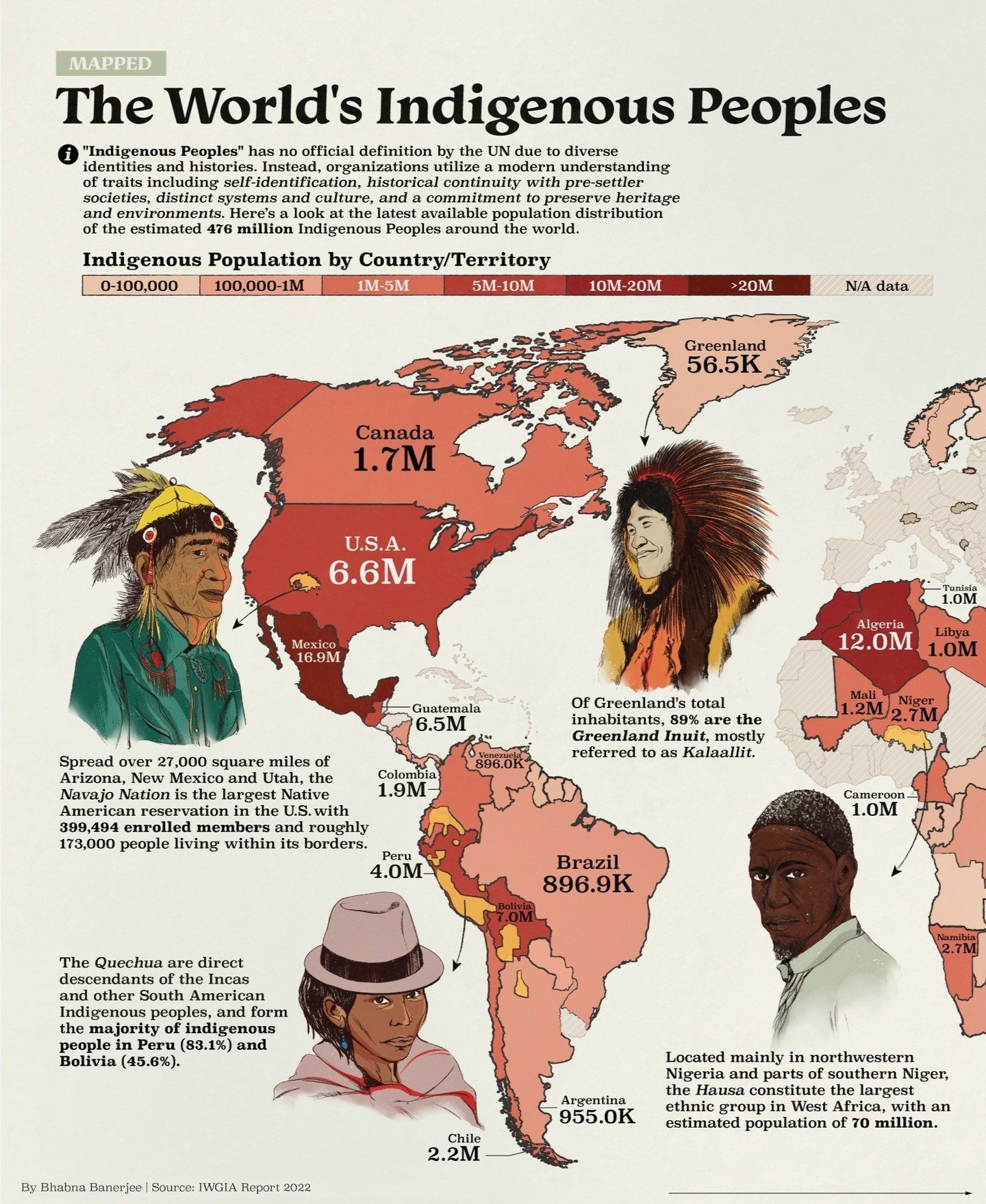
Indigenous Peoples Population
Understanding the global distribution of Indigenous peoples offers insight into the cultural and ancestral ties that have shaped our world. These groups, defined by their strong connections to their ancestral lands, make up a significant portion of the global population. While some have maintained their roots in their original territories, others have faced displacement, dilution, or have become minorities in their own lands. The Indigenous World 2022 report provides valuable data on the population distribution of the roughly 476 million Indigenous peoples around the world.
Context / Why This Matters
The demographics of Indigenous populations are crucial for understanding the cultural, social, and political landscapes of various regions. By examining the distribution and percentages of Indigenous peoples in different countries, we can better appreciate the diversity and challenges faced by these communities. This information is vital for policy-making, cultural preservation, and promoting reconciliation efforts.
Main Discussion
Global Overview
The world map highlights regions with significant Indigenous populations, providing a visual representation of their global distribution. The data reveals that Indigenous peoples are not evenly distributed but are concentrated in specific areas, often corresponding to their ancestral lands. For instance, countries like Bolivia and Guatemala have substantial Indigenous populations, with 48% and 43.8% of their populations respectively identified as Indigenous.
Regional Insights
North America
In North America, the Indigenous population is diverse and spread across various territories. For example, Greenland stands out with 89% of its population identified as Indigenous, reflecting the deep ancestral ties and cultural heritage of the Inuit people. Meanwhile, in territories like French Polynesia, 80% of the population is Indigenous, showcasing the region's strong cultural identity.
South America
South America hosts several countries with significant Indigenous populations. Bolivia leads with 48% of its population identified as Indigenous, followed by Guatemala with 43.8%. These figures underscore the importance of Indigenous cultures in the region and the need for policies that support their preservation and empowerment.
Asia and Oceania
In Asia and Oceania, the Indigenous population varies widely. Countries like the Russian Federation and Indonesia have sizable Indigenous communities, with 1.9 million and 6.6 million respectively. The Indigenous peoples in these regions often face unique challenges due to environmental changes, economic pressures, and cultural shifts.
Africa and the Middle East
Africa and the Middle East also have notable Indigenous populations. For example, Ethiopia has 16.9 million Indigenous people, while the Democratic Republic of the Congo has 7.0 million. These numbers highlight the rich cultural heritage and the need for inclusive policies that recognize and support Indigenous rights.
Key Countries and Territories
Greenland
Greenland has the highest percentage of Indigenous people, with 89% of its population identified as Indigenous. This high concentration underscores the region's deep cultural roots and the importance of preserving its unique heritage.
French Polynesia
French Polynesia follows closely with 80% of its population identified as Indigenous. The region's strong cultural identity is maintained through its Indigenous communities, who continue to practice traditional customs and languages.
Bolivia
Bolivia stands out with 48% of its population identified as Indigenous. The country's diverse Indigenous groups play a significant role in shaping its culture, politics, and social fabric.
Guatemala
Guatemala has 43.8% of its population identified as Indigenous, making it one of the countries with the highest percentages in South America. The Indigenous communities in Guatemala have a rich cultural heritage and face unique challenges in preserving their traditions.
Practical Tips
Understanding Cultural Sensitivity
When engaging with Indigenous communities, it is essential to approach with cultural sensitivity and respect. Understanding their cultural practices, languages, and traditions can foster better relationships and promote mutual understanding.
Supporting Indigenous Initiatives
Supporting Indigenous initiatives and organizations can help preserve cultural heritage and promote economic development. This support can come in various forms, including financial contributions, volunteering, and advocacy.
Promoting Inclusive Policies
Advocating for inclusive policies that recognize and support Indigenous rights is crucial. This includes policies related to land rights, cultural preservation, and economic empowerment.
Encouraging Educational Programs
Educational programs that focus on Indigenous cultures and histories can help promote a deeper understanding and appreciation of their contributions to global heritage. These programs can be integrated into school curricula and community events.
Important Takeaways
Indigenous peoples play a vital role in the cultural and social fabric of their countries. Their unique heritage, traditions, and practices contribute to the diversity and richness of our world. Recognizing and supporting their rights and needs is essential for preserving cultural heritage and promoting reconciliation.
Conclusion
The global distribution of Indigenous peoples reveals a complex and intricate web of cultural and ancestral ties that have shaped our world. From the high concentrations in Greenland and French Polynesia to the diverse communities in Bolivia and Guatemala, Indigenous peoples continue to make significant contributions to global heritage. By understanding their demographics, supporting their initiatives, and advocating for inclusive policies, we can promote a world that recognizes and celebrates the rich tapestry of Indigenous cultures.
Watch the Reel
Questions readers ask
What is the estimated total number of Indigenous peoples globally?
As of the most recent data, there are approximately 476 million Indigenous peoples distributed across the world. This number reflects the significant population of these communities and their impact on global cultural diversity.
Which regions have the highest concentrations of Indigenous peoples?
Indigenous peoples are concentrated in various regions, with significant populations in areas such as the Arctic, parts of North and South America, Australia, and the Pacific Islands. These regions are known for their rich cultural heritage and strong ancestral ties.
How does the displacement of Indigenous peoples affect their population distribution?
Displacement has led to changes in the distribution of Indigenous peoples, with many communities forced to leave their ancestral lands. This has resulted in some populations becoming minorities in their own lands and others dispersing to different regions, impacting their cultural and social structures.
Why are Indigenous population demographics important for policy-making?
Understanding the demographics of Indigenous populations is crucial for developing policies that address their unique needs and challenges. This information helps in crafting effective strategies for cultural preservation, community support, and promoting reconciliation efforts.
What are some of the key challenges faced by Indigenous communities globally?
Indigenous communities face numerous challenges, including loss of land and resources, cultural erosion, and social marginalization. Addressing these issues requires a deep understanding of their demographics and the specific circumstances they face in different regions around the world.
How does the data from reports like 'The Indigenous World 2022' support Indigenous communities?
Reports like 'The Indigenous World 2022' provide valuable data on the distribution and demographics of Indigenous populations. This data supports Indigenous communities by informing policymakers, advocates, and the public about the realities and needs of these groups, aiding in efforts to promote their rights and well-being.
What role do ancestral lands play in the identity and culture of Indigenous peoples?
Ancestral lands are fundamental to the identity and culture of Indigenous peoples. These lands hold deep spiritual, historical, and cultural significance, serving as the foundation for their traditions, livelihoods, and collective memory. Preserving these lands is essential for maintaining the integrity of Indigenous cultures.
Recent articles
Fresh deep dives from the latest Reels we unpacked.




Comments
Be the first to comment.