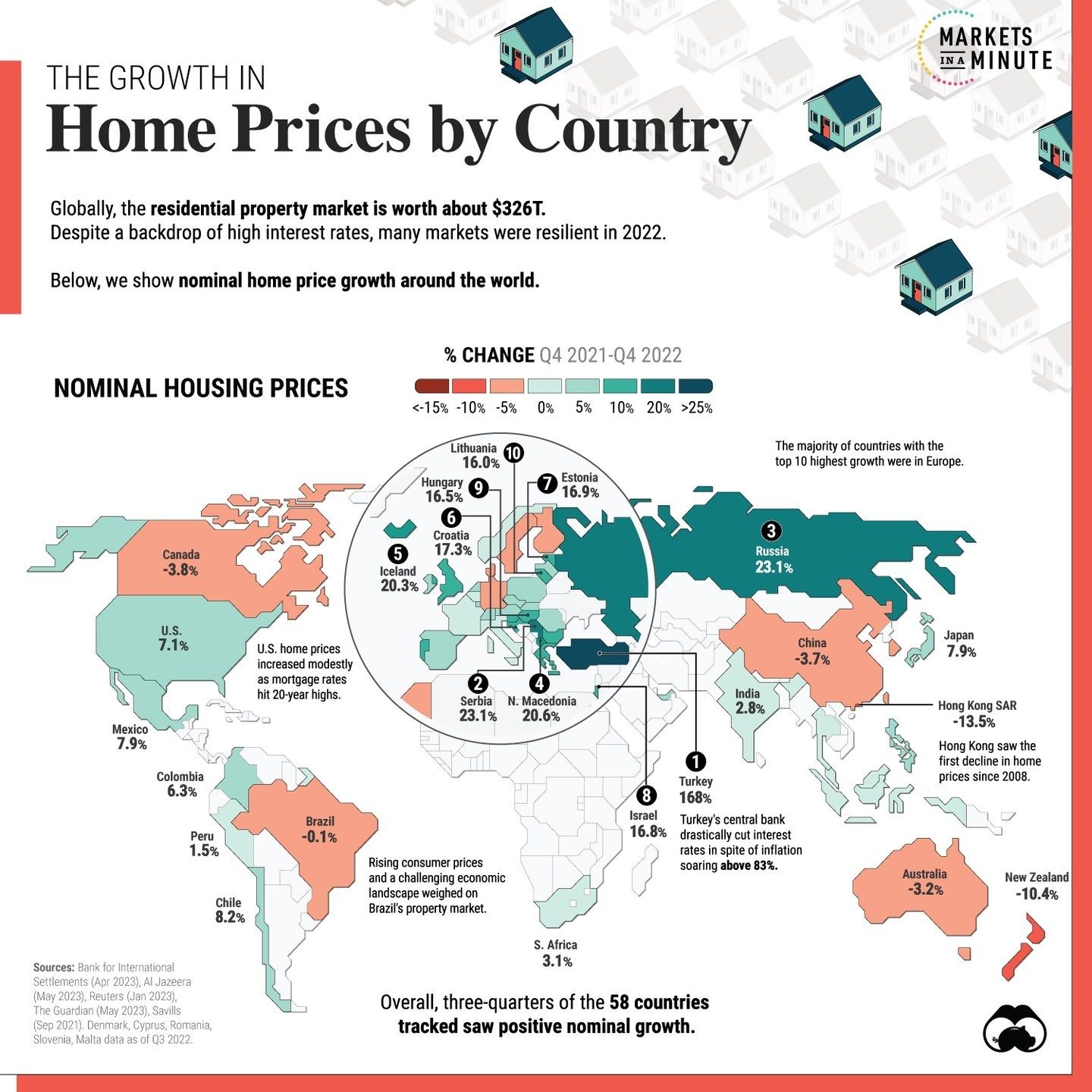
Global Housing Market Growth
The global housing market experienced significant shifts between the fourth quarter of 2021 and the fourth quarter of 2022. Despite a rise in interest rates and mortgage costs, housing markets around the world showed resilience. This article delves into the nuances of nominal and real housing price changes, highlighting key trends and providing a comprehensive overview of the market's performance.
Why This Matters
Understanding the dynamics of the global housing market is crucial for investors, homebuyers, and policymakers alike. The housing market is a critical component of the global economy, influencing employment, economic stability, and overall financial health. Recent trends reveal how various countries have navigated economic uncertainties, offering valuable insights into future market movements.
Main Discussion
Nominal Housing Prices
Nominal housing prices represent the market value of residential properties without adjusting for inflation. According to the data presented, the global residential property market is worth a staggering $326 trillion. This highlights the substantial economic impact of housing markets worldwide.
Countries with Significant Nominal Growth
Several countries experienced notable nominal growth in housing prices. For instance, Canada saw a 16.0% increase, reflecting a robust real estate market. Hungary and Croatia also showed significant growth, with increases of 16.5% and 17.3%, respectively. Iceland led with a remarkable 23.1% increase, indicating a booming housing market despite high interest rates. Russia followed closely with a 20.3% increase.
Countries with Declining Nominal Prices
Conversely, some countries experienced declines in nominal housing prices. Japan saw a 3.7% decrease, while China's drop was more pronounced at 7.9%. Mexico, Brazil, and Peru also faced declines, with decreases of 7.1%, 0.1%, and 1.5%, respectively. These declines suggest market adjustments and potential shifts in economic policies.
Real Housing Prices
Real housing prices, adjusted for inflation, provide a more accurate reflection of the market's performance by accounting for the purchasing power of money. The data reveals a 2% decline in real global housing prices, marking the first decrease in 12 years. This decline, although modest, indicates a significant shift in the market's dynamics.
Notable Real Price Changes
Russia stood out with a 9.7% increase in real housing prices, suggesting strong market resilience. In contrast, Japan and Australia experienced significant declines, with drops of 15.1% and 10.2%, respectively. New Zealand followed with a 16.5% decrease, highlighting a market correction. China and India also saw declines, with drops of 5.4% and 3.1%, respectively. These fluctuations underscore the diverse impacts of economic policies and interest rates on real estate markets.
Practical Tips
For homebuyers, the current market offers both opportunities and challenges. Here are some practical tips to navigate the evolving housing landscape:
Assess Market Trends
Stay informed about the trends in your target market. Understanding whether prices are rising or falling can help you make better financial decisions. Look for detailed reports from reliable sources, such as the Bank for International Settlements or local real estate agencies.
Consider Real vs. Nominal Prices
Real prices provide a clearer picture of affordability. By adjusting for inflation, you can better understand the long-term value of a property. This is especially important in countries experiencing high inflation rates.
Evaluate Economic Policies
Government policies, including interest rates and mortgage regulations, significantly impact housing markets. Keep an eye on economic indicators and policy changes that could affect property values and affordability.
Diversify Your Investments
For investors, diversifying your portfolio can help mitigate risks. Consider investing in multiple markets or property types to balance out potential losses and gains.
Seek Professional Advice
Consulting with real estate professionals and financial advisors can provide valuable insights. They can offer personalized advice based on your specific circumstances and market conditions.
Important Takeaways
Understanding the global housing market's dynamics is essential for making informed decisions. Here are some key takeaways:
- Nominal housing prices rose an average of 6% annually, but real prices fell 2% when adjusted for inflation.
- The global residential property market is valued at $326 trillion, underscoring its significant economic impact.
- High interest rates and mortgage costs did not deter market resilience, with three-quarters of the 58 countries analyzed showing positive nominal growth.
- Real prices remain 7% above pre-pandemic levels, indicating a sustained demand for housing even during economic uncertainties.
- Despite the overall decline in real prices, some countries like Russia and Iceland showed significant growth, highlighting diverse market performances.
Conclusion
The global housing market's performance between Q4 2021 and Q4 2022 reveals a complex interplay of economic factors and market dynamics. While nominal prices showed growth, real prices experienced a decline, reflecting the broader economic context. Understanding these trends is crucial for anyone involved in the housing market, whether as a buyer, investor, or policymaker. By staying informed and adapting to market changes, individuals and organizations can navigate the housing landscape more effectively.
Watch the Reel
Questions readers ask
How have global housing prices fared in 2023 despite rising interest rates?
Global housing prices in 2023 have shown resilience amid rising interest rates. While mortgage costs have increased, many markets have maintained steady growth, albeit at a slower pace than in previous years. This resilience can be attributed to factors like persistent demand and limited supply in key regions, which continue to buoy property values.
What is the impact of inflation on the housing market?
Inflation affects the housing market by increasing the cost of building materials and labor, which can drive up home prices. Additionally, inflation can erode purchasing power, making mortgages more expensive. However, real estate often serves as a hedge against inflation, as property values and rents tend to rise with inflation, protecting investors from its erosive effects.
How have interest rates affected the real estate market in 2022 and 2023?
Interest rates have significantly impacted the real estate market, with increases in 2022 and 2023 leading to higher mortgage costs. This has led to a slowdown in market activity, as potential buyers face higher borrowing costs. However, the market has shown resilience, with demand remaining strong in many areas, particularly where housing supply is limited.
What are the key trends in the global housing market for 2023?
Key trends in the global housing market for 2023 include ongoing resilience despite economic headwinds, with a focus on regional variations. Many markets are experiencing stable growth, while others face challenges due to supply constraints, rising costs, and changing buyer preferences. Policymakers and investors are closely monitoring these trends to navigate the evolving landscape effectively.
What can we expect from the global housing market forecast for the coming year?
The global housing market forecast for the coming year suggests a continuation of regional disparities, with some markets experiencing growth while others face declines. Factors such as interest rates, inflation, and local economic conditions will play a significant role in shaping market performance. Policymakers and investors should expect varied outcomes and adapt strategies accordingly.
Why is understanding global housing market trends important for investors and policymakers?
Understanding global housing market trends is crucial for investors and policymakers as these trends influence broader economic stability. Housing market fluctuations can affect employment, consumer spending, and overall financial health. By staying informed, stakeholders can make more informed decisions, mitigate risks, and capitalize on emerging opportunities in the dynamic housing market.
Recent articles
Fresh deep dives from the latest Reels we unpacked.




Comments
Be the first to comment.