Housing Affordability in Major Cities
Major global cities offer a multitude of advantages, from robust job markets and vibrant cultures to excellent amenities. However, affordability, particularly in the housing market, is often a significant challenge. Recent data from Demographia highlights the most unaffordable housing markets on a global scale, providing valuable insights into where living costs are highest.
Why This Matters
Understanding housing affordability is crucial for a variety of reasons, including personal financial planning, urban policy-making, and economic development strategies. For individuals and families, it directly impacts decisions about where to live, work, and raise a family. For policymakers, it informs strategies to mitigate housing crises and promote equitable development.
Main Discussion
The Data and Methodology
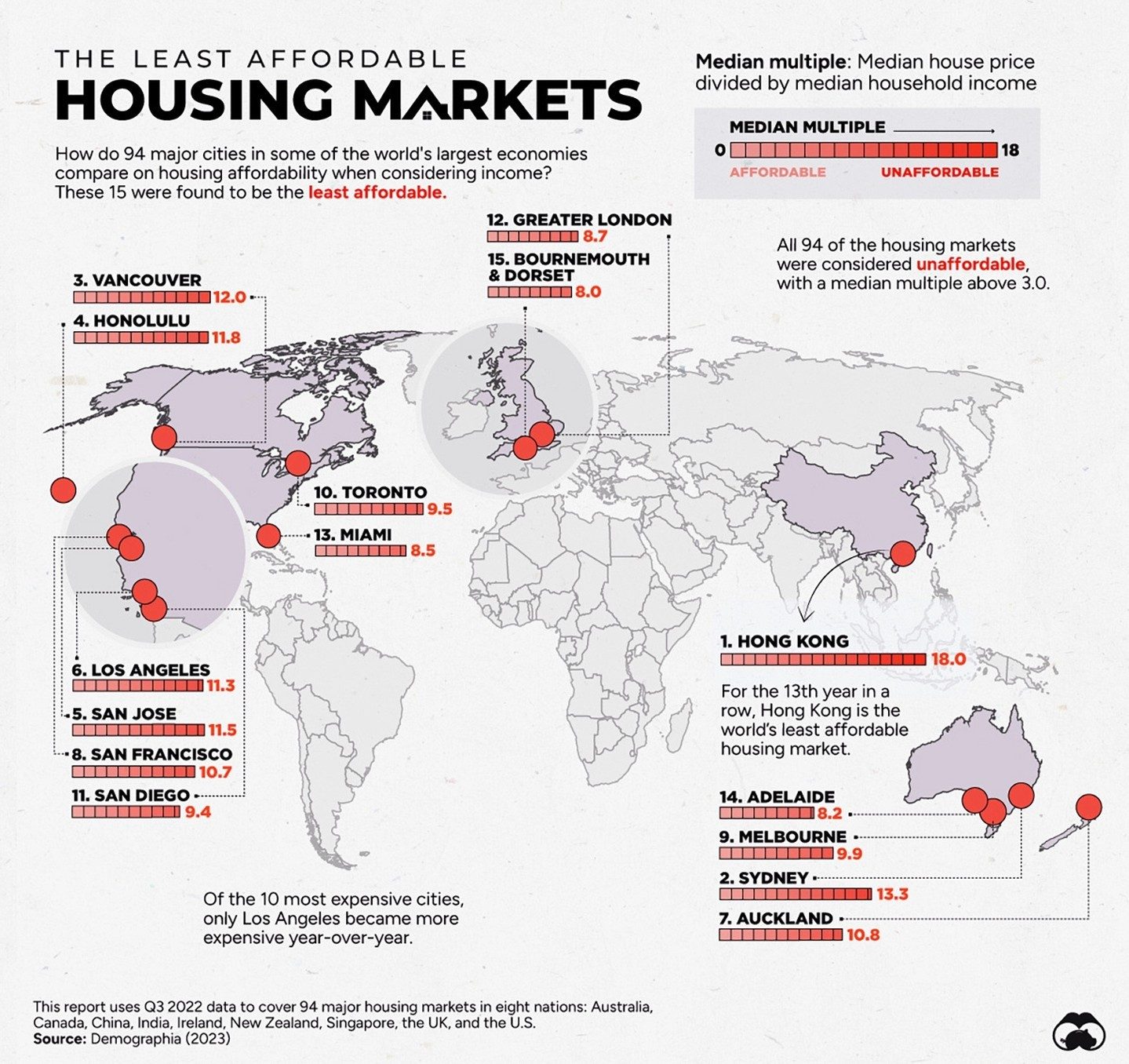
The analysis compares 94 major cities across eight countries, including Australia, Canada, China, India, Ireland, New Zealand, Singapore, the UK, and the U.S. The key metric used is the "median multiple," which is the median house price divided by the median household income. This ratio indicates how affordable a city's housing market is relative to local incomes.
Top Unaffordable Cities
Hong Kong: The Least Affordable
Hong Kong tops the list as the least affordable housing market for the 13th consecutive year. Its median multiple of 18.0 signifies that housing prices are nearly 18 times the median household income, making it notoriously difficult for residents to afford a home. Factors contributing to this include limited land availability, high demand, and stringent zoning regulations.
Sydney and Melbourne
Sydney and Melbourne, both in Australia, also rank high on the list of unaffordable cities. Sydney, in particular, has a median multiple of 13.3, indicating significant challenges for local residents seeking to purchase a home. Melbourne, with a median multiple of 9.9, is slightly more affordable than Sydney but still presents considerable financial obstacles.
U.S. Cities
Several major U.S. cities, including San Jose and Los Angeles, are also highly unaffordable. San Jose, with a median multiple of 11.7, and Los Angeles, with a median multiple of 10.7, exemplify the high cost of living in California. Other notable mentions include San Francisco, Miami, and Toronto. These cities reflect broader trends in urbanization and economic growth, where high demand and limited supply drive up housing prices.
The Global Perspective
The data underscores a global trend of increasing housing unaffordability. All 94 cities analyzed fall into the "unaffordable" category, with a median multiple above 3.0. This widespread issue underscores the need for innovative solutions and policy interventions to address the housing crisis in major urban centers.
Practical Tips
Research and Planning
Consider the cost of living in your desired city, including housing, utilities, and other expenses. Research historical housing price trends and current market conditions to make an informed decision.
Explore Alternative Locations
Sometimes, living in a nearby, less expensive city or suburb can offer a more affordable lifestyle while still providing access to the amenities of a major city. Consider areas with growing job markets and good public transportation.
Financial Strategies
Make sure to analyze your budget and plan for potential changes in housing costs, whether through mortgages, rent, or property taxes. Understanding your financial capabilities is key to making a sustainable decision.
Key Takeaways
The housing affordability crisis in major cities is a complex issue driven by various factors, including limited land availability, high demand, and strict zoning regulations. Hong Kong's prolonged status as the least affordable city, along with other cities like Sydney and San Jose, highlights the global nature of this challenge.
Conclusion
Addressing the issue of housing affordability requires a multi-faceted approach, involving both individual choices and broader policy efforts. By understanding the data and applying practical strategies, individuals can navigate the housing market more effectively. Meanwhile, policymakers must continue to develop and implement strategies to mitigate the housing crisis, ensuring that living in major cities remains a viable option for all.
Watch the Reel
Questions readers ask
What makes Hong Kong one of the least affordable cities in 2023?
Hong Kong's housing market is severely strained due to high demand and limited supply. The median housing prices are significantly higher than the median household income of its residents, making it extremely difficult for many to afford a home. High real estate costs are driven by Hong Kong's high demand, low supply, and a lack of land for development.
How does Sydney's housing market compare to other global cities in terms of affordability?
Sydney ranks among the least affordable cities in 2023, with median housing prices that are exceptionally high relative to median household incomes. The city's housing market is characterized by intense competition and limited availability, making it challenging for residents to secure affordable housing.
What factors contribute to the affordability crisis in major global cities?
Several factors contribute to the affordability crisis, including limited housing supply, high demand, stringent zoning laws, and economic disparities. Additionally, major global cities often have robust job markets and vibrant cultures, which attract a large number of people, further straining the housing market.
Why is understanding housing affordability important for individuals and families?
For individuals and families, understanding housing affordability is crucial for making informed decisions about where to live, work, and raise a family. It helps in personal financial planning and ensures that housing costs do not become a significant burden. This understanding also informs decisions about job relocation and future investments.
How can policymakers address the global housing affordability crisis?
Policymakers can address the housing affordability crisis by implementing strategies that increase the supply of affordable housing, such as easing zoning restrictions, incentivizing development, and promoting affordable housing policies. Additionally, they can invest in infrastructure to support the growth of new residential areas and encourage mixed-use development.
What are the implications of high housing prices in cities like Melbourne and Hong Kong for economic development?
High housing prices in cities like Melbourne and Hong Kong can have significant implications for economic development. They can lead to a decrease in workforce mobility, as people are less likely to move to areas with high housing costs. This can result in a shortage of skilled labor in certain sectors, potentially slowing economic growth. Additionally, high housing costs can widen income inequality, creating social and economic disparities that can undermine long-term economic stability.
Recent articles
Fresh deep dives from the latest Reels we unpacked.




Comments
Be the first to comment.