Introduction
Homicide rates vary significantly across different regions of the world, with some of the most dangerous countries concentrated in the Caribbean. The vast majority of these killings are driven by criminal activity, often involving illegal guns smuggled in from the United States.
Context: Why This Matters
Understanding regional homicide rates is crucial for multiple reasons. Firstly, it highlights areas that require urgent attention and intervention from law enforcement. Secondly, it sheds light on global patterns of violence, which can inform international policy and aid efforts.
Main Discussion
Homicide Rates in the Caribbean
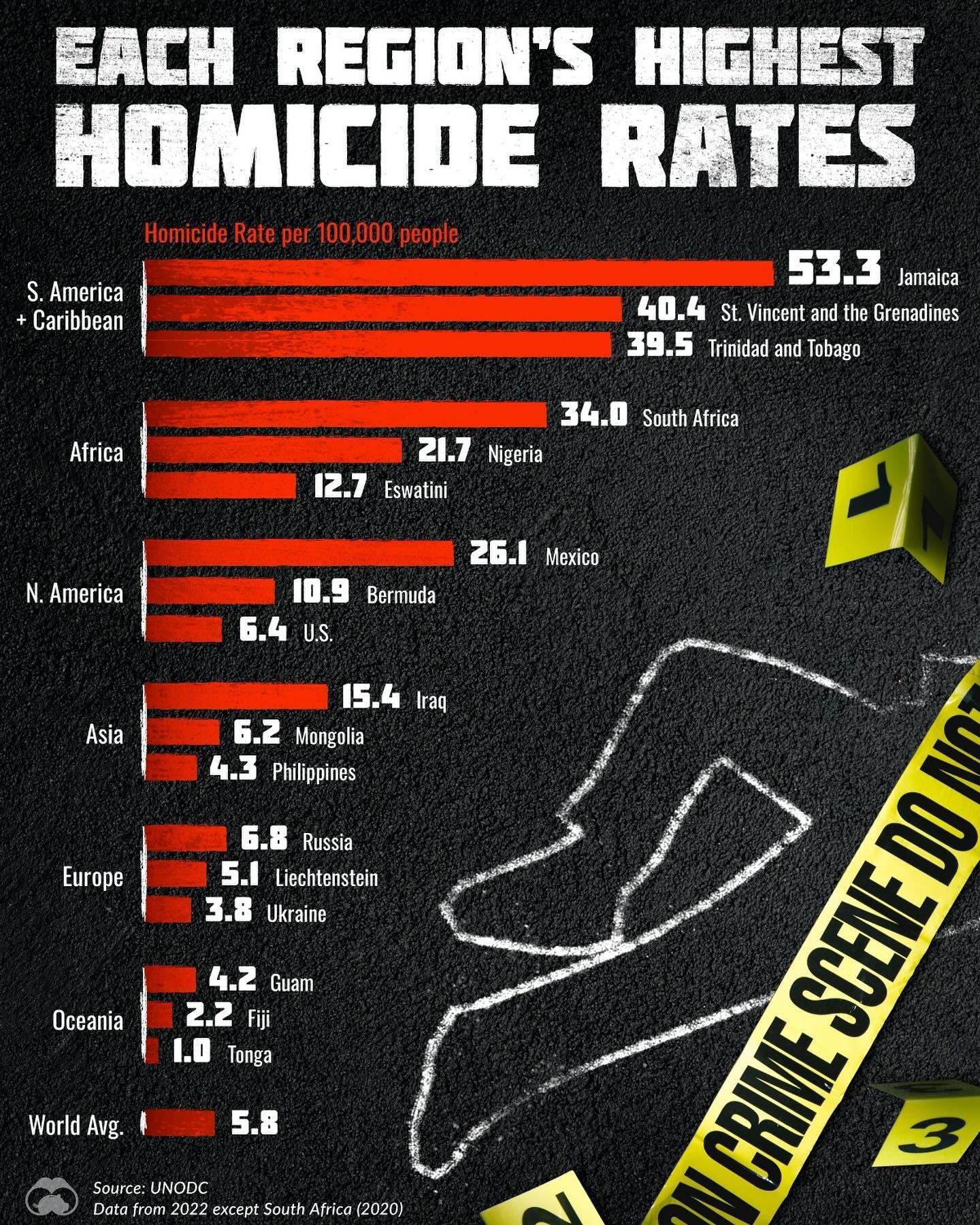
The Caribbean region, particularly the countries of Jamaica and St. Vincent and the Grenadines, stands out with alarmingly high homicide rates. Jamaica tops the list with a rate of 40.4 per 100,000 people, making it one of the most dangerous countries in the world. St. Vincent and the Grenadines follows closely with a rate of 39.5 per 100,000 people. These high rates are often attributed to organized crime and the proliferation of illegal firearms.
Africa's Homicide Landscape
In Africa, South Africa has the highest homicide rate, with 34.0 killings per 100,000 people. However, it is important to note that Eswatini, also in Africa, has a lower rate of 12.7, though it is still significant when compared to other regions. These numbers reflect the complex socio-economic challenges and political instability that many African countries face.
North America: A Mixed Picture
North America shows a mix of high and low homicide rates. While Bermuda has a relatively high rate of 10.9 per 100,000 people, the United States has a rate of 6.4. This disparity highlights the variability within the region and the need for context-specific interventions.
Asia and Europe
In Asia, Mongolia stands out with a homicide rate of 6.2 per 100,000 people, significantly higher than nearby countries like the Philippines (4.3) and Russia (6.8). Europe, on the other hand, shows a more uniform lower rate with Liechtenstein at 5.1 and Ukraine at 3.8 per 100,000 people. These rates reflect the varying levels of social stability and law enforcement effectiveness across the continent.
Oceania's Relatively Low Rates
Oceania presents a more stable picture with lower homicide rates. Guam has the highest rate in the region at 4.2 per 100,000 people, followed by Fiji at 2.2 and Tonga at 1.0. These figures suggest a relatively peaceful environment, although specific local issues may still require attention.
Practical Tips
For Policy Makers
- Data-Driven Policies: Utilize data from sources like the UNODC to create targeted policies that address the root causes of high homicide rates.
- Cross-Border Cooperation: Enhance cooperation between countries, particularly in regions like the Caribbean, to tackle the smuggling of illegal firearms and organized crime.
For Law Enforcement
- Targeted Interventions: Focus on high-risk areas and hotspots identified by data to allocate resources effectively.
- Community Engagement: Foster strong relationships with local communities to gain trust and support in combating crime.
For International Aid Organizations
- Resource Allocation: Direct aid and support to regions with the highest homicide rates to help stabilize communities and reduce violence.
- Capacity Building: Provide training and resources to law enforcement agencies in high-risk areas to improve their ability to respond to and prevent violent crimes.
Important Takeaways
- Regional Variability: Homicide rates can vary widely even within the same region, indicating the need for localized strategies.
- Illegal Guns: The smuggling of illegal guns from the United States significantly contributes to the high homicide rates in the Caribbean.
- Global Context: Understanding global homicide rates helps in identifying patterns and implementing effective measures to reduce violence.
Conclusion
Comparing homicide rates across different regions of the world provides a clear picture of where and why violence is most prevalent. The Caribbean, particularly Jamaica and St. Vincent and the Grenadines, faces a severe challenge with high homicide rates driven by criminal activity and illegal firearms. In contrast, regions like Oceania and parts of Europe show relatively lower rates, highlighting the importance of social stability and effective law enforcement. By understanding these patterns, policymakers, law enforcement, and international aid organizations can work towards reducing violence and improving the safety of communities around the world.
Watch the Reel
Questions readers ask
Which regions have the highest homicide rates in 2022?
The Caribbean region, particularly countries like Jamaica and St. Vincent and the Grenadines, has some of the highest homicide rates in 2022. South Africa also stands out for its high homicide rate, making it one of the most dangerous countries in the world.
What are the primary causes of high homicide rates in the Caribbean?
The high homicide rates in the Caribbean are primarily driven by organized crime and the widespread availability of illegal firearms. Many of these illegal guns are smuggled from other countries, notably the United States, and are used in criminal activities.
How does the homicide rate in the Caribbean compare to other regions?
The Caribbean has some of the highest homicide rates globally, significantly outpacing many other regions. For instance, the homicide rate per 100,000 people in the Caribbean is notably higher than in many parts of Europe and Asia, although some countries in Africa and South America also have elevated rates.
What role do illegal firearms play in global homicide rates?
Illegal firearms are a significant factor in global homicide rates, particularly in regions with high levels of organized crime, such as the Caribbean. The availability of illegal firearms often leads to increased violence and homicides, as these weapons are frequently used in criminal activities and gang-related conflicts.
Why is it important to track global homicide rates by region?
Tracking global homicide rates by region is crucial for identifying areas that need urgent attention and intervention from law enforcement. It also provides insights into global patterns of violence, which can inform international policy and aid efforts aimed at reducing violence and improving public safety.
Which organizations provide data on global homicide rates?
Organizations like the United Nations Office on Drugs and Crime (UNODC) provide comprehensive data on global homicide rates. The UNODC compiles and analyzes data from various countries to offer insights into homicide statistics, trends, and regional differences.
Recent articles
Fresh deep dives from the latest Reels we unpacked.




Comments
Be the first to comment.