Global Government Types
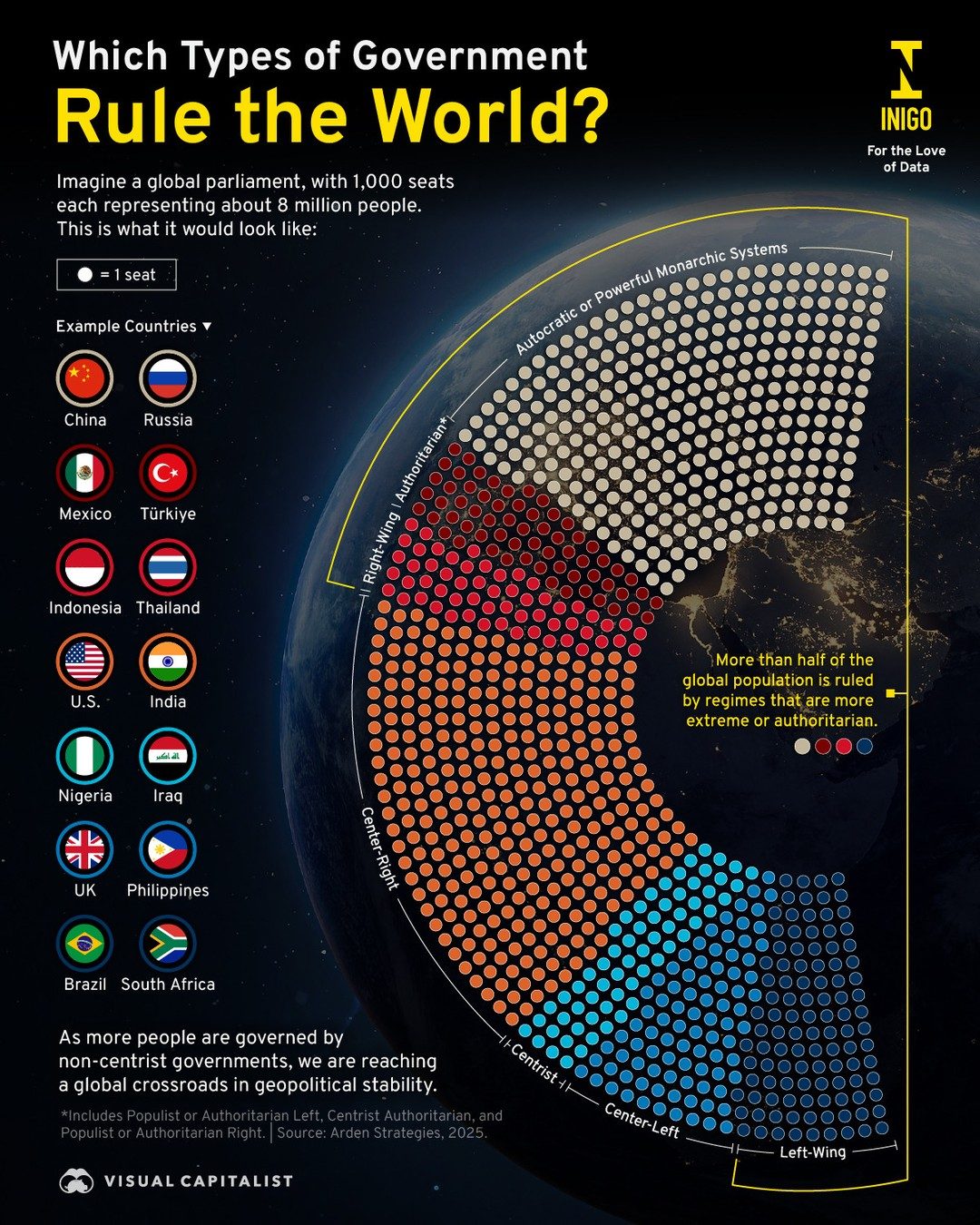
Over half the global population lives under governments that are not centrist, including a variety of types such as autocracies and left- or right-wing parties. Understanding the distribution and characteristics of these government types provides valuable insights into the global political landscape.
Context / Why This Matters
The distribution of government types is a critical factor in global politics and geopolitical stability. By examining the prevalence of different government structures, we can better understand the underlying dynamics that shape international relations, economic policies, and social governance. This knowledge is crucial for anyone interested in politics, international relations, or global affairs.
Main Discussion
The Global Parliament: A Hypothetical Representation
Imagine a global parliament with 1,000 seats, each representing approximately 8 million people. This hypothetical assembly offers a clear visual representation of how different types of governments are distributed around the world. By categorizing these governments, we can analyze the balance of power and the potential for geopolitical shifts.
Categories of Governments
The infographic categorizes governments into several types:
- Autocratic or Powerful Monarchic Systems: Governments where power is concentrated in the hands of a single ruler or a small group, often with little to no democratic input.
- Right-Wing: Governments that lean towards conservative or traditionalist policies, often emphasizing nationalism and strong law enforcement.
- Authoritarian Left: Governments that combine authoritarian rule with left-wing policies, often emphasizing social welfare and state control over the economy.
- Centrist Authoritarian: Governments that position themselves as centrist but implement authoritarian policies, balancing between left- and right-wing ideologies while maintaining a firm grip on power.
- Populist or Authoritarian: Governments that use populist rhetoric to gain support, often promoting policies that appeal to the masses while consolidating power in the hands of a single leader or party.
Example Countries and Their Government Types
To provide a clearer understanding, let's look at some example countries and their respective government types:
- China: Often categorized as an authoritarian regime, with a strong centralized government and limited democratic institutions.
- Russia: Known for its authoritarian leanings, with a government that combines elements of populism and strong central control.
- Mexico: A federal republic with a multi-party system, but often criticized for issues related to corruption and the influence of organized crime.
- Türkiye: A presidential republic with a strong executive branch, often leaning towards conservative and nationalist policies.
- Indonesia: A presidential republic with a democratic system, but with challenges related to regional autonomy and governance.
- Thailand: A constitutional monarchy with a history of military coups and authoritarian rule, often balancing between democratic reforms and military intervention.
- U.S.: A federal presidential constitutional republic, with a strong emphasis on democratic principles and a multi-party system.
- India: The world's largest democracy, with a parliamentary system and a federal structure, but also facing challenges related to governance and social issues.
- Nigeria: A federal presidential republic with a multi-party system, but facing issues related to corruption and regional stability.
- Iraq: A federal parliamentary republic, with a history of authoritarian rule and ongoing challenges related to governance and sectarian tensions.
- UK: A parliamentary constitutional monarchy, with a strong tradition of democratic governance and a multi-party system.
- Philippines: A presidential republic with a multi-party system, but often criticized for issues related to authoritarian tendencies and human rights abuses.
- Israel: A parliamentary republic, with a strong emphasis on democratic governance, but also facing challenges related to regional conflicts and social issues.
- South Africa: A parliamentary republic, with a democratic system and a history of racial inequality and social challenges.
The Shift Towards Non-Centrist Governments
As more people are governed by non-centrist governments, the world is reaching a global crossroads in geopolitical stability. This shift has significant implications for international relations, economic policies, and social governance. Understanding these changes is crucial for navigating the complexities of the modern political landscape and predicting future geopolitical trends.
Practical Tips
When analyzing global government types, consider the following practical tips:
- Understand the nuances: Different countries have unique political systems and governance structures. Avoid oversimplifying or stereotyping by understanding the specific context and historical background of each country.
- Look at key indicators: Pay attention to key indicators such as democratic institutions, civil liberties, and economic policies. These factors can provide valuable insights into the nature and effectiveness of a government.
- Monitor trends: Keep an eye on political and economic trends in different regions. Understanding these trends can help predict future shifts in global politics and geopolitical stability.
- Stay informed: Follow reliable news sources and expert analyses to stay updated on the latest developments in global politics.
Important Takeaways
- Global government types are diverse and complex: Different countries have unique political systems and governance structures, each with its own set of challenges and opportunities.
- Autocratic and authoritarian systems are prevalent: A significant portion of the global population lives under governments that are more authoritarian or extreme in nature.
- Understanding these systems is crucial: Knowing the distribution and characteristics of different government types is essential for navigating the complexities of the modern political landscape.
- Geopolitical stability is at a crossroads: As more people are governed by non-centrist governments, the world is facing significant geopolitical shifts that will shape the future of global politics.
Conclusion
The distribution of global government types offers valuable insights into the political landscape and geopolitical stability. By understanding the nuances of different government structures and their implications, we can better navigate the complexities of the modern political world. As the world continues to evolve, staying informed and adaptable will be crucial for addressing the challenges and opportunities that lie ahead.
Watch the Reel
Questions readers ask
What are non-centrist governments and why are they significant?
Non-centrist governments are political systems that do not align with the center of the political spectrum. They include a wide range of types, such as authoritarian regimes, left-wing, and right-wing parties. Their significance lies in their prevalence, with over half the global population living under these systems. Understanding these governments is key to grasping global politics and geopolitical stability.
What are the main types of non-centrist governments?
The main types of non-centrist governments include authoritarian regimes, left-wing governments, and right-wing governments. Authoritarian regimes are characterized by strong central control and limited political freedoms, while left-wing and right-wing governments have distinct ideologies and policies. Each type has unique characteristics that influence international relations and global affairs.
How do authoritarian governments differ from democratic ones?
Authoritarian governments differ from democratic ones in several key ways, including limited political freedoms, lack of free elections, and concentration of power in the hands of a single leader or party. In contrast, democratic governments typically have regular elections, protect civil liberties, and have power-sharing mechanisms. The distinction between autocracy vs. democracy is crucial for understanding global governance.
Who are some of the world's authoritarian leaders?
Some of the world's authoritarian leaders include Vladimir Putin of Russia, Xi Jinping of China, and Kim Jong-un of North Korea. These leaders are known for their strong central control and lack of political freedoms. However, it's important to note that the list of authoritarian leaders can vary and evolve over time.
How does the prevalence of non-centrist governments impact global population governance?
The prevalence of non-centrist governments significantly impacts global population governance by influencing economic policies, social governance, and international relations. For instance, autocratic regimes may implement different economic policies compared to democratic ones. Understanding these dynamics is crucial for navigating the complex landscape of global governance and politics.
How do non-centrist governments influence international relations?
Non-centrist governments influence international relations through their unique policies and ideologies. For example, left-wing governments may prioritize social welfare programs, while right-wing governments may focus on economic liberalization. These differences can shape geopolitical stability and international relations, making it essential to understand non-centrist governments' dynamics.
Why is it important to understand global government types?
Understanding global government types is crucial for grasping the nuances of global politics and geopolitical stability. It provides valuable insights into international relations, economic policies, and social governance. This knowledge is vital for anyone interested in politics, international relations, or global affairs, as it helps predict and interpret global events.
Recent articles
Fresh deep dives from the latest Reels we unpacked.




Comments
Be the first to comment.