Global GDP Projections for 2050
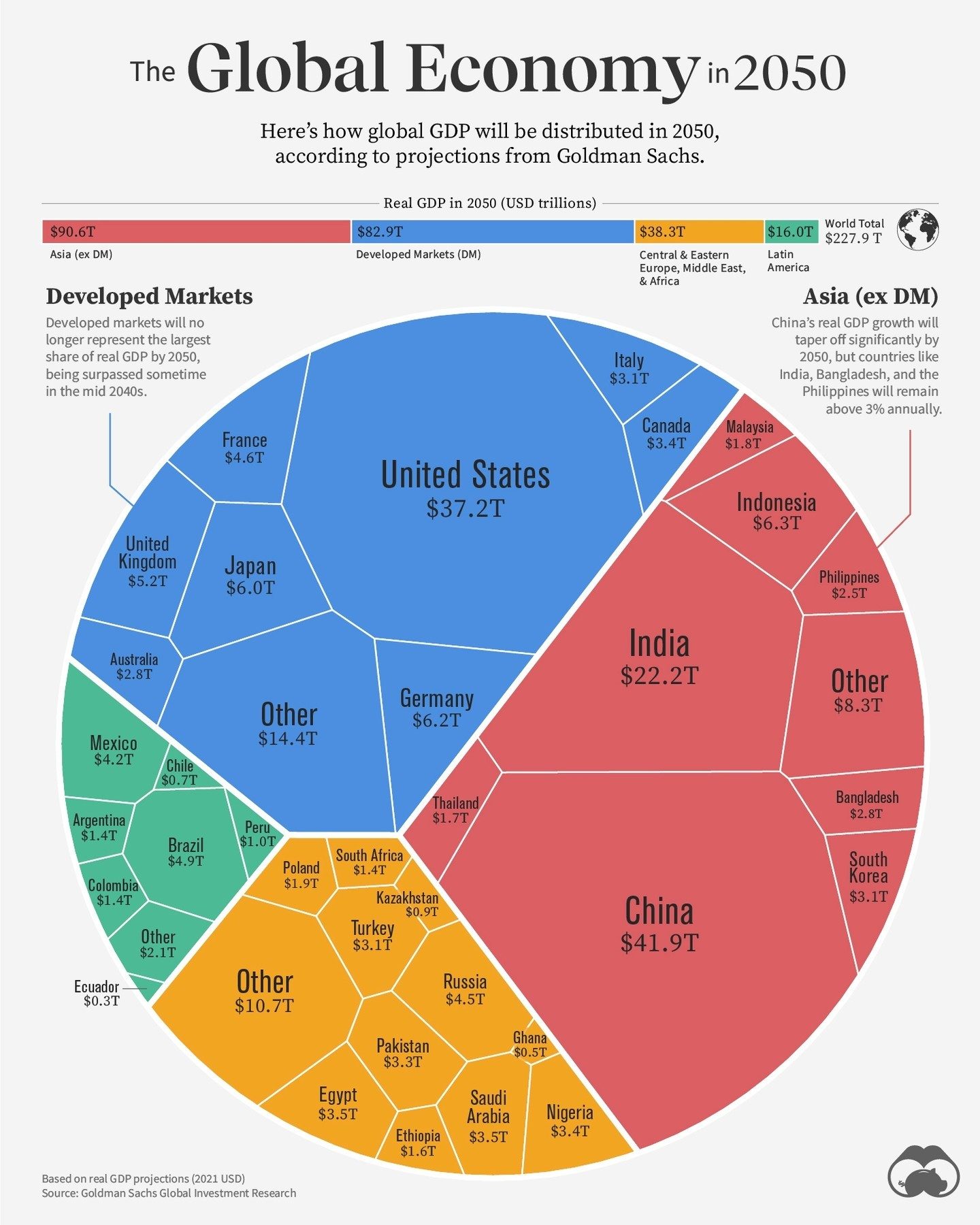
By 2050, global economic power is expected to shift significantly, with Asia poised to become the largest regional contributor to world GDP, surpassing the traditional economic powerhouses in the Developed Markets category. This shift is evident in the projections from Goldman Sachs, which outline a future where economic growth will be driven by diverse regions and countries.
Why This Matters
Understanding the projected distribution of global GDP in 2050 is crucial for businesses, policymakers, and investors. It provides insights into where future economic opportunities and challenges may arise, helping stakeholders make informed decisions about investment, trade, and policy. The projections also highlight the evolving dynamics of global economic power, with emerging markets playing an increasingly significant role.
Asia's Rising Economic Power
A Shift in Economic Leadership
Asia's rise to economic dominance is a key trend highlighted in the projections. By 2050, Asia (excluding Developed Markets) is expected to contribute $8.9 trillion to the global GDP, a substantial increase from its current position. This growth is driven by several factors, including rapid urbanization, technological advancements, and favorable demographic trends.
Key Asian Economies
China's Role: China's real GDP growth is expected to taper off by 2050, but it will remain a significant economic power with a projected GDP of $90.6 trillion. Despite the slowdown, China's vast market and technological advancements will continue to influence global economic trends.
India's Ascension: India is poised to be a major beneficiary of this economic shift. Projected to have a real GDP of $22.2 trillion by 2050, India's growth rate is expected to remain above 3% annually. This growth is supported by a young and growing workforce, digital innovation, and increasing integration into global supply chains. Countries like Bangladesh and the Philippines are also expected to maintain growth rates above 3% annually, further bolstering Asia's economic prowess.
Developed Markets: A Changing Landscape
Traditional Powerhouses
Developed Markets, which include regions like the United States, Europe, and Japan, are expected to contribute $38.3 trillion to the global GDP in 2050. While this figure is impressive, it represents a smaller share of the overall global GDP compared to Asia.
United States: The U.S. remains a dominant player with a projected GDP of $37.2 trillion. Despite its continued influence, the U.S. economy will face challenges, including demographic shifts and increasing competition from Asian economies.
Europe: Countries like Germany ($6.2 trillion) and France ($6.0 trillion) will maintain their economic significance, benefiting from advanced industries and strong trade relationships. However, they will need to address issues such as aging populations and the need for structural reforms.
Japan: Japan's projected GDP of $4.2 trillion highlights its continued economic importance, though it will also need to navigate demographic challenges and technological changes.
Emerging Markets in Developed Regions
Countries like Canada, Russia, and South Korea are also expected to play significant roles. Canada's projected GDP of $3.4 trillion, Russia's $4.5 trillion, and South Korea's $3.1 trillion underscore their growing influence in the global economy. These countries benefit from their unique strengths, such as natural resources, technology, and strategic geographic locations.
Emerging Markets: The New Contributors
Emerging markets, particularly in Asia, Africa, and Latin America, are expected to drive much of the global economic growth. Here are some notable projections:
Asia (excl. Developed Markets)
Philippines: Projected to have a GDP of $2.5 trillion, the Philippines is poised for significant growth driven by its young population and expanding middle class.
Malaysia: With a projected GDP of $1.9 trillion, Malaysia will benefit from its strong manufacturing sector and strategic location in Southeast Asia.
Africa
Nigeria: Africa's largest economy, Nigeria, is projected to have a GDP of $3.5 trillion. This growth will be fueled by its natural resources, expanding services sector, and increasing foreign investment.
South Africa: South Africa, with a projected GDP of $1.9 trillion, will leverage its advanced industries and strategic location to drive economic growth.
Latin America
Brazil: Brazil's projected GDP of $4.9 trillion highlights its status as a major economic player in the region. The country's growth will be driven by its natural resources, manufacturing sector, and efforts to improve infrastructure and governance.
Mexico: With a projected GDP of $0.7 trillion, Mexico will benefit from its strong trade relationships with the U.S. and Canada, as well as its growing manufacturing sector.
Key Takeaways
The projected economic landscape of 2050 is characterized by a significant shift in power towards Asia, with emerging markets playing a crucial role. Developed markets, while still influential, will face challenges and opportunities in a more diverse and competitive global economy. Understanding these trends is essential for navigating the complexities of the future economic landscape.
Conclusion
As the world economy evolves, the projections for 2050 highlight the need for adaptability and strategic planning. Whether you are a business leader, policymaker, or investor, staying informed about these trends will be key to success in the coming decades. By anticipating the economic shifts and leveraging emerging opportunities, stakeholders can position themselves for long-term growth and prosperity.
Watch the Reel
Questions readers ask
How will the rise of Asia impact global economic dynamics by 2050?
Asia's rise will significantly alter global economic dynamics by 2050, with the region becoming the largest contributor to world GDP. This change will present new opportunities and challenges for businesses and investors, as economic power shifts away from traditional developed markets. Key drivers of this transformation will be the robust economic growth of countries like China and India, which are projected to dominate the region's economic surge.
What does Goldman Sachs' forecast say about the future of the United States' GDP?
Goldman Sachs' forecast indicates that while the United States will remain a significant economic power, its share of global GDP is expected to decrease. This is largely due to the rapid economic growth in Asia, particularly in countries like China and India, which are anticipated to surpass the U.S. in terms of GDP contribution by 2050.
Which countries in Asia are expected to drive the region's economic growth?
China and India are the primary countries expected to fuel Asia's economic growth. Both nations are projected to experience substantial increases in GDP, with China's economy likely to be the largest in the world, and India following closely behind. These two countries will be instrumental in Asia's dominance of global GDP by 2050.
How should businesses and investors prepare for the economic power shift towards Asia?
Businesses and investors should start by closely monitoring the economic trends and developments in key Asian markets, particularly China and India. Diversifying investment portfolios to include emerging Asian economies can help capitalize on the region's growth. Additionally, understanding the regulatory environments and consumer behaviors in these markets will be crucial for making informed decisions.
What challenges might developed markets face due to Asia's economic rise?
Developed markets may encounter several challenges, including increased competition for investment and market share. Additionally, they might face pressure to adapt to new economic power dynamics, including shifts in trade agreements and regional economic alliances. Navigating these changes will require strategic planning and a willingness to adapt to the evolving global economic landscape.
What are the key global economic trends to watch for by 2050?
Key global economic trends to watch for by 2050 include the continued growth of emerging markets, particularly in Asia, and the diversification of economic power. Additionally, the role of technology and innovation in driving economic growth, as well as the impact of sustainability initiatives, will be significant factors shaping the world economy. Understanding these trends will be essential for making informed decisions about investment, trade, and policy.
Related deep dives
Similar reads based on topic and creator.




Recent articles
Fresh deep dives from the latest Reels we unpacked.




Comments
Be the first to comment.