Global GDP and Population Projections for 2025: A Regional Breakdown
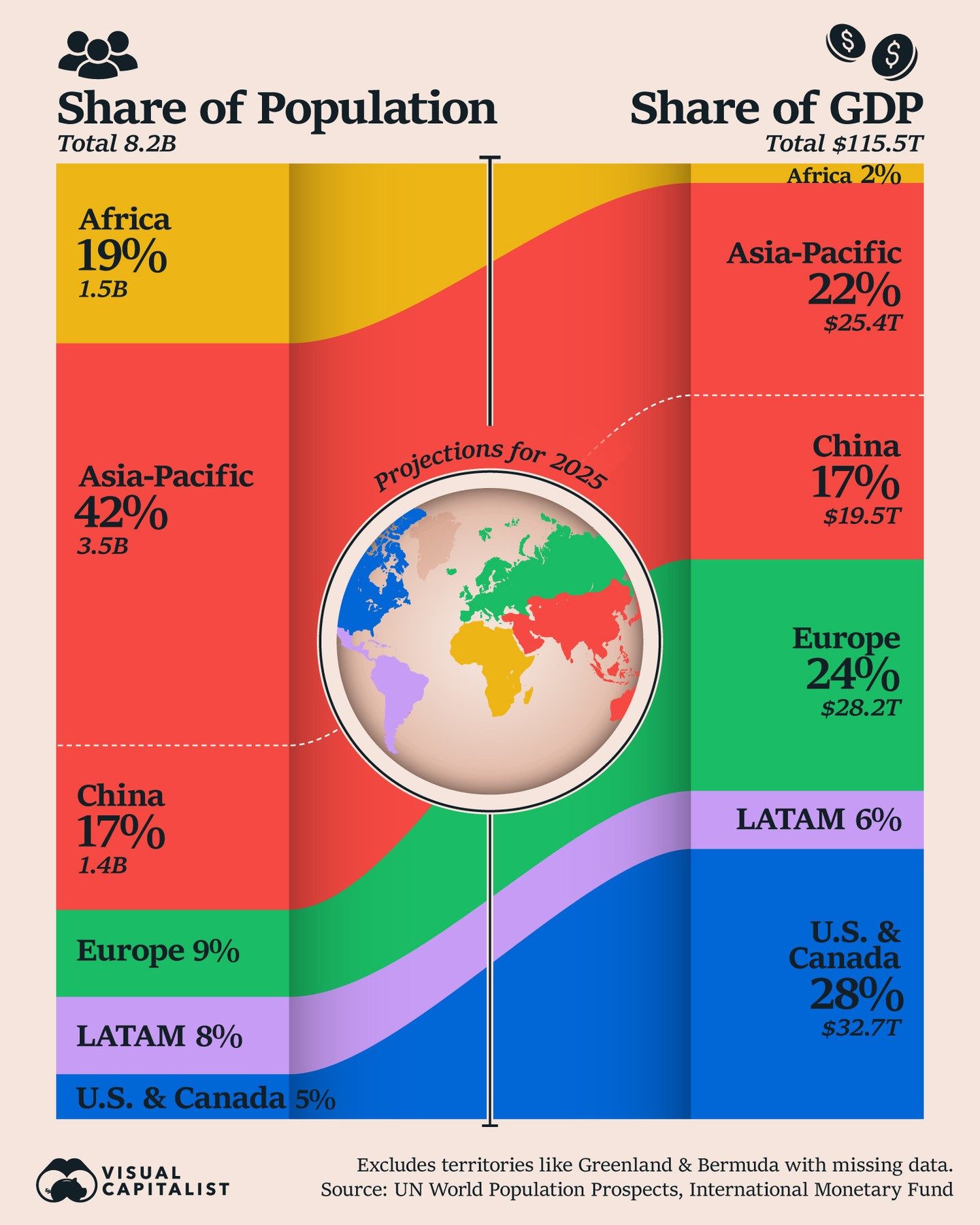
The distribution of global population and GDP among different regions is a critical aspect of understanding the world's economic landscape. By 2025, significant disparities are expected to persist, with the United States and Canada, despite having a relatively small share of the global population, accounting for a substantial portion of the world's GDP. Conversely, Africa, which will be the second-most populous continent, is projected to contribute the least to the global economy.
Context: Why This Matters
Understanding the economic and demographic projections for 2025 is crucial for policymakers, businesses, and investors. These projections help in anticipating global economic trends, resource allocation, and strategic planning. The disparities in population and GDP shares highlight the varying economic capabilities and challenges faced by different regions.
Main Discussion
Global Population and GDP Disparities
By 2025, the distribution of the global population and GDP among major regions will be as follows:
-
Asia-Pacific: This region is projected to have the largest share of the global population at 42%, with nearly 3.5 billion people. However, its share of the global GDP is expected to be 22%, with a total GDP of 25.4 trillion.
-
China: With a population share of 17% and 1.4 billion people, China will contribute 17% to the global GDP, amounting to 19.5 trillion.
-
Europe: Europe is projected to have 9% of the global population, with around 0.5 billion people. Its share of the global GDP is expected to be 24%, with a total GDP of 28.2 trillion.
-
LATAM (Latin America): LATAM will have 8% of the global population, with about 0.6 billion people. Its share of the global GDP is projected to be 6%, with a total GDP of 32.2 trillion.
-
Africa: Africa, the second-most populous continent, will have 19% of the global population, with approximately 1.5 billion people. However, its share of the global GDP is expected to be just 2%, with a total GDP of 115.5 trillion. This significant disparity highlights the economic challenges faced by the continent.
-
United States and Canada: The U.S. and Canada will account for 5% of the global population, with around 0.4 billion people. However, they are expected to generate 28% of the world’s GDP, with a total GDP of 32.2 trillion.
Regional Economic and Demographic Trends
Asia-Pacific
The Asia-Pacific region, with its large population and significant economic contributions, is a vital player in the global economy. The region's diverse economies, ranging from developed nations like Japan and South Korea to rapidly growing economies like India and Indonesia, contribute to its substantial GDP share.
China
China's economic growth has been a driving force in the global economy. Its large population and significant GDP share reflect its status as the world's second-largest economy. While China faces economic challenges, its ongoing development and innovation in technology and infrastructure continue to drive its economic growth.
Europe
Europe's economic power is evident in its relatively small population share but significant GDP contribution. The region's robust economies, diverse industries, and strong social and economic policies contribute to its economic strength. However, Europe faces challenges such as an aging population and economic integration issues within the European Union.
Latin America
Latin America’s economic performance has been influenced by its diverse economies, resource-rich countries, and export-oriented growth strategies. While it has made significant progress in reducing poverty and improving living standards, the region continues to face challenges such as income inequality and political instability.
Africa
Africa's economic potential is often overshadowed by its low GDP share compared to its large population. The continent faces significant challenges, including political instability, poverty, and limited infrastructure. However, it boasts vast natural resources, a young and growing population, and increasing investment in technology and innovation, which present potential opportunities for economic growth.
Practical Tips for Navigating the Global Economy in 2025
For policymakers, businesses, and investors looking to navigate the global economy in 2025, some practical tips include:
-
Diversify Investment Portfolios: Given the varying economic capabilities and challenges faced by different regions, it is crucial to diversify investment portfolios across multiple regions to mitigate risks.
-
Understand Regional Trends: Stay informed about the economic and demographic trends in different regions to make informed decisions. For instance, understanding the economic potential of Africa and the opportunities it presents can be beneficial for long-term investment strategies.
-
Engage in Strategic Alliances: Form strategic alliances and partnerships with countries and regions that have complementary economic strengths and opportunities. For example, collaborating with China's technology sector or Europe's advanced industries can offer significant benefits.
-
Focus on Sustainable Development: Prioritize sustainable development practices to address global challenges such as climate change, poverty, and inequality. These practices can lead to long-term economic growth and stability.
-
Invest in Education and Innovation: Invest in education and innovation to foster economic growth and development. This is particularly important for regions facing economic challenges, as investing in human capital can drive long-term economic growth.
Important Takeaways
Some of the important takeaways from the 2025 global GDP and population projections include:
- The Asia-Pacific region and China will be significant players in the global economy due to their large populations and substantial GDP contributions.
- Europe's economic strength will continue to be a driving force in the global economy despite challenges such as an aging population.
- Latin America's economic performance will be influenced by its diverse economies, resource-rich countries, and export-oriented growth strategies.
- Africa's economic potential is significant, but it faces considerable challenges that need to be addressed for sustainable economic growth.
- The U.S. and Canada will continue to be major economic powers, generating a significant portion of the world's GDP despite their relatively small population share.
Conclusion
The 2025 global GDP and population projections provide valuable insights into the future of the global economy. Understanding the economic and demographic trends in different regions is crucial for policymakers, businesses, and investors. By staying informed and adopting practical strategies, stakeholders can navigate the global economy more effectively and leverage the opportunities presented by different regions, fostering sustainable economic growth and development.
Watch the Reel
Questions readers ask
Which regions are expected to have the highest GDP per capita in 2025?
Regions like the United States and Canada are projected to have high GDP per capita in 2025. This is due to their strong economic outputs relative to their population sizes. These regions are likely to maintain significant economic power despite having a smaller share of the global population.
How will Africa's population size compare to its GDP contribution by 2025?
By 2025, Africa is expected to be the second-most populous continent. However, despite this large population, Africa is projected to contribute the least to the global economy. This highlights a significant disparity between population size and economic output in the region.
What is the significance of understanding the world population distribution for economic strategy?
Understanding the world population distribution is crucial for developing effective global economic strategies. By knowing where populations are concentrated, policymakers and businesses can better allocate resources, anticipate economic trends, and make informed decisions to drive growth and development.
How will the global GDP projections for 2025 impact resource management?
The global GDP projections for 2025 will significantly impact resource management. Regions with higher GDP shares, such as the United States and Canada, may have more resources to invest in infrastructure and development. Conversely, regions with lower GDP shares but large populations, like Africa, may require more targeted resource allocation to address economic disparities.
Which regions are expected to have the highest GDP shares in 2025?
The United States and Canada are expected to have significant GDP shares in 2025. Despite having a relatively small portion of the global population, these regions are projected to account for a substantial portion of the world's GDP. This indicates a high concentration of economic power in these areas.
What will be the economic power distribution among Asia, Europe, and Latin America by 2025?
By 2025, Asia is expected to have a significant economic presence, driven by large economies like China and India. Europe and Latin America, while also contributing to the global economy, are projected to have varying levels of GDP. These regions will play crucial roles in the global economic landscape, each with its own strengths and challenges.
Why is it important to anticipate global economic trends for 2025?
Anticipating global economic trends for 2025 is essential for policymakers, businesses, and investors. It helps in planning for future economic scenarios, identifying growth opportunities, and mitigating potential risks. By understanding these trends, stakeholders can make better-informed decisions to navigate the evolving global economy.
Recent articles
Fresh deep dives from the latest Reels we unpacked.




Comments
Be the first to comment.