Energy Import Dependence
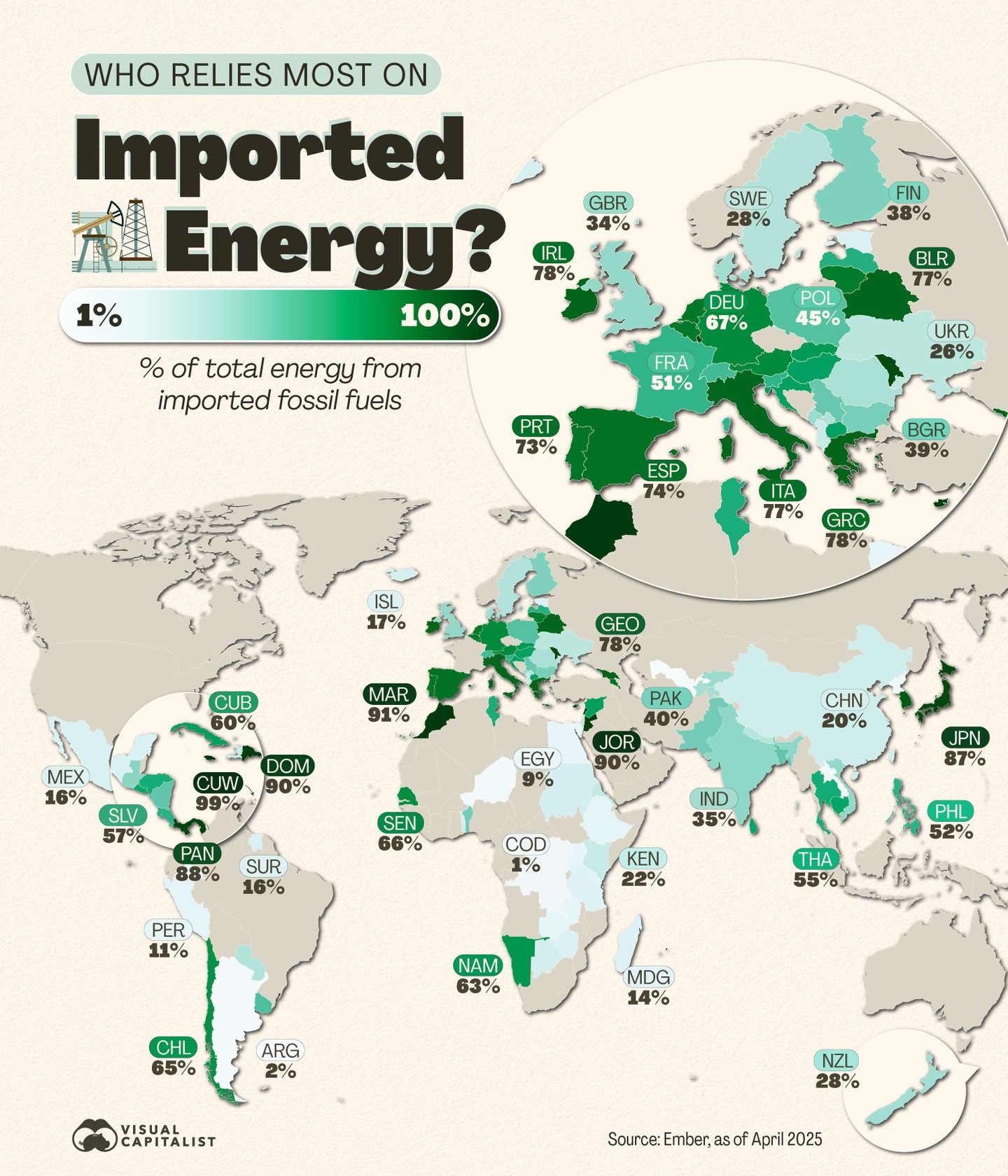
Energy import dependence is a critical issue affecting a significant portion of the world's population. Three-quarters of the global population resides in countries that are net importers of fossil fuels, making them reliant on international markets to meet their energy needs. This dependence has far-reaching implications for energy security, economic stability, and environmental sustainability.
Context / Why This Matters
Understanding the extent of fossil fuel import dependence is crucial for several reasons. It highlights the vulnerability of many countries to fluctuations in global energy prices and geopolitical tensions. Additionally, it underscores the need for diversifying energy sources and investing in renewable energy infrastructure. Countries that rely heavily on imported fossil fuels face challenges in maintaining stable energy supplies, which can impact everything from industrial production to daily household energy needs.
Main Discussion
Global Energy Dependence
The map provides a visual representation of how countries around the world rely on imported fossil fuels to meet their energy needs. The highest levels of dependence are seen in countries like El Salvador, which imports 99% of its fossil fuels, and Cuba, which imports 91%. These high percentages highlight the significant role that imported fossil fuels play in the energy mix of these nations.
Key Regions and Countries
Europe
European countries exhibit a varied but generally high dependence on imported fossil fuels. For instance, Germany and the United Kingdom rely on imports for 78% and 34% of their energy, respectively. Other European nations, such as Sweden, Poland, and Belarus, with percentages ranging from 77% to 45%, further illustrate this pattern. High reliance on imported fossil fuels in Europe reflects the continent's limited domestic fossil fuel resources and its robust industrial and energy infrastructure, which demands consistent energy supplies.
Asia
In Asia, China and India, both major fossil fuel producers, still heavily rely on imports. China imports 87% of its fossil fuels, while India imports 35%. This dependence underscores the challenge of balancing domestic production with the ever-growing energy demands of these rapidly developing economies. Japan, another significant importer, relies on 52% imported fossil fuels, highlighting the region's overall vulnerability to global energy market dynamics.
Middle East and Africa
The Middle East and Africa present a mixed picture. Egypt, for example, imports 9% of its fossil fuels, demonstrating a lower level of dependence compared to other regions. Meanwhile, countries like Namibia, Senegal, and Chile have import dependencies ranging from 63% to 65%, indicating a moderate to high reliance on imported energy. The context for these variations include political stability, economic development, and domestic energy production capabilities.
Factors Influencing Import Dependence
Several factors influence a country's reliance on imported fossil fuels. These include the availability of domestic fossil fuel reserves, the efficiency of energy production and distribution infrastructure, and the economic viability of domestic energy production. Countries with limited domestic resources often have no choice but to rely on imports, while those with robust domestic production capabilities may still import to supplement their needs.
Practical Tips
For countries looking to reduce their dependence on imported fossil fuels, several practical steps can be taken:
Investing in Renewable Energy
Investing in renewable energy sources such as solar, wind, and hydroelectric power can significantly reduce reliance on imported fossil fuels. These sources not only enhance energy security but also contribute to environmental sustainability by reducing greenhouse gas emissions.
Improving Energy Efficiency
Improving energy efficiency through technological advancements and policy measures can help countries optimize their energy use. This includes adopting energy-efficient appliances, promoting energy-saving practices, and implementing energy management systems in industries.
Diversifying Energy Sources
Diversifying energy sources by exploring alternative fuels like natural gas, nuclear energy, and biofuels can provide a more balanced and secure energy mix. This diversification can help countries mitigate the risks associated with over-reliance on a single energy source.
Important Takeaways
The global dependence on imported fossil fuels is a complex issue driven by various economic, political, and environmental factors. While countries like China and India, despite being large fossil fuel producers, still rely on imports, other regions show varied levels of dependency. Understanding these dynamics is crucial for developing strategies to enhance energy security and promote sustainable energy practices.
Conclusion
Energy import dependence is a critical issue that affects a significant portion of the world's population. By understanding the factors influencing this dependence and implementing practical measures, countries can work towards reducing their reliance on imported fossil fuels. This not only enhances energy security but also contributes to a more sustainable and resilient global energy landscape.
Watch the Reel
Questions readers ask
Which countries are the most dependent on fossil fuel imports?
Europe is a major fossil fuel importer. The countries most dependent on fossil fuel imports include Germany, Italy, and France, where 90-100% of their energy needs are met through imports. Other countries like Japan, which relies on imports for 96% of its oil and 99.6% of its natural gas, are also heavily dependent on fossil fuel imports.
How does fossil fuel import dependence affect energy security?
Fossil fuel import dependence can significantly impact energy security. Countries reliant on imports are vulnerable to disruptions in global energy markets, such as price volatility, geopolitical tensions, and supply chain disruptions. This can lead to energy shortages, increased energy costs, and potential blackouts, affecting households and industries alike.
What are the economic implications of fossil fuel import dependence?
High levels of fossil fuel import dependence can strain a country's economy. Significant portions of national budgets may be allocated to importing fossil fuels, leading to trade deficits. Additionally, price fluctuations in the global market can impact domestic energy prices, affecting consumer spending and business operations.
How does fossil fuel import dependence affect the environment?
Countries dependent on fossil fuel imports may face environmental challenges. The transportation of fossil fuels over long distances can result in emissions and environmental risks. Moreover, reliance on imported fossil fuels can hinder a country's transition to cleaner, renewable energy sources, potentially increasing greenhouse gas emissions.
What are the trends in global fossil fuel imports for the next five years?
Fossil fuel import trends are expected to continue to evolve, with projections indicating that global demand for fossil fuels may rise by 2025. However, the rate of increase is anticipated to slow down as more countries invest in renewable energy infrastructure to reduce their dependence on fossil fuel imports.
How can countries reduce their dependence on fossil fuel imports?
Countries can reduce their dependence on fossil fuel imports through several strategies. These include diversifying energy sources, investing in renewable energy infrastructure, and implementing energy efficiency measures. Additionally, countries can focus on developing domestic fossil fuel resources and enhancing energy storage capabilities.
What are some of the most significant fossil fuel import statistics?
Some of the most significant fossil fuel import statistics include 75% of the global population living in countries that are net importers of fossil fuels. In Europe, many countries import over 90% of their fossil fuel needs. For example, Germany imports approximately 99.8% of its natural gas and 92.9% of its oil.
Recent articles
Fresh deep dives from the latest Reels we unpacked.




Comments
Be the first to comment.