Top 10 Economies: A Four-Decade Shift in Global Economic Power
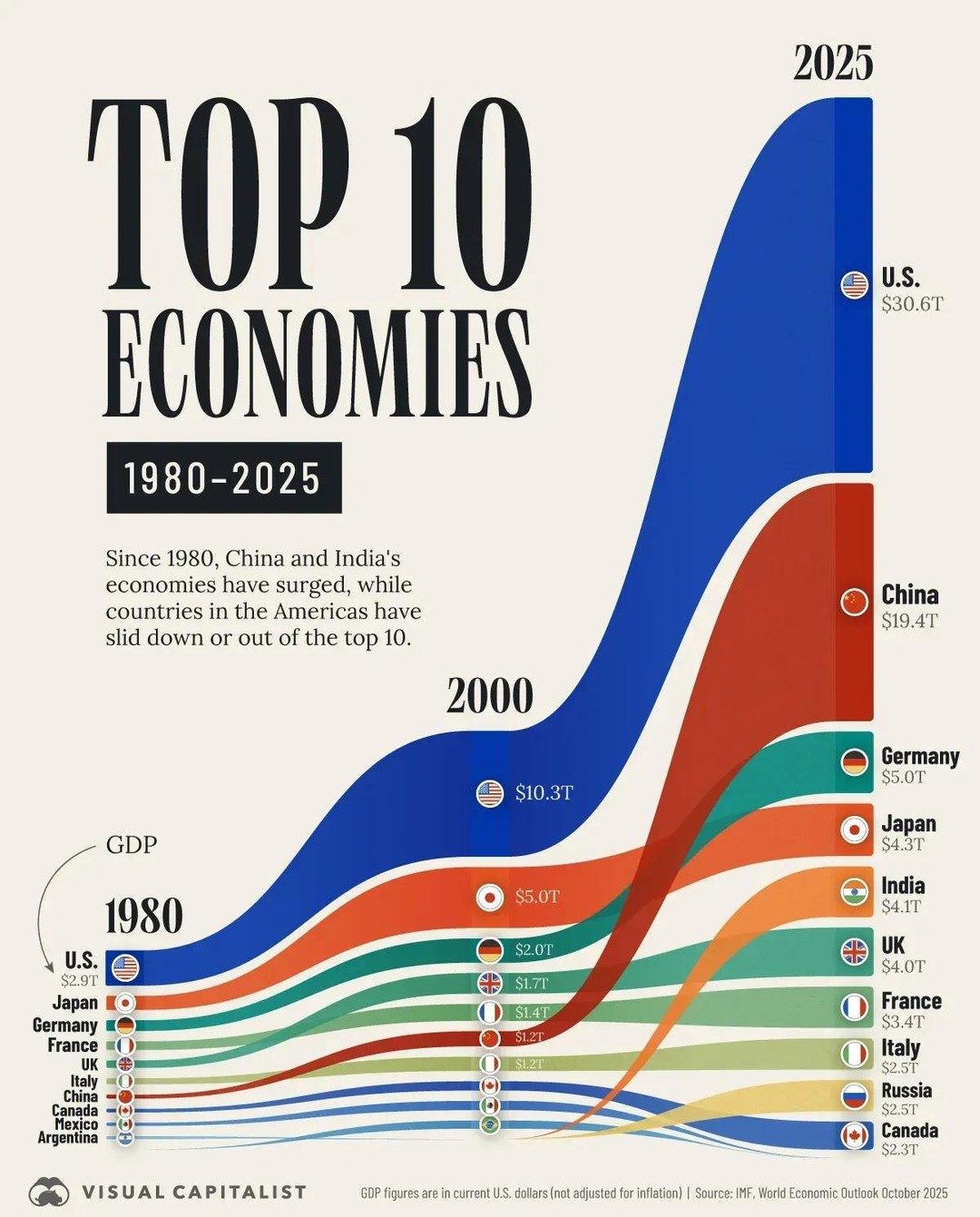
The global economic landscape has undergone significant transformations over the past four decades. The United States has maintained its position as the world’s largest economy since 1980, with a nominal GDP that has increased more than tenfold by 2025. Meanwhile, China's rise has been the most dramatic shift, overtaking Japan, Germany, and other major economies to become the world’s second-largest economy.
Why This Matters
Understanding the shifts in global economic power is crucial for businesses, investors, and policymakers alike. These changes influence trade dynamics, investment opportunities, and geopolitical balances. By examining the top 10 economies from 1980 to 2025, we can gain insights into the economic trajectories of key nations and the factors driving these changes.
Main Discussion
The Dominance of the United States
The U.S. has consistently been the global economic leader, with a nominal GDP of $30.6 trillion in 2025. This dominant position is a result of several factors, including a robust financial sector, technological innovation, and a large consumer market. The country's economic policies, such as deregulation and market-oriented reforms, have also played a significant role in maintaining its economic prowess.
The Rise of China
China's economic surge is one of the most striking developments of the past four decades. In 1980, China was not even among the top 10 economies, but by 2025, it has become the world's second-largest economy with a nominal GDP of $19.4 trillion. This rapid growth can be attributed to China's economic reforms, including the opening of its markets, investment in infrastructure, and a focus on manufacturing. China's rise has had a profound impact on global trade and investment patterns, making it a key player in the international economic arena.
Other Notable Changes
Other economies have also experienced significant shifts. For instance, India has seen a remarkable economic surge, becoming the 5th largest economy by 2025 with a GDP of $4.0 trillion. This growth is driven by India's large and growing consumer market, a skilled workforce, and a focus on technology and innovation.
Japan and Germany have maintained their positions among the top economies, with nominal GDPs of $4.3 trillion and $5.0 trillion, respectively, in 2025. These economies have benefited from strong industrial bases, advanced technologies, and stable economic policies. Japan’s resilience is particularly notable, given its recovery from the devastating 2011 earthquake and tsunami, while Germany continues to be a leader in manufacturing and engineering.
Decline of Economies in the Americas
Several economies in the Americas have experienced relative declines. Countries like Canada, Mexico, and Argentina have seen their rankings slip, reflecting various economic challenges. Canada, with a GDP of $2.3 trillion in 2025, still remains a significant player, but its growth has been outpaced by other economies. Mexico and Argentina have faced economic volatility, including currency devaluations and political instability, which have hindered their economic progress.
Practical Tips
For businesses looking to navigate these economic shifts, several strategies can be effective:
Diversify Investment Portfolios
Given the dynamic nature of global economies, it is crucial to diversify investment portfolios. This approach helps mitigate risks associated with over-reliance on a single market. Investing in a mix of developed and emerging markets can provide stability and growth opportunities.
Understand Local Economic Conditions
Before entering a new market, it is essential to conduct thorough research on local economic conditions, regulations, and consumer behaviors. This knowledge can help in tailoring products and services to meet local demands and navigating regulatory challenges.
Foster Strategic Partnerships
Building strategic partnerships with local businesses can provide valuable insights and resources. These collaborations can help in understanding the market better, navigating regulatory environments, and accessing local supply chains.
Focus on Innovation and Technology
Innovation and technology are key drivers of economic growth. Businesses should invest in research and development to stay competitive in the global market. Adopting new technologies can enhance productivity, improve product quality, and create new market opportunities.
Important Takeaways
The U.S. Remains the Global Economic Leader
Despite significant changes, the U.S. continues to dominate the global economic landscape. Its robust financial sector, technological innovation, and large consumer market ensure its sustained leadership.
China’s Rise is Unprecedented
China's economic growth is unprecedented, making it the world's second-largest economy. This growth is driven by economic reforms, investment in infrastructure, and a focus on manufacturing.
Emerging Economies Are Gaining Ground
Emerging economies, particularly India, are making significant strides. These economies offer vast market potential and are attracting global investment.
Economic Shifts Influence Global Trade and Investment
The shifts in global economic power have a profound impact on trade and investment patterns. Understanding these changes is crucial for businesses and investors.
Diversify and Adapt
Businesses must diversify their investment portfolios, adapt to local economic conditions, and invest in innovation to thrive in the changing global economic landscape.
Conclusion
The global economic landscape has evolved significantly over the past four decades, with the U.S. maintaining its leadership and China's rise being the most dramatic shift. Other economies, such as India, Japan, and Germany, have also made notable progress, while some in the Americas have faced challenges. Understanding these changes is essential for businesses and investors to navigate the global economic landscape effectively. By diversifying investment portfolios, adapting to local economic conditions, and investing in innovation, businesses can position themselves for success in this dynamic environment.
Watch the Reel
Questions readers ask
How has the United States maintained its position as the world's largest economy since 1980?
The United States has maintained its position due to a combination of factors, including a large domestic market, technological innovation, and a strong financial system. The country's nominal GDP has increased more than tenfold from 1980 to 2025, demonstrating its continued economic prowess.
What key factors have contributed to China's rapid economic rise since 1980?
China's economic rise can be attributed to several factors, including significant government investment in infrastructure, a large and growing workforce, and a focus on manufacturing and exports. Additionally, China has implemented policies to attract foreign investment, further fueling its economic growth.
How have the economic shifts impacted traditional economic powers like Japan and Germany?
Japan and Germany, while still major economies, have seen their global rankings shift as a result of China's rapid growth. In 1980, Japan and Germany were among the top three economies, but by 2025, they have moved down the rankings to 4th and 5th respectively, reflecting the changing dynamics in global economic power.
What role do trade dynamics and investment opportunities play in the shifting global economic landscape?
Trade dynamics and investment opportunities significantly influence the shifts in global economic power. Countries with strong trade relationships and favorable investment climates tend to see greater economic growth, as seen with China’s rise. Conversely, changes in trade policies and investment flows can alter a country’s economic trajectory.
Which other countries, besides China, have seen notable economic growth since 1980?
Alongside China, countries like India have seen notable economic growth. India’s economic reforms and market liberalization have driven its ascent, making it one of the fastest-growing major economies. By 2025, India is projected to be among the top five largest economies, reflecting its significant economic progress.
Why is it important for businesses and investors to understand these economic shifts?
Understanding these economic shifts helps businesses and investors make informed decisions about where to allocate resources, establish operations, and identify growth opportunities. For example, China's rise presents both opportunities and challenges for global trade, while the United States remains a stable and robust market. These insights are crucial for strategic planning and navigating the global economic landscape.
Related deep dives
Similar reads based on topic and creator.


Recent articles
Fresh deep dives from the latest Reels we unpacked.




Comments
Be the first to comment.