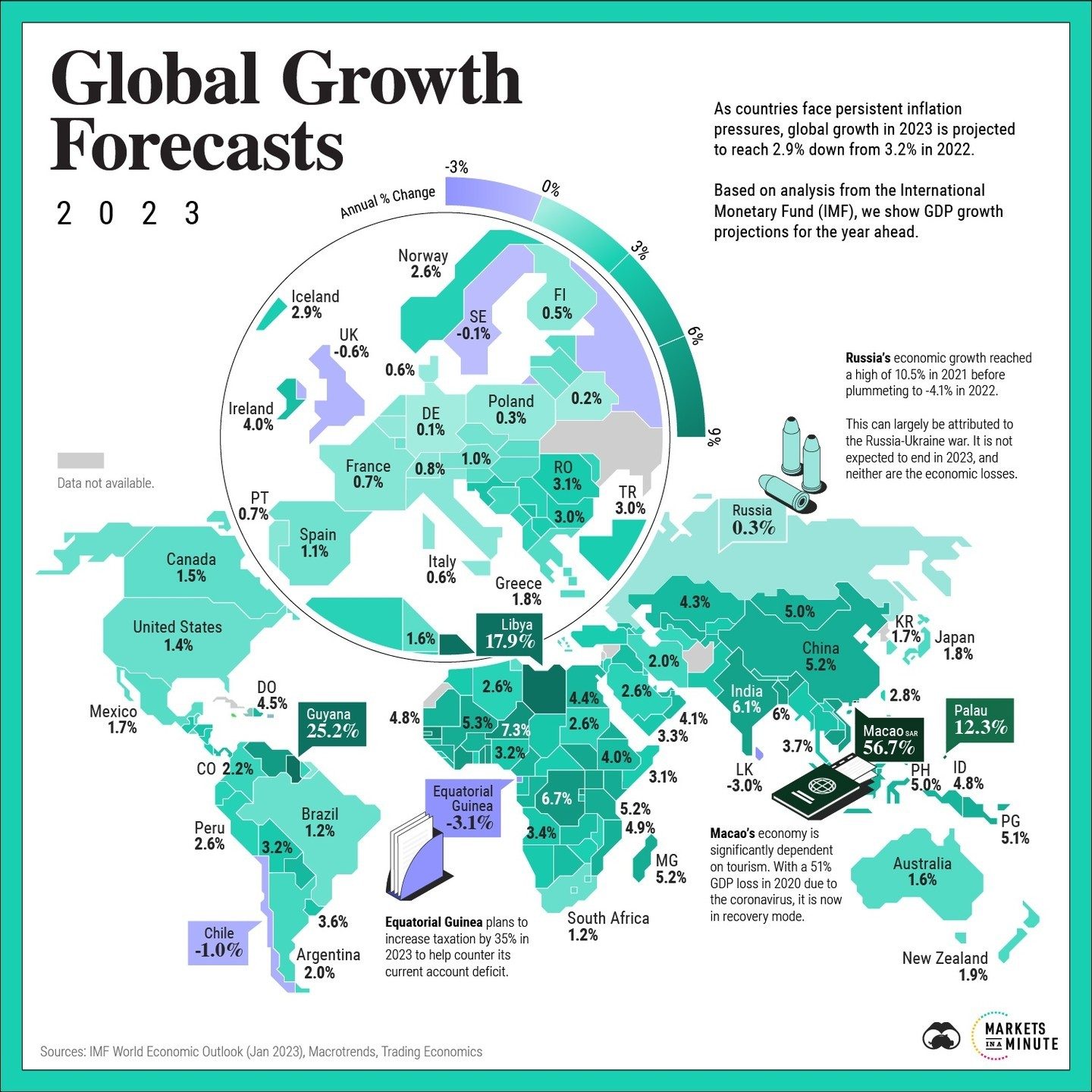
Global economic growth in 2023 is projected to be 2.9 percent, a notable decrease from the 3.2 percent growth experienced in 2022. This projection comes as countries worldwide grapple with persistent inflation pressures. Understanding these forecasts can provide valuable insights into the economic landscape for the year ahead.
Why This Matters
Persistent inflation has been a significant factor impacting global economic forecasts for 2023. Inflation affects various economic indicators, including GDP growth, and understanding these projections can help businesses, investors, and policymakers make informed decisions. The global growth forecast provides a snapshot of the economic health of different countries and regions, highlighting areas of strength and concern.
Main Discussion
Global Economic Outlook
The global economic outlook for 2023 is mixed, with some countries experiencing significant growth while others face economic challenges. The circular chart displays the projected annual percentage change in GDP for various nations, offering a comprehensive view of the global economic landscape.
Countries with High Growth
Several countries are expected to experience substantial economic growth in 2023. Palau leads the list with an impressive 12.3 percent projected growth, making it one of the fastest-growing economies globally. Equatorial Guinea follows closely with a projected 17.9 percent growth, driven by its oil and gas sector.
Guyana is another standout, with a projected growth rate of 4.8 percent. This growth can be attributed to significant investments in its oil and gas industry. India and China, two of the world's largest economies, are also expected to grow by 6.1 percent and 5.0 percent, respectively. Their robust manufacturing sectors and domestic consumption contribute to this growth.
Countries Facing Economic Challenges
On the other hand, some countries face significant economic challenges. Norway, for instance, is expected to see a decline in its GDP by 3.0 percent. This can be attributed to its reliance on the oil and gas sector, which has been affected by global market fluctuations. The United Kingdom is projected to experience a marginal decline of 0.1 percent in its GDP, highlighting the economic uncertainties faced by the country post-Brexit.
Russia's economic situation is particularly noteworthy. Prior to the Russia-Ukraine war, Russia's economic growth reached a high of 10 percent in 2021. However, the ongoing conflict has led to significant economic losses, which are not expected to abate in 2023. The war has disrupted Russia's economy, impacting its trade, investment, and overall economic stability.
Regional Economic Forecasts
Europe
Several European countries are expected to experience modest growth in 2023. Ireland stands out with a projected growth rate of 4.0 percent, driven by its strong technology and pharmaceutical sectors. France, Germany, and the United Kingdom are also projected to see growth, with rates of 0.8 percent, 0.5 percent and -0.1 percent, respectively, although the latter faces a decline. These projections reflect the region's economic resilience despite ongoing challenges.
Asia
Asia's economic outlook for 2023 is mixed. Japan and South Korea are expected to experience modest growth rates of 1.8 percent and 2.8 percent, respectively. While South Korea's growth rate is higher, it still faces economic challenges, including an aging population and low fertility rates. China, the world's second-largest economy, is projected to grow by 5.0 percent, driven by its robust manufacturing sector and domestic consumption.
Americas
North and South America present a varied economic landscape. In North America, the United States is projected to grow by 1.6 percent, while Canada is expected to see a growth rate of 1.4 percent. In South America, Brazil is projected to grow by 2.5 percent, driven by its recovery from the COVID-19 pandemic and investments in infrastructure. Argentina and Mexico are expected to experience growth rates of 2.0 percent and 1.5 percent, respectively.
Practical Tips
Understanding the economic forecasts can help you make informed decisions. Here are some practical tips:
- Invest Wisely: Consider investing in countries with high growth projections, such as Palau, Equatorial Guinea, and Guyana.
- Diversify Your Portfolio: Diversifying your portfolio across different regions can help mitigate risks associated with economic downturns in specific countries.
- Stay Informed: Keep up-to-date with the latest economic developments and forecasts to make informed business and investment decisions.
Important Takeaways
- Global economic growth in 2023 is projected to be 2.9 percent, down from 3.2 percent in 2022.
- Palau and Equatorial Guinea are expected to have the highest growth rates, while Norway faces a significant decline.
- The Russia-Ukraine war continues to impact Russia's economic situation, with no end to the conflict or economic losses expected in 2023.
- Understanding economic forecasts can help in making informed business and investment decisions.
Conclusion
The global economic outlook for 2023 presents a mixed picture, with some countries experiencing significant growth while others face economic challenges. Understanding these forecasts can provide valuable insights into the economic landscape and help in making informed decisions. Whether you are an investor, a business owner, or a policymaker, staying informed about the global economic outlook can help you navigate the challenges and opportunities ahead.
Watch the Reel
Questions readers ask
What is the projected global economic growth rate for 2023?
The global economy is expected to grow by 2.9% in 2023. This is a slowdown from the 3.2% growth rate seen in 2022, primarily due to persistent inflation pressures worldwide.
Which countries are expected to see significant economic growth in 2023?
Countries like Palau and Equatorial Guinea are projected to experience notable economic growth in 2023. These countries are expected to outperform the global average, providing interesting opportunities for investment and development.
How does inflation impact the global economic growth projections for 2023?
Persistent inflation is a major factor contributing to the slowdown in global economic growth in 2023. Inflation affects various economic indicators, including GDP growth, and can influence consumer spending, business investments, and overall economic stability.
What are the economic challenges faced by Norway in 2023?
Norway is expected to face economic challenges in 2023, which may include factors such as high energy prices and inflation. These challenges can impact the country's GDP growth and overall economic performance, making it essential for policymakers to implement effective strategies to mitigate these issues.
How does the Russia-Ukraine war impact global economic growth in 2023?
The ongoing Russia-Ukraine war continues to influence global economic trends, contributing to inflation, supply chain disruptions, and geopolitical uncertainties. These factors can affect global GDP growth, with some countries, like Poland, anticipated to experience varied economic outcomes as a result of the conflict.
What can businesses and investors learn from the 2023 global economic growth forecast?
The 2023 global economic growth forecast provides insights into the economic health of different countries and regions, helping businesses and investors identify areas of strength and concern. This information can guide informed decision-making, risk management, and strategic planning for the year ahead.
Recent articles
Fresh deep dives from the latest Reels we unpacked.




Comments
Be the first to comment.