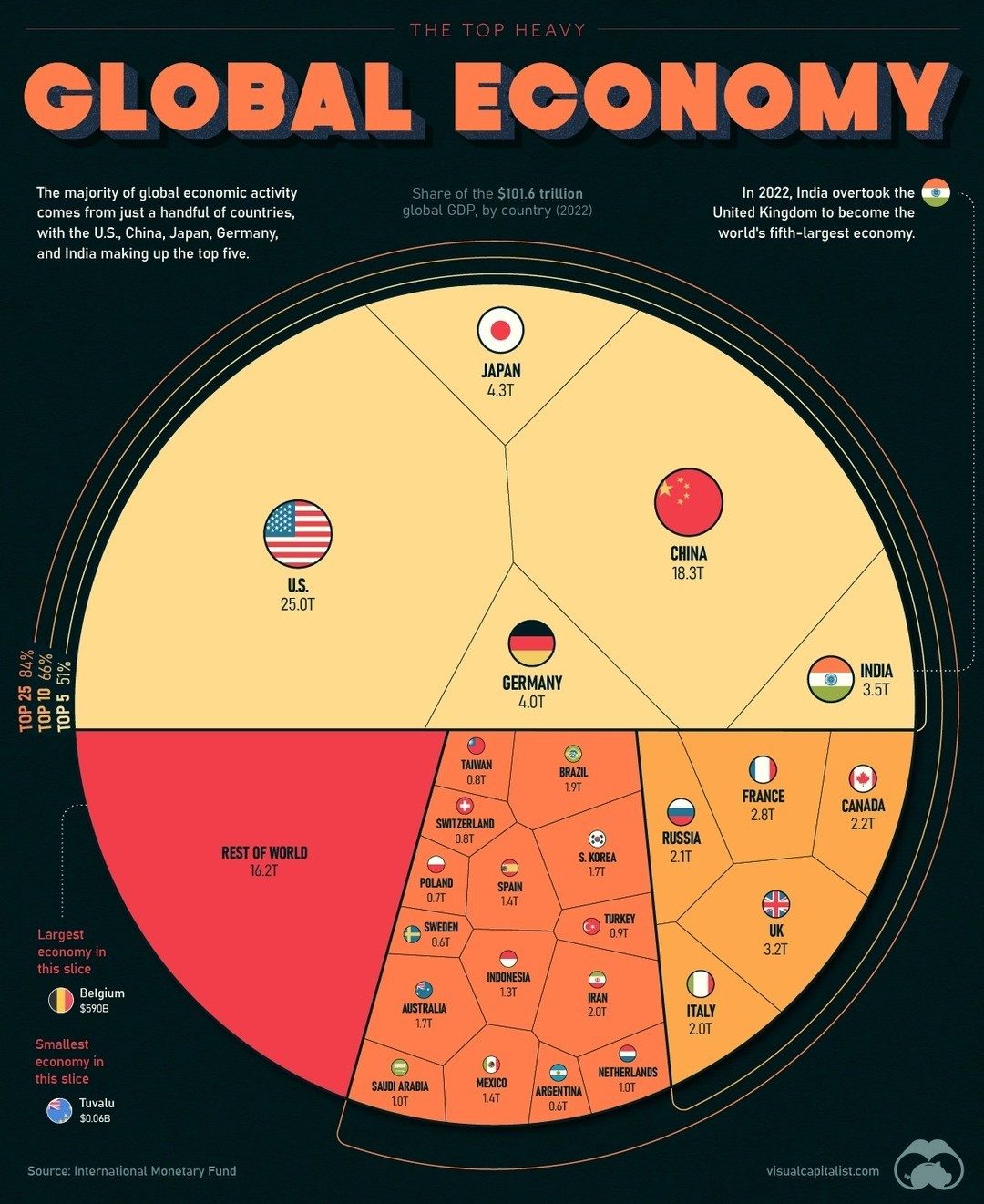
The Global Economy in 2022: A Growing $101.6 Trillion
As 2022 draws to a close, the global economic landscape has witnessed significant milestones. One of the most notable achievements is the global economy surpassing $100 trillion. This economic growth reflects the cumulative Gross Domestic Product (GDP) of all countries, showcasing the distribution of global economic activity. Let’s delve into the key players and their contributions to this impressive figure.
Why This Matters
Understanding the distribution of global economic activity is crucial for various stakeholders, from investors and policymakers to businesses and consumers. This information helps in making informed decisions, identifying growth opportunities, and assessing economic risks.
The Top Economies and Their Contributions
The United States: Leading the Pack
The United States continues to dominate the global economy, contributing a hefty $25.0 trillion to the overall GDP. This significant share underscores the U.S.'s influential role in global economic affairs. The country's robust economy is driven by a strong financial sector, technological innovation, and a diverse industrial base.
China: A Close Second
China follows closely behind the U.S. with a GDP of $18.3 trillion. China's rapid economic growth over the past few decades has been fueled by its manufacturing sector, infrastructure development, and a large consumer market. China's economic policies, including significant investments in technology and green energy, have positioned it as a major player in the global economy.
Japan: A Major Contributor
Japan, with a GDP of $16.2 trillion, remains one of the world's largest economies. The country's economic strength lies in its advanced technology, automotive industry, and high level of innovation. Japan's consistent focus on research and development has kept it competitive in the global market.
Germany: Europe's Powerhouse
Germany, contributing $4.0 trillion to the global GDP, is Europe's economic leader. The country's economic prowess is built on its manufacturing sector, particularly in automotive, mechanical engineering, and chemical industries. Germany's strong export orientation and skilled workforce are key factors in its economic success.
India: The Rising Star
India has made a significant leap in the global economic ranking, overtaking the United Kingdom to become the world’s fifth-largest economy. With a GDP of $3.2 trillion, India's growth is driven by its expanding service sector, robust manufacturing, and increasing consumer spending. The country's large and growing workforce, coupled with its strategic economic reforms, positions it as a future economic powerhouse.
The Top 10 and Top 5 Economies: Contributions to Global GDP
The Top 10 Economies
The top 10 economies collectively account for 66% of the global GDP. This group includes not only the aforementioned countries but also other significant contributors such as:
- Brazil with $0.8 trillion
- South Korea with $1.1 trillion
- Canada with $2.2 trillion
- France with $2.8 trillion
- Russia with $2.0 trillion
- Italy with $2.0 trillion
- Mexico with $1.6 trillion
- Iran with $2.0 trillion
The Top 5 Economies
The top 5 economies, which include the United States, China, Japan, Germany, and India, contribute to 51% of the global GDP. Their combined economic strength underscores their pivotal role in shaping global economic trends and policies.
The Role of Smaller Economies
While the top economies dominate the global GDP, it's essential to recognize the contributions of smaller economies. Countries like Switzerland, Poland, Turkey, and Indonesia, although not in the top 10, still play significant roles in their respective regions. Their combined efforts contribute to the overall global economic activity, making the world a more interconnected and economically diverse place.
Practical Tips for Understanding Global Economic Trends
Stay Informed
Keeping up with the latest economic data and trends is essential for staying informed. Follow reputable sources like the International Monetary Fund (IMF) and the World Bank for the latest economic reports and forecasts.
Diversify Your Investments
Given the varying economic performances of different countries, diversifying your investment portfolio can help mitigate risks. Consider investing in multiple regions and sectors to balance your portfolio and maximize returns.
Monitor Trade Policies
Trade policies significantly impact global economic activity. Stay updated on trade agreements and policies that affect the countries you are interested in. This knowledge can help you make more informed investment decisions.
Understand Regional Dynamics
Regional economic dynamics play a crucial role in global economic trends. For example, while Europe and North America have traditionally been the economic hubs, Asia's growing economic influence cannot be ignored. Understanding these dynamics can provide a broader perspective on global economic activities.
Important Takeaways
The Economic Powerhouses
The United States, China, and Japan remain the economic powerhouses, contributing significantly to the global GDP. Their economic policies and performance have a ripple effect on the global economy.
The Rise of India
India's ascent to the fifth-largest economy highlights the shifting dynamics of global economic power. India's growth trajectory is a testament to its economic reforms and the potential for future economic expansion.
The Significance of Economic Diversity
The top 10 economies account for 66% of the global GDP, underscoring the importance of economic diversity. While the top players dominate, the collective efforts of smaller economies also contribute to the overall global economic activity.
The Impact of Trade and Policies
Trade policies and economic reforms play a crucial role in shaping global economic trends. Understanding these factors can help in making informed decisions and navigating the complex world of global economics.
Conclusion
The global economy surpassing $100 trillion in 2022 is a significant milestone that reflects the collective efforts and growth of various economies. Understanding the distribution of global economic activity and the contributions of different countries provides valuable insights into the dynamics of the global economy. As we move forward, keeping an eye on economic trends, trade policies, and regional dynamics will be crucial for staying informed and making strategic decisions.
Watch the Reel
Questions readers ask
Which countries were the top economies in 2022 and what was their GDP ranking?
In 2022, the top economies were the United States, China, Japan, and Germany. These countries contributed significantly to the world economy with the United States leading the way followed by China, Japan, and Germany. India was also a significant player in the top 5 economies 2022.
How much did the global GDP reach in 2022?
The global GDP in 2022 reached an impressive $101.6 trillion, the first time the global economy surpassed the $100 trillion mark.
What role did the U.S. economy play in the 2022 global GDP?
The U.S. economy held the top spot in 2022, contributing a significant portion to the $101.6 trillion global GDP. The U.S. economy has been a consistent leader in the world economy 2022.
How has China's economy grown in recent years, and what was its ranking in 2022?
China's economy has shown rapid growth in recent years, making it the second-largest economy in 2022. China's role in the global economy 2022 is a significant indicator of its continuous economic rise.
What was the ranking of the Indian economy in 2022?
The Indian economy ranked 5th in 2022. India's position in the global economic activity is indicative of the country's importance in the world economy 2022.
How do the economies of Japan and Germany compare in the 2022 global economic activity?
Japan and Germany ranked third and fourth in the 2022 global economy. Both countries have robust economies, contributing significantly to the world GDP 2022. Japan and Germany are major players in the economy comparison 2022.
Recent articles
Fresh deep dives from the latest Reels we unpacked.




Comments
Be the first to comment.