Global Wealth Distribution
GDP is a commonly cited metric for assessing a nation's economic performance. This measure provides a snapshot of a country's total output over a specific period, typically a year. While GDP offers valuable insights, household wealth statistics offer a deeper understanding of how wealth is distributed among a nation's citizens. This perspective is crucial for understanding the economic landscape and the disparity between different countries.
Why This Matters
Household wealth statistics reveal which countries' citizens hold the highest levels of money and assets. Unlike GDP, which primarily focuses on the overall economic output, household wealth provides a more personalized view of economic success. This distinction is important because it shows how wealth is distributed among the population, highlighting both the economic successes and potential disparities within a nation.
Global household wealth distribution is a vital metric to consider when evaluating a nation's overall wealth. By understanding how wealth is distributed, policymakers and economists can better address economic inequalities and promote inclusive growth. This data is particularly relevant for nations aiming to improve their economic standing and ensure that their citizens benefit from economic development.
Main Discussion
United States and China: The Dominant Players
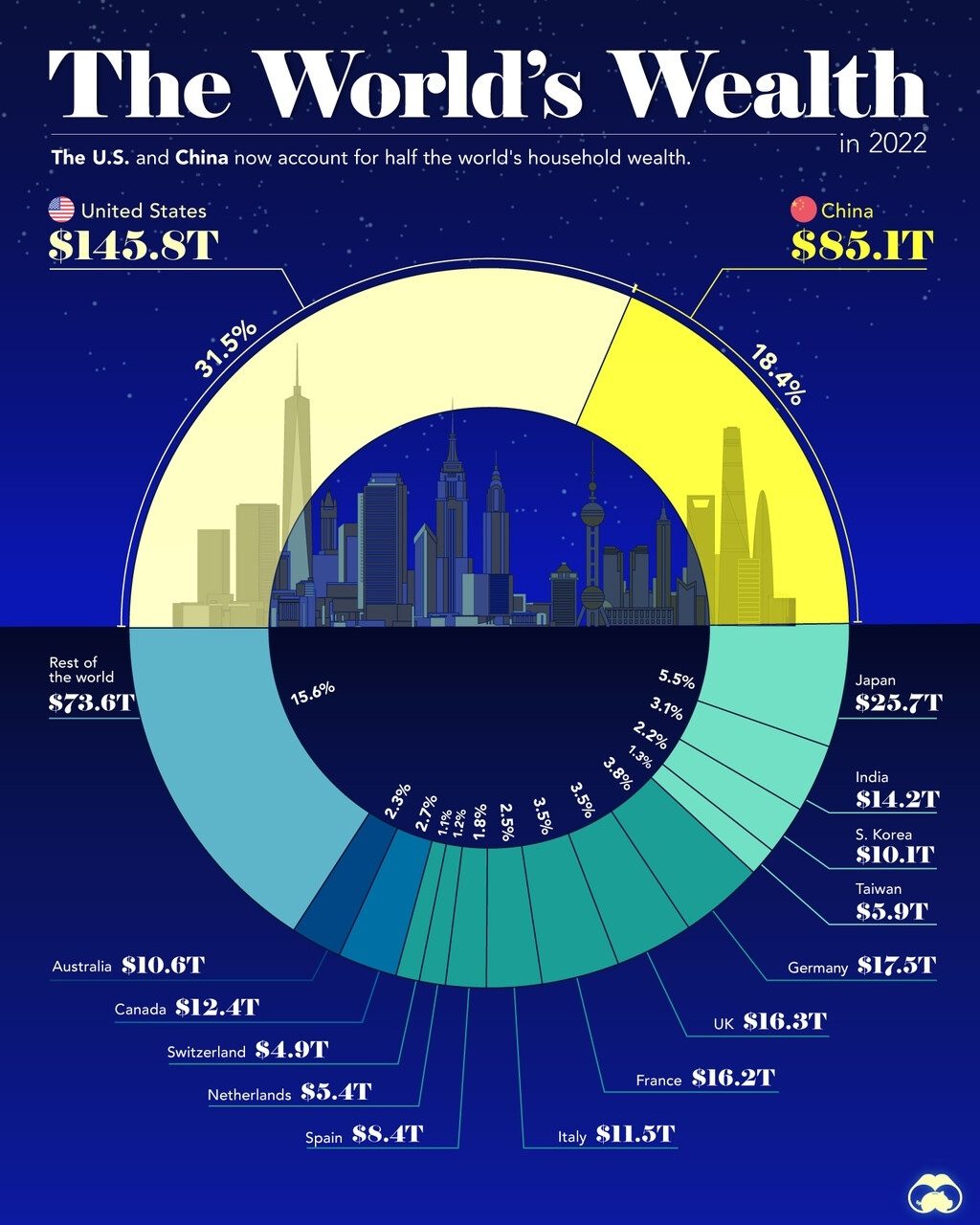
The United States ($143.5T) and China ($85.1T) collectively hold approximately half of the world's household wealth. This figure underscores the significant economic influence of these two nations. The sheer magnitude of their household wealth highlights their dominant roles in the global economy. For instance, the United States' household wealth of $143.5T is significantly higher than that of any other country, emphasizing its economic prowess and the wealth accumulated by its citizens. Similarly, China's $85.1T in household wealth reflects its rapid economic growth and the increasing prosperity of its population.
The Rest of the World
While the United States and China lead in household wealth, the rest of the world collectively holds $73.6T. This figure includes nations such as Australia ($10.6T), Canada ($12.4T), Switzerland ($4.9T), Netherlands ($5.4T), Spain ($8.4T), Italy ($11.5T), Germany ($17.3T), UK ($16.3T), France ($16.2T), South Korea ($10.1T), Japan ($25.7T), Taiwan ($5.9T), and India ($14.2T). These countries exhibit varying levels of household wealth, reflecting their unique economic landscapes and development stages. For example, Japan's household wealth of $25.7T shows its robust economy, while India's $14.2T indicates a growing but still developing economic landscape.
Key Takeaways from the Distribution
The global wealth distribution reveals several key points:
- Economic Dominance: The United States and China's combined household wealth of $228.6T signifies their economic dominance and influence on the global stage. Their wealth accumulation reflects their economic policies, technological advancements, and market opportunities.
- Economic Disparities: While nations like the United States and China demonstrate significant wealth, others, despite their contributions to the global economy, show comparatively lower household wealth. Understanding these disparities is essential for creating policies that promote inclusive growth.
- Economic Potential: Nations like India and Japan, with substantial household wealth, exhibit economic potential. This wealth can drive economic growth, technological innovation, and social development.
Practical Tips
Reviewing household wealth statistics can provide practical insights for both individuals and policymakers. For individuals, understanding global wealth distribution can offer a broader perspective on economic opportunities and challenges. For policymakers, these statistics can inform strategies to address economic inequalities and promote sustainable growth.
For Individuals
- Global Investment Opportunities: Understanding where the world's wealth is concentrated can help individuals make informed investment decisions. For example, investing in markets with high household wealth, such as the United States and China, may offer greater returns.
- Career and Education: Knowing which countries have high household wealth can guide career and education choices. For instance, pursuing opportunities in wealthy nations can provide access to better jobs, higher salaries, and advanced education.
- Financial Planning: Recognizing global wealth distribution can inform financial planning. Individuals can choose to diversify their assets in countries with stable economies and high household wealth, thereby mitigating risks and maximizing returns.
For Policymakers
- Economic Policies: Policymakers can use household wealth statistics to design policies that address economic disparities. This may involve creating initiatives to support economic growth in underperforming regions and promoting inclusive economic development.
- Infrastructure Development: Understanding which countries have significant wealth can guide infrastructure development projects. For example, investing in infrastructure in wealthy nations can attract more investment and boost economic growth.
- International Cooperation: Global wealth distribution can inform international cooperation strategies. Policymakers can work with other countries to promote economic stability, reduce disparities, and foster mutual growth.
Important Takeaways
Household wealth statistics reveal a unique perspective on global economic health and disparities. While GDP offers valuable insights, it doesn't tell the full story. Understanding how wealth is distributed among nations' citizens provides a more comprehensive view of economic success and challenges. This information is crucial for individuals making financial decisions and policymakers designing strategies to promote inclusive growth.
Conclusion
Household wealth statistics provide a deeper understanding of global economic dynamics. They highlight the economic dominance of nations like the United States and China while revealing the economic potential of other countries. By examining these statistics, individuals and policymakers can make informed decisions to promote economic growth and address disparities. This knowledge is invaluable for navigating the complex landscape of global economics and fostering sustainable development.
Watch the Reel
Questions readers ask
Which countries hold the majority of the world's household wealth?
The United States and China are the dominant players in global household wealth, together holding nearly half of the world's total. This significant share underscores their economic influence on a global scale.
How does household wealth differ from GDP?
While GDP measures a country's total economic output, household wealth statistics focus on the money and assets held by individuals and families. This difference provides insights into the distribution of wealth among citizens, rather than just the overall economic performance.
What trends have been observed in global wealth distribution in 2022?
Recent trends highlight a widening gap between wealthier and poorer nations, with the top countries by household wealth continuing to accumulate more assets. This shift underscores the increasing global wealth inequality.
How does the United States compare to China in terms of household wealth?
The United States has traditionally held a larger share of global household wealth than China. However, China's rapid economic growth has led to a significant increase in its household wealth, narrowing the gap between the two countries.
Which other countries have significant household wealth?
Beyond the United States and China, countries like Australia and Canada also have substantial household wealth. These nations, along with others in Europe, contribute significantly to the global wealth distribution.
How can understanding global wealth distribution help in analyzing economic disparities?
By examining household wealth statistics, we gain insight into how wealth is shared among individuals worldwide. This information is crucial for understanding the economic landscape and the disparities between different countries, which can inform policies and initiatives aimed at reducing global wealth inequality.
Recent articles
Fresh deep dives from the latest Reels we unpacked.




Comments
Be the first to comment.