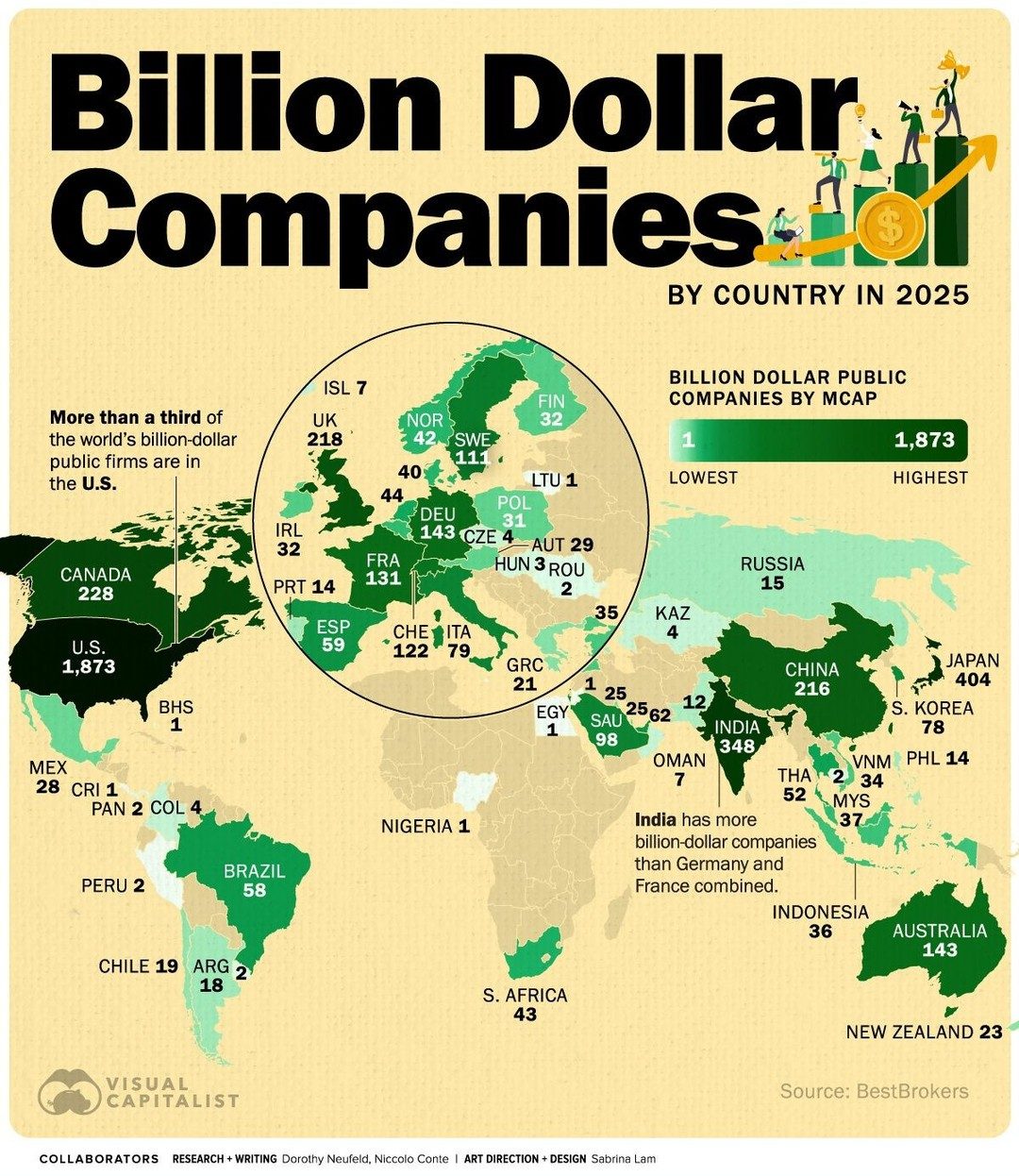
Billion Dollar Companies by Country
The United States dominates the global landscape with 1,873 billion-dollar publicly listed companies, commanding over a third of the global market capitalization. Following closely are Japan with 404, India with 348, and Canada with 216 billion-dollar firms. This distribution highlights the economic powerhouses of the world, with each country contributing significantly to the global market.
Why This Matters
Understanding the geographic distribution of billion-dollar companies offers valuable insights into global economic trends, investment opportunities, and market dynamics. This analysis is particularly useful for investors, economists, and policymakers looking to identify emerging markets and assess the financial health of different regions.
Mapping the World's Billion-Dollar Companies
The United States: A Global Leader
The United States stands out as the undisputed leader in the number of billion-dollar companies. With 1,873 firms, the U.S. holds a dominant position, reflecting its robust economic policies, innovative ecosystems, and strong investor confidence. This dominance is evident in various sectors, including technology, finance, and healthcare, which are major contributors to the country's economic output.
Japan: The Second Largest
Japan, with 404 billion-dollar companies, holds the second position. The country's strong industrial base, coupled with a highly skilled workforce and advanced technology, has enabled it to maintain its status as a global economic powerhouse. Key sectors such as automotive, electronics, and manufacturing continue to drive Japan's economy.
India: Rapid Growth and Potential
India is experiencing rapid growth, with 348 billion-dollar companies. This remarkable achievement is a testament to India's economic reforms, digital transformation, and a burgeoning startup ecosystem. The country's strengths lie in sectors like information technology, pharmaceuticals, and renewable energy, making it a hotspot for global investment.
Canada: A Steady Contributor
Canada, with 216 billion-dollar companies, is another significant player in the global market. The country's stable economic environment, rich natural resources, and strong financial sector contribute to its robust economic performance. Key sectors include natural resources, healthcare, and telecommunications, which play a crucial role in Canada's economic growth.
Other Notable Countries
China: Rapid Economic Expansion
China boasts 348 billion-dollar companies, highlighting its rapid economic expansion and growing influence on the global market. The country's strengths in manufacturing, technology, and infrastructure have propelled its economic growth and market capitalization.
Germany and France: Industrial Powerhouses
Germany and France, with 40 and 32 billion-dollar companies respectively, are well-established industrial powerhouses in Europe. Their strengths lie in sectors such as automotive, engineering, and finance, which contribute significantly to their economic output.
India vs. Germany and France
India's 348 billion-dollar companies surpass the combined total of Germany and France, highlighting its rapid economic growth and potential. This comparison underscores India's emergence as a major economic power, driven by technological advancements, entrepreneurial spirit, and supportive government policies.
The Role of BestBrokers
The analysis is sourced from BestBrokers, a renowned financial research and analysis firm. BestBrokers provides comprehensive data and insights into global markets, helping investors and policymakers make informed decisions. Their research methodology and data accuracy make them a trusted source for understanding the dynamics of billion-dollar companies across different countries.
Practical Tips
Investing in Billion-Dollar Companies
Investors looking to diversify their portfolios should consider the economic strengths and market dynamics of countries with a high number of billion-dollar companies. Thorough research and due diligence are essential to identify promising opportunities and mitigate risks.
Policy Implications
Policymakers can leverage this data to formulate strategies that promote economic growth and attract investment. Understanding the global distribution of billion-dollar companies can help in identifying areas that need improvement and developing policies that foster innovation and entrepreneurship.
Economic Trends and Forecasting
This analysis serves as a valuable tool for economic forecasting and trend analysis. By studying the distribution and growth of billion-dollar companies, economists can predict future market movements and economic trends, enabling better preparation for potential challenges and opportunities.
Important Takeaways
Global Economic Landscape
The global economic landscape is characterized by the dominance of the United States, followed by Japan, India, and Canada. Understanding this distribution is crucial for investors, economists, and policymakers to navigate the complex global market effectively.
Emerging Markets and Opportunities
Countries like India and China offer substantial opportunities for growth and investment, driven by their rapid economic expansion and technological advancements. These emerging markets present lucrative prospects for investors and businesses looking to diversify their portfolios.
Importance of Data and Research
Reliable data and comprehensive research, such as that provided by BestBrokers, play a vital role in understanding the dynamics of billion-dollar companies. Accurate information is essential for making informed decisions, whether in investment, policy formulation, or economic forecasting.
Conclusion
The distribution of billion-dollar companies across different countries offers a comprehensive view of the global economic landscape. The United States leads the way, followed by Japan, India, and Canada, each contributing significantly to the global market. Understanding these dynamics is essential for investors, economists, and policymakers to navigate the complex global market effectively and make informed decisions. By leveraging reliable data and comprehensive research, stakeholders can capitalize on emerging opportunities and mitigate potential risks.
Watch the Reel
Questions readers ask
Which countries have the highest number of billion-dollar companies?
The United States leads with 1,873 billion-dollar companies, followed by Japan with 404, India with 348, and Canada with 216. These countries are significant players in the global economy, each with a unique blend of technology and manufacturing companies.
How does the distribution of these companies inform global economic trends?
The distribution of billion-dollar companies provides insights into where the world's largest companies are thriving, helping to reveal emerging markets and global investment opportunities. By examining which countries have the most of these companies, we can see where economic growth and innovation are happening most prominently.
What does the concentration of billion-dollar companies in the US signify?
The high concentration of billion-dollar companies in the United States indicates its dominant role in the global economy. This is largely due to the country's robust technology sector, extensive market capitalization, and business-friendly environment, making it a hub for global economic activity.
Which countries have the fastest-growing billion-dollar companies in 2025?
While the article does not specifically highlight countries with the fastest-growing billion-dollar companies in 2025, emerging markets like India are likely to show significant growth. This can be attributed to factors such as increasing technological advancements, expanding manufacturing capabilities, and burgeoning investment opportunities.
Can I find specific top companies in the United States?
The article highlights that the United States has 1,873 billion-dollar publicly listed companies. However, it does not list specific top companies, but you can find this information through additional research. These companies span various sectors, including technology and manufacturing, contributing significantly to the global economy.
What are the implications of the high number of billion-dollar companies in Japan and Canada for investors?
The presence of 404 billion-dollar companies in Japan and 216 in Canada suggests strong and stable markets with diverse opportunities. Investors looking for steady growth and innovation should consider these countries, as they offer robust technology and manufacturing sectors and are integral to global economic stability.
What can investors learn from the distribution of billion-dollar companies in India?
India's 348 billion-dollar companies indicate a rapidly growing economy with significant potential for investment. The country's strengths in technology and manufacturing, along with its increasing number of billion-dollar firms, make it a key market to watch for emerging investment opportunities and global market dynamics.
Related deep dives
Similar reads based on topic and creator.


Recent articles
Fresh deep dives from the latest Reels we unpacked.




Comments
Be the first to comment.