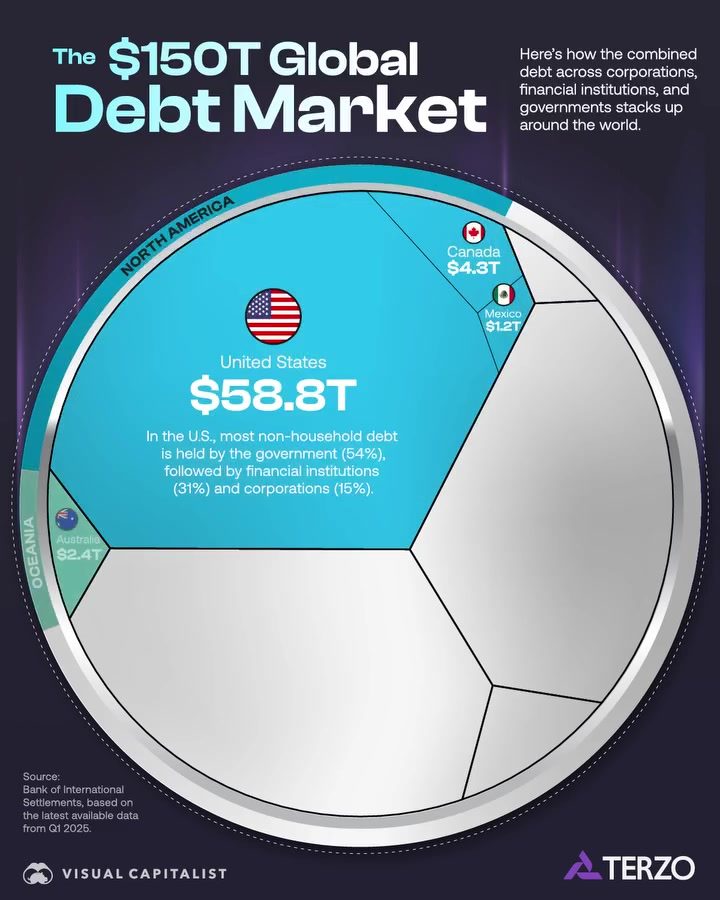
Global Debt Market Visualization
Global debt continues to rise, reaching an unprecedented $150 trillion in the first quarter of 2025. This staggering figure encompasses the combined debt of corporations, financial institutions, and governments worldwide. Understanding which countries carry the heaviest burdens is crucial for grasping the current state of the global economy.
Why This Matters
The global debt market is a critical indicator of economic health. High levels of debt can lead to economic instability, affect interest rates, and influence government policies. By examining the debt distribution across different regions and countries, we can better understand the economic challenges and opportunities facing the world.
Main Discussion
The Global Debt Landscape
The global debt market is segmented into four major regions: North America, Europe, Asia, and Oceania. Each of these regions has unique debt dynamics driven by their economic structures and government policies.
North America
North America is a significant contributor to the global debt market, with a total debt of $63.1 trillion. The United States alone accounts for $58.8 trillion, making it the largest debtor in the world. Most of the U.S. non-household debt is held by the government (54%), followed by financial institutions (31%) and corporations (15%).
Canada, the second-largest contributor in North America, holds $4.3 trillion in debt. This figure is relatively modest compared to the United States but still significant in the global context.
Europe
Europe's total debt stands at approximately $31.8 trillion. The region is characterized by a mix of high and moderate debt levels among its countries. Germany, with $4.7 trillion, is the largest debtor in Europe. It is followed by France ($6.5 trillion), the UK ($6.3 trillion), and Italy ($3.8 trillion).
Other notable debtors in Europe include the Netherlands ($2.5 trillion), Spain ($2.4 trillion), and Belgium ($1.0 trillion). The "Rest of Europe" category, which includes countries like Austria, Switzerland, and Portugal, holds approximately $1.0 trillion in debt.
Asia
Asia, the largest and most populous continent, has a total debt of $70.2 trillion. China leads the region with $26.1 trillion, making it the second-largest debtor globally. Japan follows with $11.1 trillion, highlighting the region's significant financial commitments.
South Korea ($2.5 trillion) and countries grouped under "Rest of Asia" ($797 billion) also contribute to the region's debt. These figures underscore the diverse economic landscape of Asia, where rapid industrialization and economic growth have been accompanied by rising debt levels.
Oceania
Oceania, primarily represented by Australia, holds $2.4 trillion in debt. This figure is relatively low compared to other regions, but it still reflects the economic activities and financial commitments of the continent.
Debt Distribution by Sector
The global debt market is composed of debt held by governments, financial institutions, and corporations. Each of these sectors plays a crucial role in shaping the overall debt landscape.
Government Debt
Government debt is the largest component of the global debt market, accounting for a significant portion of the total debt. High levels of government debt can constrain fiscal policies, limit economic growth, and increase the risk of financial crises. In the United States, for example, government debt makes up 54% of the total non-household debt.
Financial Institutions
Financial institutions, including banks and other lending entities, hold a substantial amount of debt. This debt is often used to fund loans and investments, driving economic activity. In the United States, financial institutions account for 31% of the total non-household debt.
Corporations
Corporations also play a significant role in the global debt market. Corporate debt is used to finance investments, expansions, and operations. In the United States, corporations hold 15% of the total non-household debt.
Practical Tips
Monitoring the global debt market is essential for investors, policymakers, and economists. Here are some practical tips for staying informed and navigating the complexities of the global debt landscape.
Stay Informed about Economic Indicators
Economic indicators such as GDP growth, inflation, and unemployment rates can provide valuable insights into a country's debt situation. Keeping track of these indicators can help you understand the economic context of a country's debt levels.
Analyze Debt-to-GDP Ratios
The debt-to-GDP ratio is a key metric for assessing a country's debt sustainability. This ratio compares a country's total debt to its gross domestic product, providing a clearer picture of its debt burden. Countries with high debt-to-GDP ratios may face challenges in managing their debt.
Understand Government Policies
Government policies, including fiscal and monetary policies, play a crucial role in shaping a country's debt levels. Staying informed about a country's economic policies can help you anticipate changes in its debt situation and assess its economic outlook.
Diversify Your Investments
Diversifying your investments across different regions and sectors can help mitigate the risks associated with high debt levels. By spreading your investments, you can reduce exposure to a single country's debt situation while still benefiting from opportunities in other regions.
Important Takeaways
Global debt continues to rise, fueled by increasing levels of government, financial, and corporate debt. Understanding the distribution of debt across regions and sectors is crucial for navigating the complexities of the global debt market.
North America, Europe, Asia, and Oceania each have unique debt dynamics driven by their economic structures and government policies. Monitoring economic indicators, analyzing debt-to-GDP ratios, and staying informed about government policies can help you stay ahead of the debt curve.
Additionally, diversifying your investments can help mitigate the risks associated with high debt levels, providing a more resilient investment strategy in an increasingly interconnected world.
Conclusion
The global debt market is a complex and evolving landscape, shaped by the economic activities and financial commitments of corporations, financial institutions, and governments. As global debt continues to rise, staying informed and adapting to changing economic conditions will be crucial. By understanding the distribution of debt across regions and sectors, monitoring economic indicators, and diversifying investments, you can navigate the challenges and opportunities of the global debt market.
Watch the Reel
Questions readers ask
Which regions are expected to contribute the most to the $150 trillion global debt by 2025?
By 2025, North America, Europe, and Asia are projected to be the most significant contributors to the global debt. These regions include some of the world's largest economies, such as the United States, Japan, and Germany, which carry substantial debt burdens.
What types of debt are included in the $150 trillion global debt projection?
The $150 trillion global debt projection includes debt from governments, corporations, and financial institutions, as well as household debt. This comprehensive figure provides a full picture of the global economic landscape by 2025.
How does household debt factor into the global debt projection for 2025?
Household debt is a significant component of the global debt projection, with consumers worldwide contributing to the overall debt burden. This includes personal loans, mortgages, and credit card debt, all of which impact the broader economic stability and financial policies.
What insights can be gained from the global debt visualization by country?
The global debt visualization by country offers insights into which nations bear the heaviest debt loads. This information is crucial for understanding the economic challenges and opportunities facing specific regions, as well as the global economy as a whole.
What are some of the economic implications of a $150 trillion global debt by 2025?
High levels of global debt can lead to various economic implications, including potential instability, changes in interest rates, and shifts in government policies. Monitoring debt levels helps to anticipate economic trends and make informed decisions about financial strategies, investments, and policy-making.
How does the debt distribution in Oceania and the rest of the world compare to other regions in 2025?
While North America, Europe, and Asia carry the heaviest debt loads, it is also important to consider the debt distribution in Oceania and the rest of the world. Although these regions contribute less to the overall debt, their individual economic challenges and opportunities are still significant in the global economic landscape.
What is the significance of the global debt projection for corporate and financial institutions in 2025?
The global debt projection for 2025 highlights the debt levels of corporations and financial institutions, which can impact their financial health and operational strategies. This information is crucial for investors, stakeholders, and policymakers in assessing the stability and resilience of the corporate and financial sectors worldwide.
Recent articles
Fresh deep dives from the latest Reels we unpacked.




Comments
Be the first to comment.