Understanding Global Debt Burdens
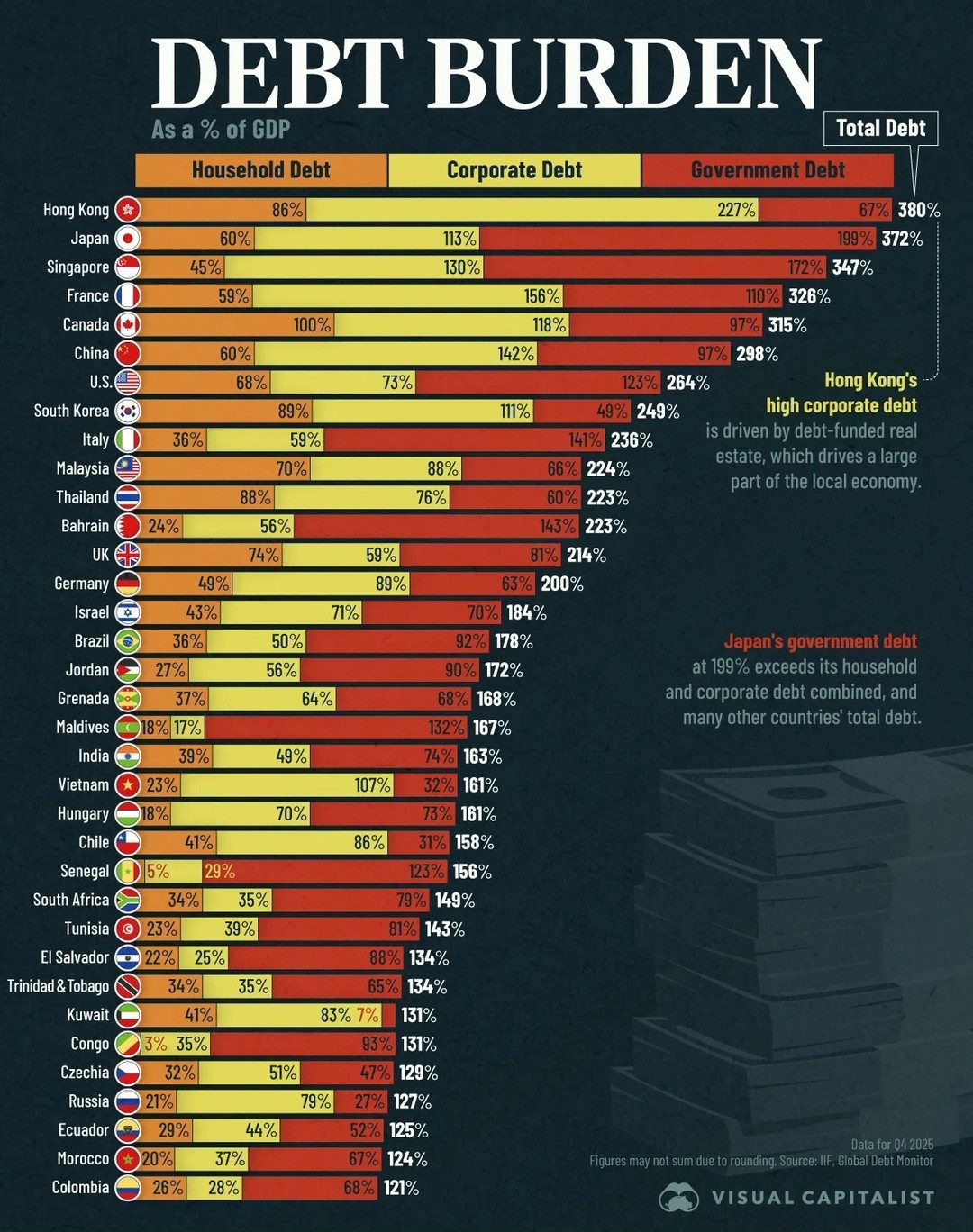
Hong Kong is currently the most indebted economy worldwide, with a total debt load of 380% of its GDP. Japan follows closely with 372% of GDP in debt, while the U.S. ranks seventh with 264% of GDP. The rising debt levels in major economies are driven by a combination of government, corporate, and household debt.
All over the world, economies are grappling with significant debt burdens. The infographic displays the total debt-to-GDP ratios of 35 countries, breaking down debt into household, corporate, and government sectors. This ranking, based on data from the Institute of International Finance's Global Debt Monitor (Q4 2025), offers a clear picture of global debt trends.
Global Debt Analysis: Why This Matters
Understanding the debt burdens of different countries is crucial for several reasons. It helps in assessing the economic stability and sustainability of nations, influencing investment decisions, and shaping global economic policies. High debt levels can lead to economic vulnerabilities, affecting everything from interest rates to currency values and economic growth prospects.
Breaking Down the Debt Burden
The United States: A Mixed Debt Profile
The U.S. stands out with a total debt-to-GDP ratio of 264%. This figure is composed of 123% government debt, 73% corporate debt, and 36% household debt. The high government debt is largely driven by public spending, while corporate debt reflects the borrowing activities of businesses. Household debt, though lower, still represents a significant portion of the total debt.
High-Indebted Economies
Hong Kong and Japan:
Hong Kong tops the list with 380% of GDP in total debt, followed by Japan at 372%. Both economies have substantial corporate and government debts, which are key contributors to their high debt-to-GDP ratios.
Europe and Asia:
Countries like Italy (223%), Singapore (224%), and South Korea (227%) also face significant debt burdens. These economies are grappling with high government and corporate debts, reflecting their reliance on borrowing to sustain economic activities.
Emerging Economies:
In emerging economies, the debt landscape varies widely. For instance, the Maldives has a relatively low debt burden at 59% of GDP, while Russia and Brazil have higher debt levels at 158% and 143% of GDP, respectively. This diversity highlights the unique economic challenges and opportunities within these regions.
Low-Debt Economies
Several countries, including Senegal, Tunisia, and South Africa, have relatively lower debt burdens. For example, Tunisia's total debt-to-GDP ratio stands at 81%, while Senegal's is 76%. These lower levels of debt indicate stronger fiscal positions and potentially more resilient economies, although they still face their own unique economic challenges.
Practical Tips for Investors and Economists
Assessing Economic Health
For investors and economists, understanding the debt burden of a country is crucial for assessing its economic health. High debt levels can indicate potential economic risks, while lower debt levels may suggest a more stable economic environment. It is essential to look at the composition of debt, whether it is mainly government, corporate, or household debt, as this can influence economic policies and market conditions.
Investing in Low-Debt Economies
Investors might find lower-risk opportunities in countries with relatively low debt burdens. For example, the Maldives and Grenada, with debt levels of 59% and 32% of GDP respectively, may offer more stable investment environments. However, it is important to conduct thorough research and consider other economic factors such as GDP growth, inflation, and political stability.
Diversifying Investment Portfolios
Diversifying investment portfolios across countries with varying debt levels can help mitigate risks. By spreading investments across low, medium, and high-debt economies, investors can balance potential returns with the associated risks. This strategy can provide a more resilient investment portfolio, capable of weathering economic fluctuations.
Maintaining Economic Stability
For policymakers, balancing debt levels is essential for maintaining economic stability. This involves managing government spending, encouraging responsible corporate borrowing, and promoting financial literacy to reduce household debt. Policies aimed at economic diversification, improving productivity, and fostering innovation can also help reduce the debt burden over time.
Important Takeaways
- Global Debt Trends: Hong Kong and Japan lead the world with the highest total debt-to-GDP ratios, while the U.S. ranks seventh.
- Debt Composition: The composition of debt varies widely among countries, impacting economic stability and growth prospects.
- Investment Strategies: Investors should consider debt levels and composition when assessing economic health and making investment decisions.
- Economic Policies: Policymakers need to focus on debt management, economic diversification, and productivity enhancement to maintain economic stability.
Conclusion
The global debt landscape is complex and multifaceted, with significant variations across different countries. Understanding these debt burdens and their components is essential for investors, economists, and policymakers alike. By analyzing the debt-to-GDP ratios, investors can make more informed decisions, while policymakers can develop effective strategies to manage and reduce debt levels, ensuring economic stability and growth.
Watch the Reel
Questions readers ask
Why is Hong Kong considered a crucial example in the global debt crisis?
Hong Kong’s debt load of 380% of its GDP makes it the most indebted economy in the world. This high debt-to-GDP ratio highlights the economic challenges and vulnerabilities that can arise from excessive debt, making it a significant case study in the global debt crisis.
How does Japan’s debt burden compare to other major economies?
Japan has the second-highest debt-to-GDP ratio at 372%, following closely behind Hong Kong. This places Japan among the countries with the most significant debt burdens globally, indicating substantial economic challenges.
What are the main components of global debt burdens, as highlighted in the article?
The article highlights that global debt burdens comprise government, corporate, and household debt. These components together create a comprehensive picture of a country’s debt situation, assisting in understanding the overall economic health.
Which countries, besides Hong Kong and Japan, have high debt burdens?
Other countries with substantial debt burdens include Italy (223%) and the United States (264%). These nations, along with Hong Kong and Japan, face notable economic challenges due to their high debt levels.
What factors contribute to the rising debt levels in major economies?
The increasing debt levels in major economies are influenced by a mix of factors, including government spending, corporate borrowing, and household debt. These elements collectively drive the total debt-to-GDP ratio, impacting economic stability.
What does the Institute of International Finance's Global Debt Monitor reveal about world debt statistics?
The Institute of International Finance's Global Debt Monitor (Q4 2025) provides detailed data on the total debt-to-GDP ratios of 35 countries, breaking down debt into household, corporate, and government sectors, offering a comprehensive view of global debt trends.
Why is it important to analyze the debt burdens of various countries?
Analyzing debt burdens helps identify potential economic vulnerabilities and challenges. High debt levels can lead to economic instability, making it crucial for policymakers and stakeholders to understand these dynamics to implement effective strategies for debt management and economic stability.
Recent articles
Fresh deep dives from the latest Reels we unpacked.




Comments
Be the first to comment.