Understanding Global Currency Returns in 2023
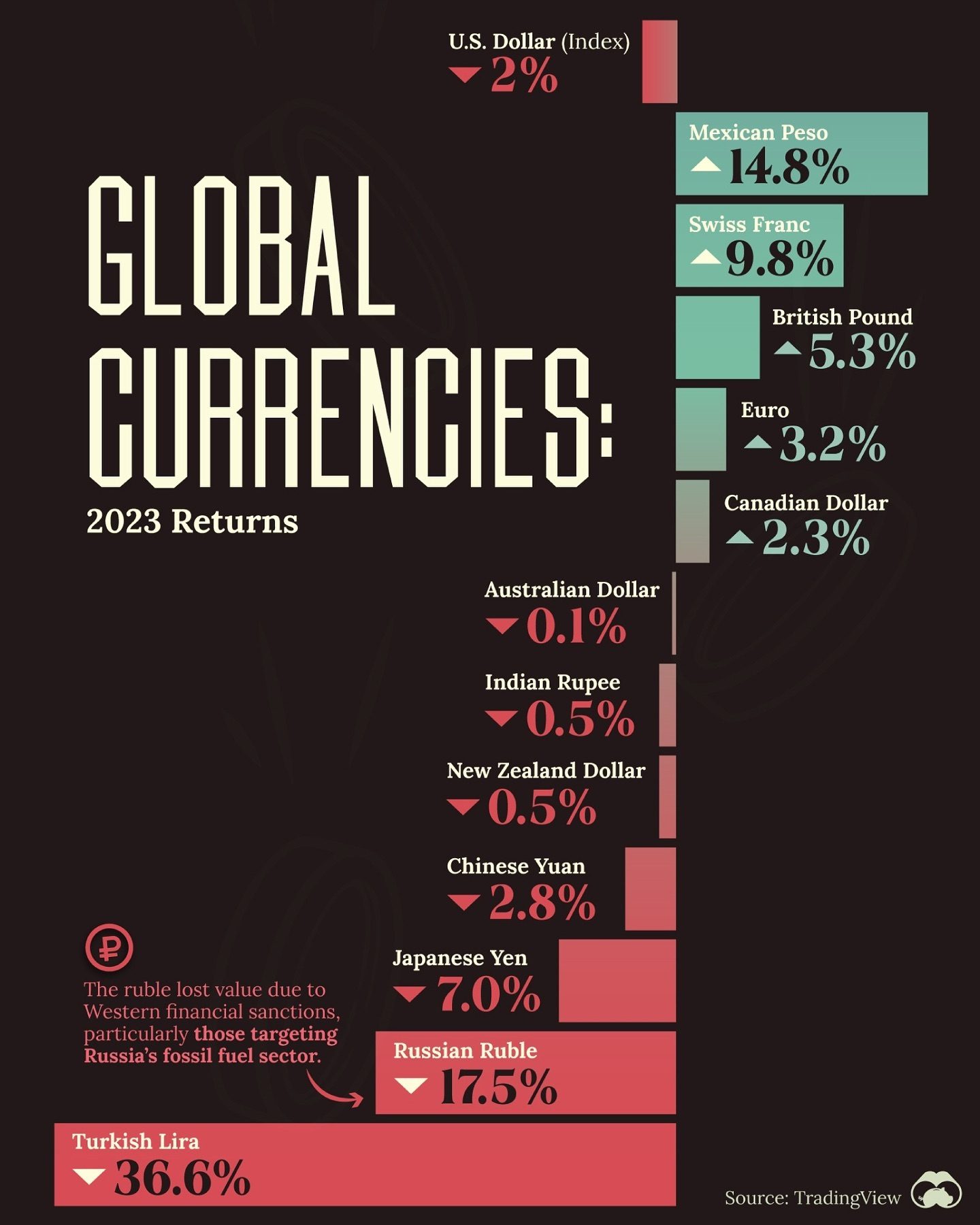
Global currency markets have always been a dynamic and complex landscape, influenced by a myriad of factors. In 2023, the returns of major currencies against the U.S. dollar have shown significant fluctuations, with some currencies faring better than others.
Context / Why This Matters
The U.S. Dollar Index, which measures the value of the U.S. dollar against a basket of foreign currencies, peaked in fall 2022 at its highest level in nearly two decades. This peak was driven by aggressive interest rate hikes by the Federal Reserve. However, in 2023, the index has declined from its highs, though it remains at an elevated level as interest rates have stayed steady. This shift has had a ripple effect on other major currencies, making it crucial to understand how they have performed against the U.S. dollar.
Main Discussion
Performance of Major Currencies
Mexican Peso
The Mexican Peso has shown one of the highest returns among the currencies, coming in at 14.8%. This positive performance can be attributed to various factors including stable economic growth, favorable trade agreements, and supportive monetary policies in Mexico.
Swiss Franc
The Swiss Franc has also performed well with a 9.8% return. Known for its stability and strength, the Swiss Franc is often seen as a safe-haven currency. The inflation is one of the lowest in the world, making it a reliable choice for investors.
British Pound
The British Pound has posted a 5.3% return. Despite ongoing Brexit-related uncertainties, the Pound has managed to stabilize and show moderate growth. Factors such as economic policies, trade deals, and inflation rates play a significant role in its performance.
Euro
The Euro has seen a 3.2% return. The Eurozone's economic recovery, combined with the European Central Bank's monetary policies, has contributed to this modest growth. However, challenges such as energy prices and geopolitical tensions continue to impact the Euro.
Australian Dollar
The Australian Dollar has experienced a 2.3% return. This performance is linked to Australia's strong commodity exports and a resilient economy. The central bank's policies and global demand for Australian resources have supported the currency's value.
Indian Rupee
The Indian Rupee has had a 0.5% return. India's economic growth, driven by its robust services sector and manufacturing, has helped the Rupee maintain a steady value. However, external factors such as global oil prices and inflation also affect its performance.
New Zealand Dollar
The New Zealand Dollar showed a marginal 0.1% return. New Zealand's economy, heavily dependent on exports like dairy and agriculture, faces challenges from global market fluctuations. The central bank's policies and trade dynamics have a significant impact on the currency's value.
Japanese Yen
The Japanese Yen has seen a 0.5% return. Despite Japan's low interest rates and deflationary pressures, the Yen remains a stable currency due to its safe-haven status. Economic policies and trade dynamics play a crucial role in its performance.
Chinese Yuan
The Chinese Yuan has experienced a 2.8% return. China's economic policies, including government spending and investment in infrastructure, have supported the Yuan's value. However, geopolitical tensions and trade dynamics also influence its performance.
Russian Ruble
The Russian Ruble has experienced a 7.0% loss. This decline is primarily due to Western financial sanctions targeting Russia’s fossil fuel sector. The sanctions have limited Russia's ability to trade and access international markets, leading to a significant devaluation of the Ruble.
Turkish Lira
The Turkish Lira has faced a substantial 36.6% loss. Turkey's high inflation rates, economic instability, and political turmoil have all contributed to the Lira's decline. The central bank's policies and external economic pressures have further exacerbated the situation.
Practical Tips
- Stay Informed: Keep track of global economic indicators and news. Understanding the broader economic context is crucial for making informed investment decisions.
- Diversify Your Portfolio: Consider diversifying your investment portfolio to include multiple currencies. This can help mitigate risks associated with fluctuations in any single currency.
- Monitor Monetary Policies: Pay attention to the monetary policies of central banks. Changes in interest rates, quantitative easing, and other policies can significantly impact currency values.
- Analyze Trade Dynamics: Understand the trade relationships and agreements between countries. Trade dynamics can influence currency values and economic stability.
- Use Reliable Data Sources: Utilize reliable data sources like TradingView to track currency performance and economic indicators. Accurate data is essential for making informed decisions.
Important Takeaways
- The Mexican Peso and Swiss Franc have shown significant returns, driven by stable economic conditions and favorable trade agreements.
- The British Pound and Euro have performed moderately, influenced by economic policies and geopolitical factors.
- The Australian Dollar and Indian Rupee have seen moderate returns, supported by robust economies and exports.
- The Japanese Yen and Chinese Yuan have shown stability, influenced by economic policies and global trade dynamics.
- The Russian Ruble and Turkish Lira have faced significant losses due to financial sanctions and economic instability.
Conclusion
The performance of global currencies in 2023 has been shaped by a variety of factors, including economic policies, trade dynamics, and geopolitical tensions. Understanding these factors and staying informed about global economic trends can help individuals and businesses make better investment decisions. By diversifying portfolios, monitoring monetary policies, and using reliable data sources, investors can navigate the complex landscape of global currency markets with greater confidence.
Watch the Reel
Questions readers ask
How has the Mexican Peso (MXN) performed against the U.S. dollar (USD) in 2023?
The Mexican Peso has shown resilience in 2023, with a stable return against the USD. This performance can be attributed to strong economic growth and prudent monetary policies, which have helped mitigate the effects of global economic uncertainties.
What factors have influenced the Swiss Franc (CHF) to USD return in 2023?
The Swiss Franc has experienced notable fluctuations against the USD in 2023, primarily driven by geopolitical tensions and its status as a safe-haven currency. Additionally, the monetary policies of the Swiss National Bank, aimed at controlling inflation and stabilizing the economy, have played a significant role in its performance.
Why has the British Pound (GBP) to USD return been volatile in 2023?
The British Pound's performance against the USD in 2023 has been marked by volatility due to political instability, Brexit-related uncertainties, and the Bank of England's monetary policy adjustments. These factors have made the GBP to USD exchange rate particularly sensitive to both domestic and international economic developments.
What has driven the Euro (EUR) to USD return in 2023?
The Euro's return against the USD in 2023 has been influenced by the European Central Bank's monetary policy, economic growth within the Eurozone, and broader geopolitical dynamics. The Euro has faced challenges due to varying economic performances among member states and the impact of global interest rate changes.
How have the Russian Ruble and Turkish Lira performed in 2023?
The Russian Ruble has shown mixed performance in 2023, reflecting the country's evolving economic situation and geopolitical tensions. The Turkish Lira, however, has faced significant depreciation due to high inflation and monetary policy decisions that have led to increased volatility in the currency.
What insights can be gained from the 2023 currency market shifts for traders?
Currency traders in 2023 have observed that understanding global economic trends, central bank policies, and geopolitical risks is crucial for success. The shifting dynamics of major currencies highlight the importance of staying informed about international economic developments and adapting strategies accordingly.
How has the U.S. Dollar Index's decline from its 2022 peak affected other currencies in 2023?
The decline of the U.S. Dollar Index from its 2022 peak has resulted in a more favorable environment for other currencies, as the USD's dominance has waned. This shift has allowed currencies like the Mexican Peso and Swiss Franc to strengthen against the USD, while others, such as the Turkish Lira, have continued to face challenges.
Related deep dives
Similar reads based on topic and creator.


Recent articles
Fresh deep dives from the latest Reels we unpacked.




Comments
Be the first to comment.