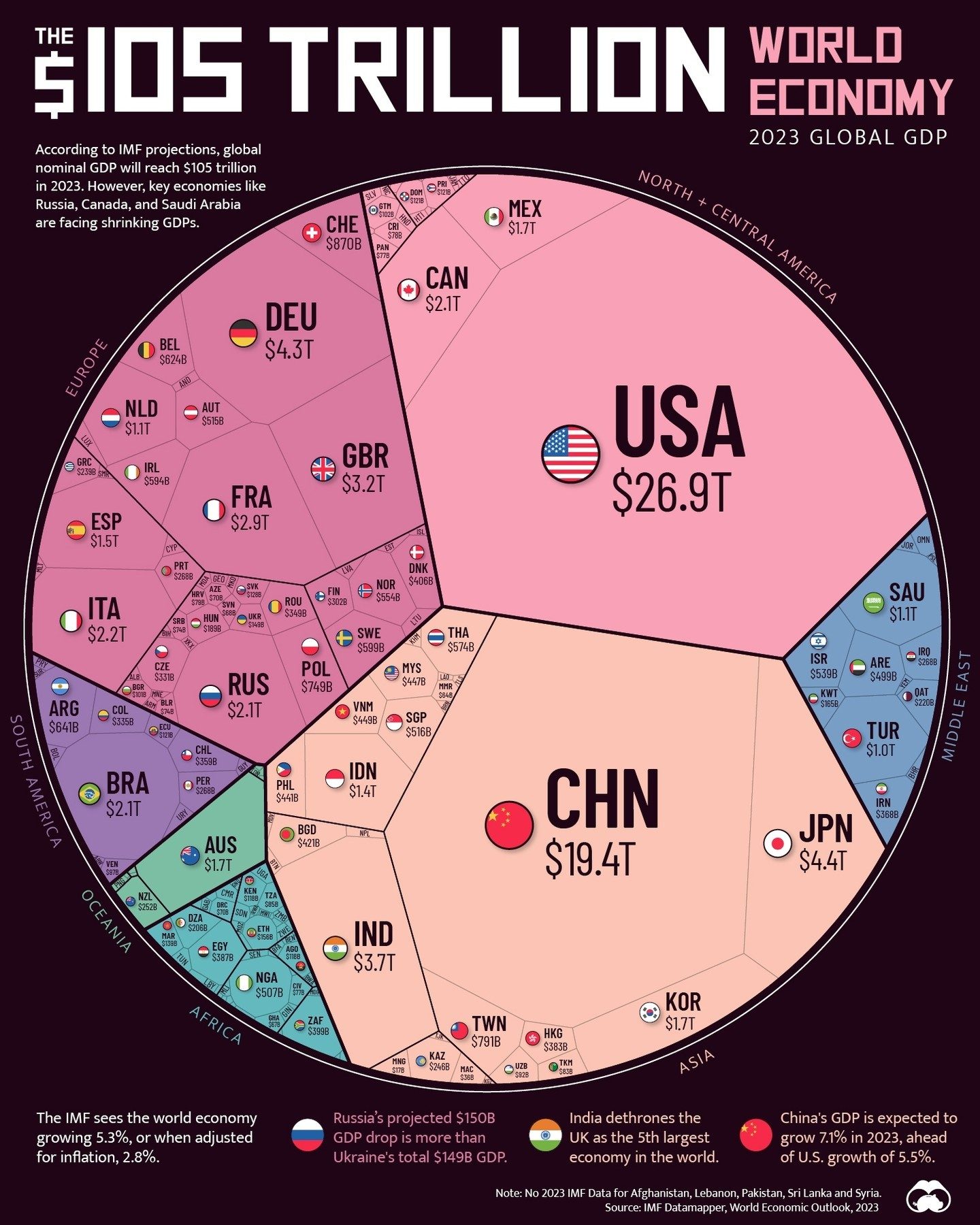
Global GDP in 2023
Today, the global economy is projected to reach unprecedented heights, with a gross domestic product (GDP) of $105 trillion by the end of 2023. This projection, which is $5 trillion higher than the previous year, comes from the latest International Monetary Fund (IMF) report, the 2023 World Economic Outlook. The nominal GDP increase of 5.3% translates to a 2.8% rise in inflation-adjusted terms. This growth reflects significant shifts in the global economic landscape, with various countries experiencing distinct economic trends.
Context: Understanding GDP
GDP, or Gross Domestic Product, is a critical measure of a country's economic health. It represents the total value of all goods and services produced within a country's borders in a specific time period. GDP growth indicates a country's economic progress and its citizens' overall standard of living. When global GDP grows, it implies that collectively, nations are producing more, which can lead to increased employment, more investment, and better living conditions.
Importance of Global GDP
Global GDP serves as a barometer for the world economy. It provides insights into how different countries contribute to the global economic landscape. A growing global GDP signifies that the world is collectively moving towards greater economic stability and prosperity. However, it also highlights disparities between countries, as some economies grow faster than others.
Main Discussion
Regional and Country-Specific Insights
The global GDP landscape is diverse, with significant variations between regions and individual countries.
Europe
In Europe, the economic landscape is varied. For instance, Belgium's GDP stands at $2.6 trillion, while the Netherlands' GDP is $840 billion. Ireland, with a GDP of $94 billion, and Spain, with $1.5 trillion, showcase the economic diversity within the region. Italy, with a GDP of $2.2 trillion, and Russia, with $2.1 trillion, are significant players in the European economy. Poland, with a GDP of $749 billion, and the United Arab Emirates, with $1.1 trillion, also contribute notably to the region's economic output.
Asia
Asia is home to some of the world's largest economies. The United States, with a GDP of $26.9 trillion, continues to be a dominant force. China, with a GDP of $19.4 trillion, is a close second, while Japan, with a GDP of $4.4 trillion, is another major economic player. Brazil, with a GDP of $2.1 trillion, and Australia, with $1.7 trillion, are also significant contributors. India, with a GDP of $4.4 trillion, is projected to become the third-largest economy by 2027. South Korea, with a GDP of $1.8 trillion, and Saudi Arabia, with a GDP of $980 billion, further enrich the region's economic diversity.
Long-Term Projections
Looking ahead, the IMF projects that the world economy will reach $510 trillion by 2033. Despite this optimistic outlook, certain key economies, including Russia, Canada, and Saudi Arabia, are facing shrinking GDPs. This trend is influenced by various factors, such as population decline and economic policies, which have slowed economic growth in these countries.
Key Economies and Their Challenges
Russia
Russia's economic outlook is particularly concerning, with its population declining at an alarming rate. This demographic challenge poses significant obstacles to sustained economic growth. The country's GDP, currently at $2.1 trillion, is expected to face further contraction, which could impact its role in the global economy.
Saudi Arabia
Saudi Arabia, with a GDP of $980 billion, is also grappling with economic challenges. The country's reliance on oil exports makes it vulnerable to fluctuations in global oil prices. Additionally, efforts to diversify its economy have faced hurdles, impacting its overall economic growth.
Emerging Economies
While some economies face decline, others are on the rise. India, for instance, is projected to become the third-largest economy by 2027, overtaking Japan and Germany. This shift underscores the growing influence of emerging markets in the global economy. Countries like Pakistan, Sri Lanka, and Mongolia are also expected to experience increased economic competitiveness.
Practical Tips
Understanding global GDP trends can provide valuable insights for businesses, investors, and policymakers. Here are some practical tips for navigating the global economic landscape:
For Businesses
- Diversify your market presence: Expand into emerging markets with high growth potential, such as India and other Southeast Asian countries. Diversifying your market presence can mitigate risks associated with economic downturns in other regions.
- Stay informed: Keep track of economic trends and projections to anticipate changes in consumer behavior and market dynamics. This information can help you make informed decisions about investments, expansion, and strategic planning.
- Leverage technology: Use data analytics and economic forecasting tools to identify opportunities and risks in different markets. Technology can provide valuable insights into economic trends, helping you make data-driven decisions.
For Investors
- Consider long-term investments: Long-term investments in emerging economies can yield significant returns as these markets grow. Look for opportunities in sectors with high growth potential, such as technology, healthcare, and infrastructure.
- Diversify your portfolio: Spread your investments across various countries and sectors to minimize risks associated with economic volatility. Diversification can help you weather economic downturns and capitalize on opportunities in growing markets.
- Stay updated on policy changes: Government policies can significantly impact economic growth and investment returns. Stay informed about policy changes and regulatory frameworks in different countries to make informed investment decisions.
For Policymakers
- Promote economic stability: Implement policies that foster economic stability and growth. This includes promoting investment, improving infrastructure, and encouraging innovation and entrepreneurship.
- Support emerging economies: Provide support to emerging economies through trade agreements, foreign aid, and international cooperation. This can help boost economic growth and stability in these countries, benefiting the global economy.
- Encourage sustainable development: Promote sustainable development practices that balance economic growth with environmental and social concerns. This can help ensure long-term economic prosperity and resilience.
Important Takeaways
The global GDP projections for 2023 highlight both opportunities and challenges in the global economy. Here are some key takeaways:
- The global economy is expected to grow significantly, with a GDP of $105 trillion by the end of 2023.
- Economic trends vary across regions and countries, with some economies facing growth while others face decline.
- Emerging markets, such as India, are poised for significant growth, which could reshape the global economic landscape.
- Understanding global GDP trends and projections can provide valuable insights for businesses, investors, and policymakers.
Conclusion
The projected global GDP of $105 trillion by the end of 2023 underscores the dynamic nature of the world economy. While some economies face significant challenges, others are poised for growth. By staying informed about these trends and adapting to the changing landscape, businesses, investors, and policymakers can navigate the global economy effectively. This insightful analysis of GDP trends provides a roadmap for understanding the complex interplay of economic forces shaping our world.
Watch the Reel
Questions readers ask
What is the projected global GDP for 2023?
The projected global GDP for 2023 is $105 trillion, according to the latest International Monetary Fund (IMF) report, which is an increase of $5 trillion from the previous year. This represents a nominal GDP increase of 5.3%.
How does the 2023 GDP growth compare to previous years?
The 2023 GDP growth is projected to be 2.8% in inflation-adjusted terms, which is a significant increase from the previous year and is expected to be a major milestone.
Which organization publishes the GDP projections for 2023?
The GDP projections for 2023 are published by the International Monetary Fund (IMF) in their 2023 World Economic Outlook report. This report provides insights into the global economic trends and projections for the year.
What does the nominal GDP increase of 5.3% mean?
The nominal GDP increase of 5.3% means that the total value of all goods and services produced globally is projected to rise by this percentage from the previous year without adjusting for inflation. This is a significant indicator of global economic growth for 2023.
Which regions are expected to drive the most significant growth in 2023?
The article highlights that there are varied trends across regions and countries, with some economies outpacing others. Specific regions driving growth are not detailed, and for nuances you can explore the full report from the IMF.
Recent articles
Fresh deep dives from the latest Reels we unpacked.




Comments
Be the first to comment.