Economic Forecasts: Comparing G7 and BRICS Countries
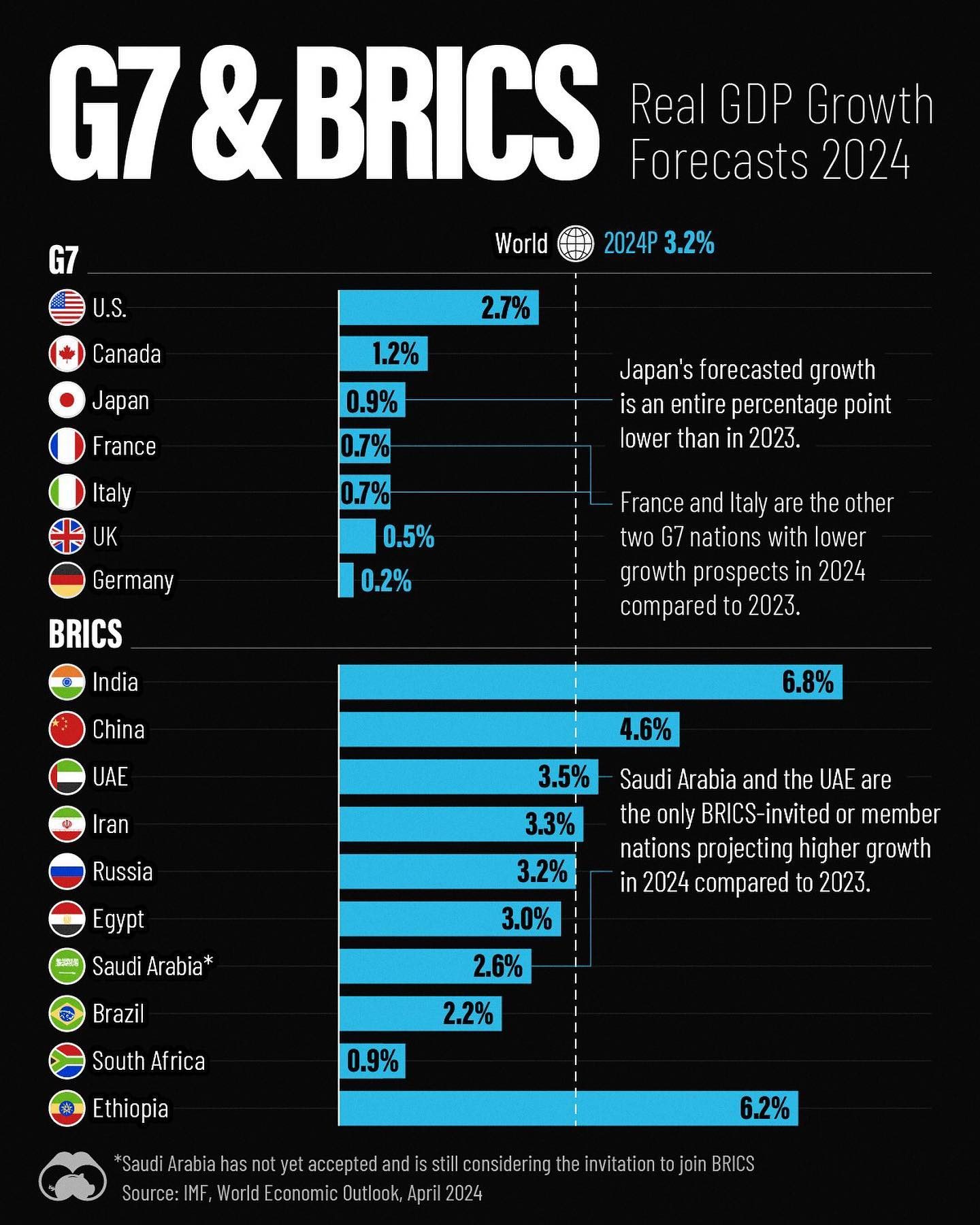
The G7 and BRICS nations stand at the forefront of global economic discussions, with the International Monetary Fund (IMF) projecting steady global growth at 3.2% for 2024. However, this overall stability masks significant variations in expected real GDP growth across these major economies. Let's delve into the forecasts and understand the nuances shaping the economic landscape for 2024.
Why This Matters
Understanding the economic growth projections for the G7 and BRICS countries is crucial for investors, policymakers, and businesses. These projections provide insights into potential opportunities and risks, helping stakeholders make informed decisions. The IMF’s 2024 World Economic Outlook offers a comprehensive view of global economic trends, highlighting both the strengths and vulnerabilities of key economies.
Main Discussion
G7 Countries: Mixed Outlook
The G7 nations—which include the United States, Canada, Japan, France, the UK, Germany, and Italy—present a mixed outlook for 2024. Germany, traditionally a powerhouse of the European economy, is expected to see the lowest growth rate at 0.2%. This slowing can be attributed to various factors, including internal economic adjustments and external geopolitical tensions. The United States is anticipated to grow at 2.7%, a moderate rate reflecting its status as a resilient economic giant. Japan and the UK are projected to grow at 0.9% and 0.7%, respectively, while France is expected to grow at 0.7%.
Canada, with a projected growth of 1.2%, stands out among the G7 nations for its relatively stronger economic performance. This growth can be attributed to Canada’s strong fiscal policies, robust trade relations, and diversified economy, which includes sectors like technology, natural resources, and finance.
BRICS Nations: Diverse Growth Prospects
The BRICS nations—Brazil, Russia, India, China, and South Africa—offer a diverse range of growth prospects. India leads the pack with a projected growth rate of 6.8%, driven by its large and growing population, expanding middle class, and robust industrial and services sectors. China, the world's second-largest economy, is expected to grow at 4.6%, maintaining its position as a significant contributor to global economic growth. Russia, despite ongoing geopolitical challenges, is projected to grow at 3.2%, while Brazil and South Africa are expected to grow at 2.2% and 0.9%, respectively.
Economic Performance of Saudi Arabia and the UAE
Saudi Arabia and the UAE stand out as notable outliers in the BRICS-invited nations and member projections. Both countries are expected to see higher growth in 2024 compared to 2023. Saudi Arabia is projected to grow at 2.6%, reflecting its strategic economic reforms and diversification efforts away from oil dependence. The UAE, similarly, is poised for growth due to its robust tourism, logistics, and financial services sectors, although no specific growth rate information was provided.
Key Considerations for the G7 and BRICS Nations
Economic growth projections are influenced by a variety of factors, including fiscal policies, trade agreements, and geopolitical stability. The G7 nations, with their advanced economies and extensive trade networks, are generally more resilient to global economic shocks. However, they also face challenges such as aging populations, high levels of debt, and internal political divisions. In contrast, the BRICS nations are characterized by their rapid economic growth, large populations, and significant potential for development. However, they grapple with issues such as income inequality, infrastructure gaps, and reliance on commodity exports.
Geopolitical and Economic Context
Geopolitical tensions and economic policies play a crucial role in shaping the growth trajectories of both G7 and BRICS nations. The ongoing geopolitical tensions in Europe, the Middle East, and other regions have a significant impact on global trade and investment, affecting countries differently based on their economic dependencies and strategic interests. Similarly, internal economic policies, including fiscal and monetary measures, taxation, and regulatory frameworks, influence the economic performance of these nations.
Practical Tips
For investors and businesses looking to capitalize on these growth trends, it is essential to stay informed about the latest economic developments and policy changes. Here are some practical tips to navigate the economic landscape:
Diversify Investment Portfolios
Given the varied growth prospects of G7 and BRICS nations, investors should consider diversifying their portfolios across different regions and sectors. This approach can help mitigate risks and maximize returns. For instance, investing in sectors such as technology, healthcare, and renewable energy in emerging markets can provide significant growth opportunities.
Monitor Policy Changes
Staying updated on fiscal and monetary policies of key economies is crucial for informed decision-making. Policy changes, such as tax reforms, interest rate adjustments, and trade agreements, can have a significant impact on economic growth and investment opportunities.
Leverage Strategic Partnerships
Establishing strategic partnerships with local companies and institutions can provide valuable insights and opportunities for growth. Collaborating with local businesses can help navigate regulatory environments, gain market access, and build a strong local presence.
Focus on Sustainability
Sustainable practices are increasingly becoming a priority for businesses and investors. Investing in companies that prioritize environmental, social, and governance (ESG) factors can not only contribute to long-term growth but also enhance reputation and attract socially conscious investors.
Important Takeaways
The economic outlook for 2024 presents a mix of opportunities and challenges for the G7 and BRICS nations. India's robust growth, Saudi Arabia and the UAE's higher-than-2023 projected growth, and Canada's stronger performance within the G7 highlight the varied economic trajectories. Understanding these projections can help stakeholders make informed decisions and capitalize on the emerging opportunities. Further, staying updated on policy changes, diversifying investment portfolios, and leveraging strategic partnerships can enhance the chances of success in this dynamic economic landscape.
Conclusion
The IMF’s 2024 World Economic Outlook offers a comprehensive view of the economic growth prospects for G7 and BRICS nations, revealing both the strengths and vulnerabilities of key economies. While the global economy is projected to grow at 3.2%, individual countries face unique challenges and opportunities. By staying informed and strategic, investors, policymakers, and businesses can navigate the complex economic landscape and capitalize on the emerging opportunities.
Watch the Reel
Questions readers ask
What are the lowest and highest GDP growth forecasts for G7 nations in 2024?
The lowest GDP growth forecast for a G7 nation in 2024 is 0.2%, while the highest is 2.7%. These figures highlight the disparities in economic performance expected within the group.
Which BRICS country is expected to have the highest GDP growth in 2024?
The article does not specify the exact growth rates for each BRICS country. However, it mentions that there are significant variations in growth expectations among the five nations, suggesting that some may have high growth prospects while others face considerable challenges.
How does the IMF's global growth projection for 2024 compare to the expected growth in G7 and BRICS countries?
The IMF projects a global growth rate of 3.2% for 2024, which serves as a benchmark for comparing the economic performance of G7 and BRICS countries. This overall stability, however, does not reflect the diverse growth rates expected within these two groups.
What factors might contribute to the varied growth prospects within the G7 nations in 2024?
The varied growth prospects within the G7 nations can be attributed to factors such as domestic policies, trade dynamics, and global economic conditions. For instance, the United States and Germany, which are part of the G7, may experience different growth rates due to their respective economic policies and trade relations.
Why is it important to compare the economic growth of G7 and BRICS countries for investors and policymakers?
Comparing the economic growth of G7 and BRICS countries is crucial for investors and policymakers as it provides valuable insights into potential opportunities and risks. This information helps stakeholders make well-informed decisions regarding investments, trade, and economic policies.
Related deep dives
Similar reads based on topic and creator.


Recent articles
Fresh deep dives from the latest Reels we unpacked.




Comments
Be the first to comment.