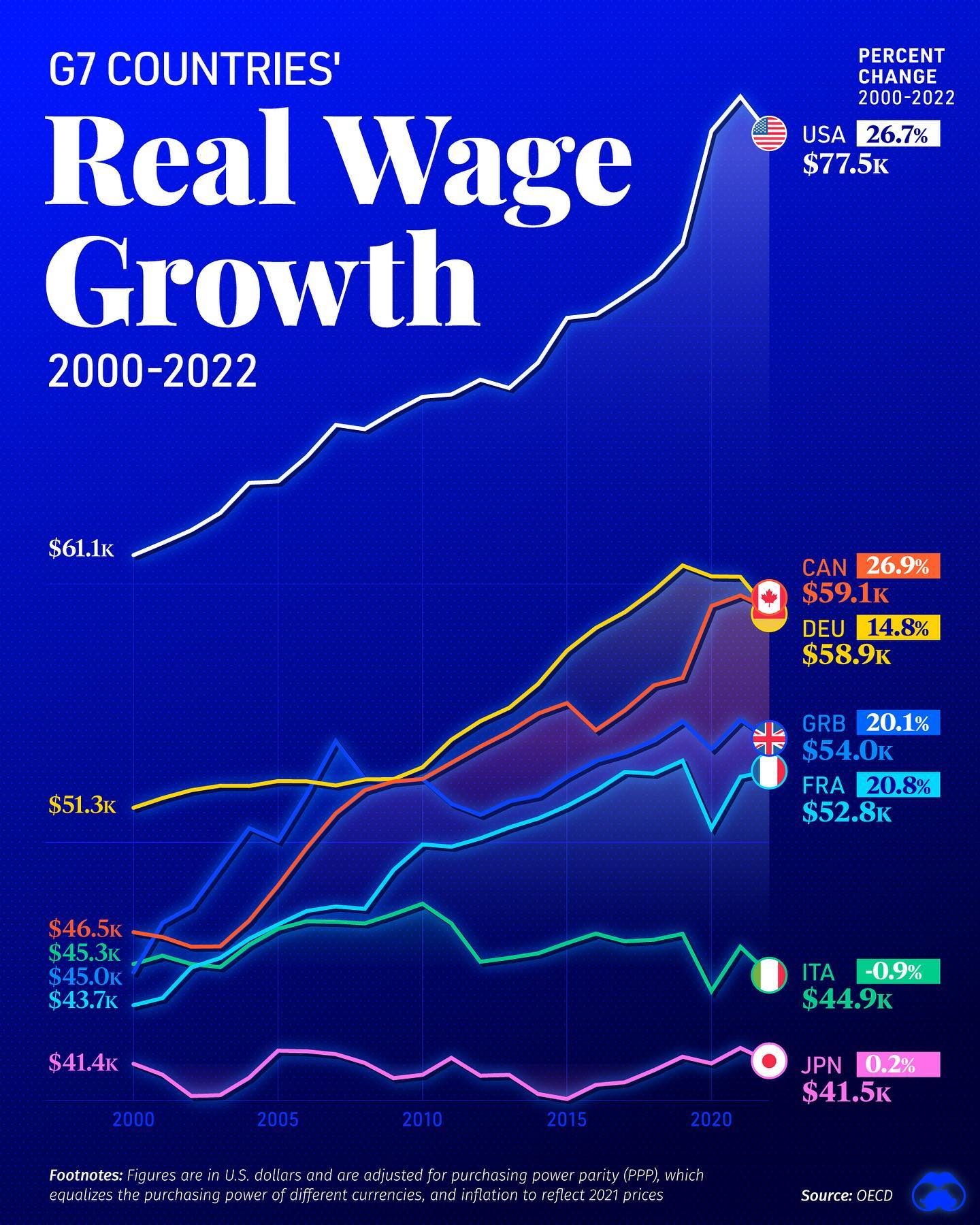
Understanding real wage growth in the G7 countries is an essential aspect of analyzing economic performance and worker prosperity. The G7 countries — the United States, France, Germany, the United Kingdom, Italy, Japan, and Canada — are among the most economically advanced nations in the world. When examining the real wage growth from 2000 to 2022, the data reveals significant variations in how these countries have fared in terms of wages for full-time workers.
Context: Why This Matters
Real wage growth is crucial because it reflects the actual purchasing power of workers' earnings after accounting for inflation and purchasing power parity (PPP). This metric provides a clearer picture of economic prosperity and living standards compared to nominal wage growth, which does not account for changes in the cost of living.
Real Wage Growth Across the G7
United States: Leading the Pack
The United States stood out with the highest real wage growth among the G7 countries, at 26.7% from 2000 to 2022. This significant increase means that the average full-time worker in the U.S. saw their wages rise substantially, even after accounting for inflation and the cost of living. The robust growth is indicative of a strong economy and a relatively stable labor market.
France: Steady but Moderate Growth
France experienced a real wage growth of 20.8%, placing it second among the G7 countries. This steady increase reflects a stable economy with a focus on wage stability and worker benefits. While the growth may not be as pronounced as in the U.S., it still indicates a positive trend for workers in France.
Germany: Moderate but Consistent
Germany's real wage growth was 14.8%, which, while lower than the U.S. and France, still represents a consistent upward trend. Germany's economy is known for its strong industrial base and skilled labor force, which contributes to steady wage increases over time. The moderate growth reflects a balanced approach to economic policy, prioritizing both stability and growth.
United Kingdom: Close to the Leaders
The United Kingdom saw a real wage growth of 20.1%, closely following France. This growth highlights the UK's dynamic economy and its efforts to maintain competitive wage levels for full-time workers. Despite facing economic challenges, the UK has managed to achieve a respectable level of wage growth.
Italy: A Unique Challenge
Italy's real wage growth stands out as the only negative figure among the G7 countries, at -0.9%. This means that the average annual wage in Italy in 2022 fell below its level from over 20 years ago, even after accounting for inflation and PPP. This decline is concerning and indicates significant economic challenges, including stagnant productivity, high unemployment, and a struggling labor market.
Japan: Minimal Growth
Japan's real wage growth was a modest 0.2%, the second-lowest among the G7 countries. This minimal growth reflects Japan's long-standing economic challenges, including an aging population, low birth rates, and a stagnant economy. Despite these issues, Japan's stable economic policies have helped maintain some level of wage growth, albeit at a very slow pace.
Factors Influencing Real Wage Growth
Economic Policies and Stability
Economic policies play a critical role in determining real wage growth. Countries with stable economic policies and a focus on job creation and labor market reforms tend to see higher wage growth. For instance, the U.S. and France have implemented policies aimed at boosting employment and supporting worker benefits, which has contributed to their higher real wage growth.
Productivity and Innovation
Productivity and innovation are key drivers of wage growth. Countries with higher levels of productivity and innovation, such as the U.S. and Germany, tend to experience better wage growth. These factors contribute to increased economic output and, subsequently, higher wages for workers.
Inflation and Cost of Living
Inflation and the cost of living are critical factors in determining real wage growth. High inflation rates can erode wage gains, even if nominal wages are increasing. Countries that manage inflation effectively and provide a stable cost of living environment tend to see better real wage growth.
Labor Market Conditions
Labor market conditions, including unemployment rates and job creation, significantly impact wage growth. Countries with lower unemployment rates and strong job creation tend to experience higher wage growth. For example, the U.S. and UK have relatively strong labor markets, which contributes to their higher real wage growth.
Practical Tips for Workers and Policy Makers
For individuals, understanding real wage growth can help in making informed decisions about career choices, negotiations, and financial planning. Here are some practical tips:
Negotiate for Real Wage Increases
Workers should focus on negotiating real wage increases, which account for inflation and the cost of living. This ensures that any wage increases actually improve living standards and purchasing power.
Invest in Skills and Education
Continuous learning and skill development can enhance productivity and make workers more valuable in the labor market. Investing in education and training can lead to better job opportunities and higher wages.
Stay Informed About Economic Trends
Staying informed about economic trends, including inflation rates, job market conditions, and policy changes, can help workers make better decisions. Understanding these trends can provide insights into potential wage growth and economic stability.
Advocate for Policies That Support Wage Growth
Policy makers and workers should advocate for policies that support wage growth, such as minimum wage increases, labor market reforms, and measures to control inflation. These policies can contribute to a more equitable and prosperous economy.
Important Takeaways
Real wage growth across the G7 countries reveals a mixed picture, with some countries performing exceptionally well and others facing significant challenges. The United States leads the way in real wage growth, while Italy faces a unique challenge with a decline in real wages.
Productivity, innovation, economic stability, and labor market conditions are critical factors influencing real wage growth. Workers and policy makers should focus on negotiating real wage increases, investing in skills, and advocating for supportive policies to enhance economic prosperity.
For policy makers, understanding the factors that drive real wage growth is essential for developing effective economic policies. This includes focusing on productivity, innovation, and labor market reforms to support wage growth and economic stability.
Conclusion
Analyzing real wage growth in the G7 countries provides valuable insights into economic performance and worker prosperity. While the United States and some European countries have seen significant real wage growth, others like Italy and Japan face unique challenges. By focusing on key factors such as productivity, economic stability, and labor market conditions, both workers and policy makers can work towards achieving better economic outcomes and improving living standards for all.
Watch the Reel
Questions readers ask
Which G7 country experienced the most significant real wage growth from 2000 to 2022?
The United States had the highest real wage growth among the G7 countries during this period. This indicates that full-time workers in the U.S. saw the most substantial increase in their purchasing power compared to their counterparts in other G7 nations.
How does real wage growth differ from nominal wage growth?
Real wage growth takes into account inflation and purchasing power parity, providing a more accurate measure of workers' actual buying power. In contrast, nominal wage growth simply reflects the percentage increase in wages without considering the effects of inflation.
What are some of the factors contributing to the diverse real wage growth trends among G7 countries?
Differences in economic policies, labor market conditions, and inflation rates have led to varied real wage growth trends among the G7. For instance, countries with lower inflation rates and stronger labor market performance tend to show higher real wage growth.
Which international organization provides data on real wage growth for G7 countries?
The OECD (Organisation for Economic Co-operation and Development) is a key source for real wage data among G7 countries. The OECD compiles and analyzes wage growth trends, offering insights into economic performance and living standards in these advanced economies.
What can be inferred about a country's economic performance based on its real wage growth rate?
A higher real wage growth rate generally indicates better economic performance and improved living standards. It suggests that the country is effectively managing inflation and that workers' earnings are keeping pace with, or even outpacing, the rising cost of living.
Which G7 countries showed steady increases in real wage growth from 2000 to 2022?
France and Germany are notable examples of G7 countries that displayed steady increases in real wage growth during this period. This trend reflects consistent economic policies and labor market conditions that have supported worker prosperity.
How does real wage growth affect the overall economic outlook of a G7 country?
Steady real wage growth contributes to a positive economic outlook, indicating economic stability and improved living standards. It also suggests a healthier balance between productivity gains and wage increases, fostering a more sustainable economic environment.
Recent articles
Fresh deep dives from the latest Reels we unpacked.




Comments
Be the first to comment.