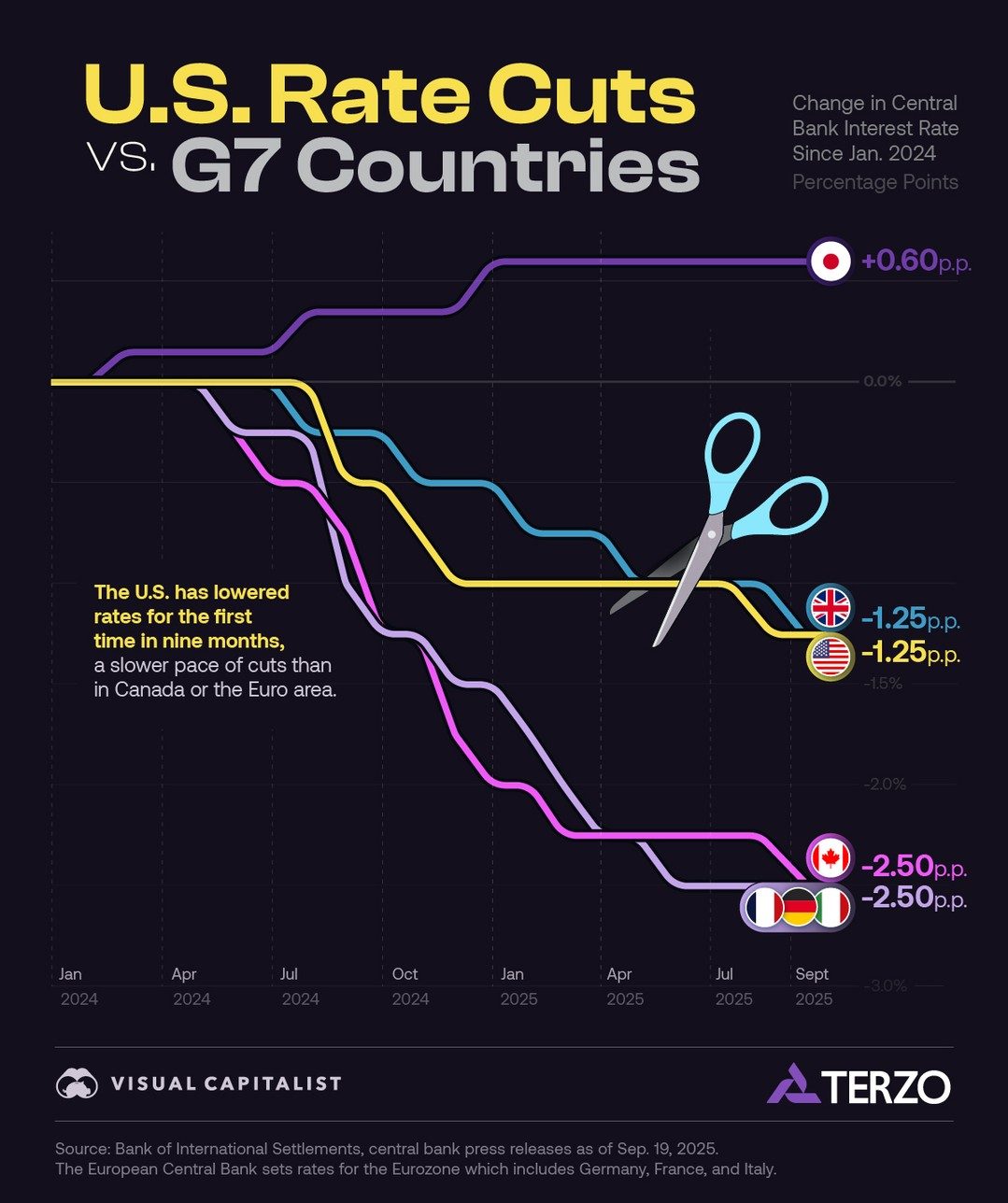
Interest rates are a critical aspect of any economy, and recent changes to interest rates by major G7 economies have sparked considerable attention. This comparison aims to break down the latest trends in interest rate cuts, focusing on how the U.S. stacks up against other G7 countries.
Context and Overall Significance
The G7 economies, which include the U.S., Canada, France, Germany, Italy, Japan, and the UK, are among the world's most influential economic powers. Their decisions on interest rates have far-reaching implications for global finance, trade, and investment. When central banks adjust interest rates, they impact everything from borrowing costs to consumer spending and business investment.
The graphic highlights changes in central bank interest rates from 2024 to 2025, showing how these adjustments are made to navigate economic challenges. For businesses, these rate cuts can mean lower borrowing costs, potentially stimulating growth and investment. However, they also come with risks, such as inflation and currency fluctuations.
Main Discussion
U.S. Interest Rate Cuts
The U.S. Federal Reserve has lowered interest rates for the first time in nine months. This move reflects efforts to stimulate economic activity and support a recovering economy. The rate cut is relatively modest, at +0.60 percentage points (p.p.), indicating a cautious approach by the Federal Reserve. This measured adjustment aims to balance economic growth with inflation control, ensuring stability in the financial markets.
Comparison with Other G7 Countries
While the U.S. has made a cautious move, other G7 countries have taken more aggressive actions. Canada and the Euro area, for example, have implemented more substantial rate cuts, with the Euro area seeing a significant -2.50 p.p. reduction. These more aggressive cuts reflect these economies' unique challenges and goals, such as addressing higher inflation or supporting economic recovery.
Canada
Canada’s central bank has implemented a -1.25 p.p. rate cut. This move is part of a broader strategy to boost economic activity and support industries affected by recent global events. The cut aims to lower borrowing costs, making it more affordable for businesses and consumers to invest and spend, thereby stimulating economic growth.
Euro Area
The Euro area has experienced a notable -2.50 p.p. rate cut, the most significant among the G7 countries. This aggressive move is designed to address inflationary pressures and support the region's diverse economies. By lowering interest rates, the European Central Bank (ECB) aims to make borrowing more accessible, encouraging spending and investment while managing inflation.
UK
The UK has seen a -1.5% rate cut, reflecting a proactive approach to economic stabilization. This cut is part of the Bank of England's strategy to support businesses and consumers by reducing borrowing costs. The goal is to foster economic recovery without overly stimulating inflation, ensuring a balanced economic environment.
Practical Tips for Businesses
For businesses navigating these interest rate changes, it's crucial to understand how these adjustments can impact operations and strategies. Here are some practical tips:
-
Review Financing Options: Lower interest rates can make borrowing more affordable. Businesses should review their financing options and consider refinancing existing loans or taking on new debt to support growth initiatives.
-
Investment Planning: With lower borrowing costs, now is an opportune time to invest in long-term projects, such as expansion, research and development, or capital expenditures. Evaluate the potential returns on these investments and align them with your business goals.
-
Cash Flow Management: Interest rate cuts can impact cash flow, particularly if your business relies on floating-rate debt. Review your cash flow projections and adjust your financial plans to accommodate potential changes in interest payments.
-
Forex Strategy: For businesses involved in international trade, interest rate changes can affect currency values. Develop a forex strategy to manage risks and optimize currency exchange rates, ensuring stable cash flow and profitability.
-
Monitor Economic Indicators: Keep an eye on key economic indicators, such as GDP growth, inflation rates, and employment figures. These indicators can provide insights into future interest rate changes and help you anticipate market shifts.
Important Takeaways
The recent interest rate cuts by G7 economies underscore the complex interplay between central banks and global financial markets. Businesses must stay informed about these changes and adapt their strategies to capitalize on new opportunities while mitigating risks. Key takeaways include:
- Diversified Approaches: Different G7 countries are adopting varied approaches to interest rate adjustments, reflecting their unique economic contexts and challenges.
- Opportunities for Growth: Lower interest rates can create opportunities for businesses to invest, expand, and improve their financial health.
- Economic Stability: Central banks are balancing economic growth with inflation and stability, ensuring that interest rate cuts are sustainable and effective.
Conclusion
The recent interest rate cuts by major G7 economies present a mixed landscape for businesses. While the U.S. has made cautious adjustments, other countries have implemented more substantial changes. Understanding these differences and their implications can help businesses navigate the evolving economic landscape more effectively. By staying informed and adapting strategies, businesses can capitalize on the opportunities presented by these rate cuts and ensure long-term success. This involves careful planning, strategic investment, and a keen eye on economic indicators.
Watch the Reel
Questions readers ask
What prompted the recent interest rate cuts by G7 economies?
The recent interest rate cuts by G7 economies, including the U.S., are a response to various economic challenges such as inflation, economic growth concerns, and financial market volatility. Each country's central bank adjusts rates based on its specific economic conditions and priorities.
How does the U.S. Federal Reserve's approach to rate cuts differ from other G7 countries?
The U.S. Federal Reserve has taken a more measured approach to rate cuts compared to countries like Canada and those in the Euro area. Other G7 countries may be more aggressive in their rate adjustments based on their unique economic situations and policy goals.
What are the broader implications of interest rate changes by G7 economies?
Interest rate changes by G7 economies affect global finance, trade, and investment. These adjustments influence borrowing costs, consumer spending, and business investment, both domestically and internationally. As such, the decisions made by central banks in these countries can have ripple effects across the global economy.
How can investors track the latest interest rate changes in G7 economies?
Investors can stay updated on the latest interest rate changes by following weekly interest rate updates from central banks, monitoring financial news sources, and using tools like interest rate cuts infographics and bank rate cuts graphics. These resources provide clear visualizations and analyses of rate changes over time.
What can we expect from the 2025 economic outlook for G7 countries based on current rate cut trends?
The 2025 economic outlook for G7 countries will depend on how current rate cut trends evolve. If central banks continue to adjust rates in response to economic indicators, we may see varied results across these economies, with some potentially experiencing stronger growth or stability, while others face persistent challenges.
Why are interest rate decisions by G7 economies so closely watched?
Interest rate decisions by G7 economies are closely watched because these countries are among the world's most influential economic powers. Their policies can significantly impact global markets, influencing everything from currency exchange rates to investment flows and international trade dynamics.
Recent articles
Fresh deep dives from the latest Reels we unpacked.




Comments
Be the first to comment.